Pacific
p. 91 · Read in the full issue
Art In
Denmark
By Marjorie Crocombe
In 1843, Captain Sodring returned to his home port of Copenhagen, the capital of Denmark, after two years whaling in the South Pacific. With him was a Dr Moller, who was a keen collector of Pacific Islands art.
They took back a rich collection and gave it to the National Museum. It is still there today, very well looked after and very well displayed.
Captain Sodring is thought to be the first Danish sea captain to sail in Pacific waters, but this was his second voyage. He also wrote a diary in Danish about the voyage. I hope that someone will before long translate this into English and let us all know what he recorded of life in the islands 130 years ago.
Mrs Lise Rishoj, who is in charge of the large Oceanic Department at the National Museum, showed us around the many rooms of Pacific art which are on display, as well as the storerooms at the back where large quantities of artifacts from many ■islands are stacked away. She also supplied the photos used to illustrate this article.
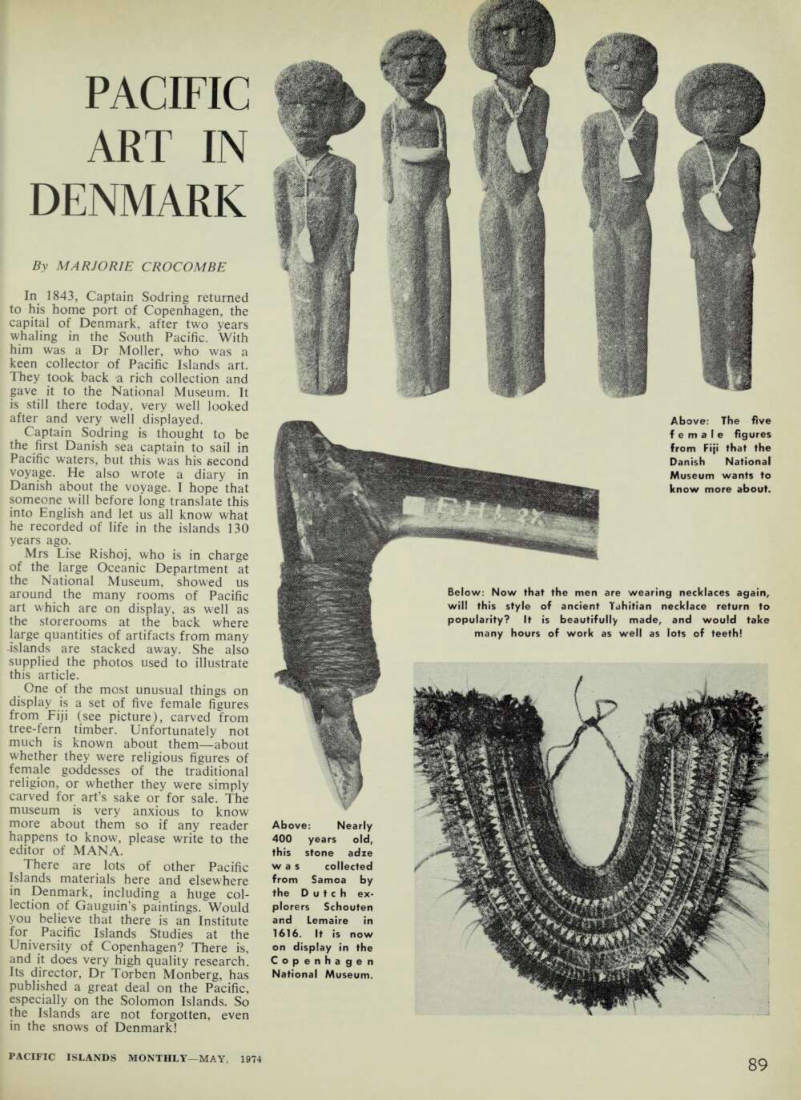
One of the most unusual things on display is a set of five female figures from Fiji (see picture), carved from tree-fern timber. Unfortunately not much is known about them—about whether they were religious figures of female goddesses of the traditional religion, or whether they were simply carved for art’s sake or for sale. The museum is very anxious to know more about them so if any reader happens to know, please write to the editor of MANA.
There are lots of other Pacific Islands materials here and elsewhere in Denmark, including a huge col lection of Gauguin’s paintings. Would you believe that there is an Institute for Pacific Islands Studies at the University of Copenhagen? There is, and it does very high quality research.
Its director, Dr Torben Monberg, has published a great deal on the Pacific, especially on the Solomon Islands. So the Islands are not forgotten, even in the snows of Denmark!
Above: Nearly 400 years old, this stone adze was collected from Samoa by the Dutch ex plorers Schouten and Lemaire in 1616. It is now on display in the
Copenhagen
National Museum.
Above: The five female figures from Fiji that the Danish National Museum wants to know more about.
Below: Now that the men are wearing necklaces again, will this style of ancient Tahitian necklace return to popularity? It is beautifully made, and would take many hours of work as well as lots of teeth!