for Japan
pp. 71-73 · Read in the full issue
The Pacific becomes a pantry for Japan
Natural phenomena in floods drought, prolonged rains in many parts of the world since 1971 have upset the balance of food supplies.
Changes in ocean currents and pollution have had their effect on marine resources in several parts of the world. Japan has been hit by drought, pollution and short monsoon seasons which reduced vital rice crops and the fishing area round the islands.
The food bowls of the South Pacific, and there are many of them, if used properly could be exploited to take advantage of Japan’s shortfalls in various commodities. It often happens that disaster in one area is balanced by good fortune for another.
Pacific Islands, particularly those of volcanic origin, are capable of producing a wide variety of foodstuffs.
Only about 18 per cent of Japan is given over to agriculture. With a population of upwards of 100 million to feed, there is little margin to take care of bad seasons, particularly of rice. About 60 per cent of the agricultural land is in rice paddies. Japan
is turning to other food, but she has to import a lot of it, for she does not have the space to grow all she needs.
Japan’s food tastes and diet have grown with the economy and the rapid rise in personal incomes. As these tastes develop, the Japanese diet diversifies further, making her more and more reliant on imports. It has been estimated that by 1982 Japan will be eating about 2.5 times as much meat as now. The Pacific Islands could come into the picture with meat and poultry, Fish plays an important part in the Japanese diet. A number of Pacific Islands have direct evidence of this for they are bases for Japanese fishing fleets and canneries. The Japanese eat more fish than anyone else. The 1970 average was 32 kg per capita a year, about four times the global average.
The Japanese fishing industry made a total haul of 9.9 million tons in 1971. The 1972 catch was more than 10 million tons, or about 15 per cent
of the global catch. In 10 years to the end of 1972, the Japanese fishing industry’s haul increased by an estimated 3 million tons, most of it by ocean fishing.
Yet Japan still has to import fish.
In 1972 she imported 190,000 million yen worth. She is among the “big three” fish importers—the other two are the US and the UK. There is evidence that the pollack fishing grounds around Japan are almost fished out, and rehabilitation will be a slow process.
Apart from the depletion of marine resources, there are two other formidable pressures on Japan’s fish intake—a recent tendency for nations, especially developing nations to be come increasingly protective of sea resources in their area, and worsening pollution in and around Japan.
Some nations, at a 1973 UN con ference about the peaceful use of the seabed and ocean floor, sought a 12mile limit to territorial waters, after previously insisting on 200 miles, and for exclusive areas 200 miles offshore.
With the exception of migratory fish, practically all fish gather in coastal waters and on continental shelves to
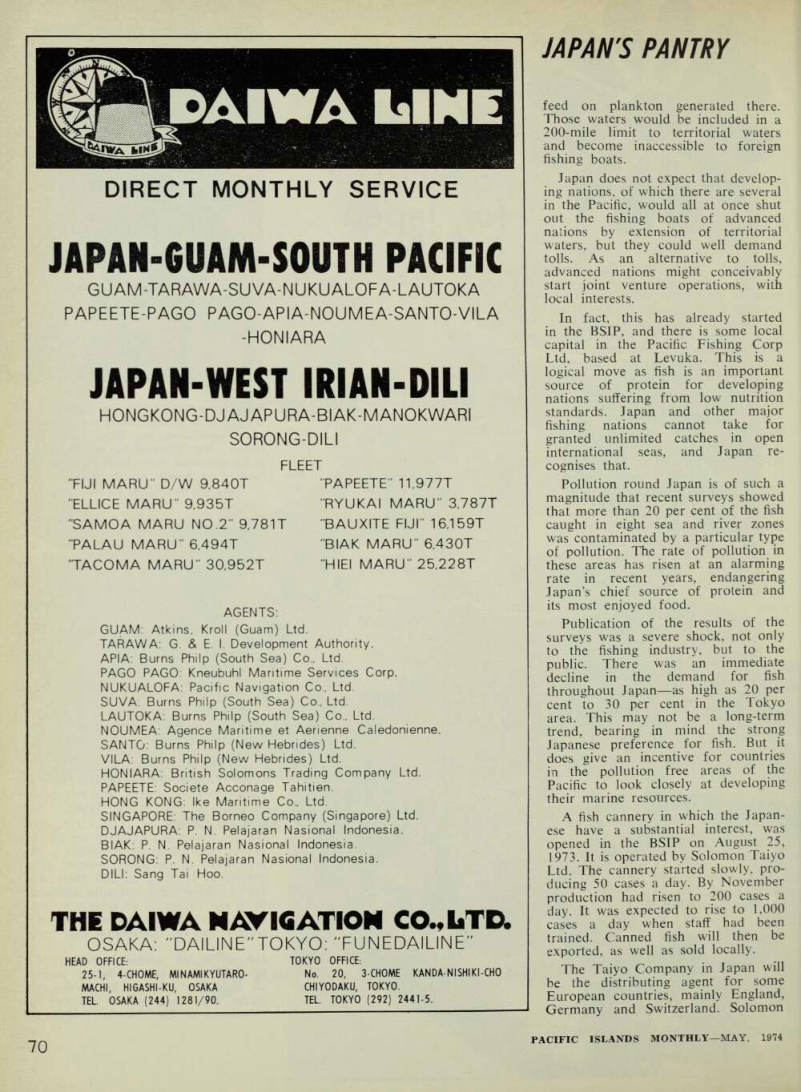
Deep-frozen tuna, which was caught near the Solomon Islands where the Japanese have established the large Taiyo fish factory and shore base at Tulagi, is being unloaded from Kashimaru No 21, berthed at Tsukiji wharf. Nearly 1,200 head of tuna were in the holds.
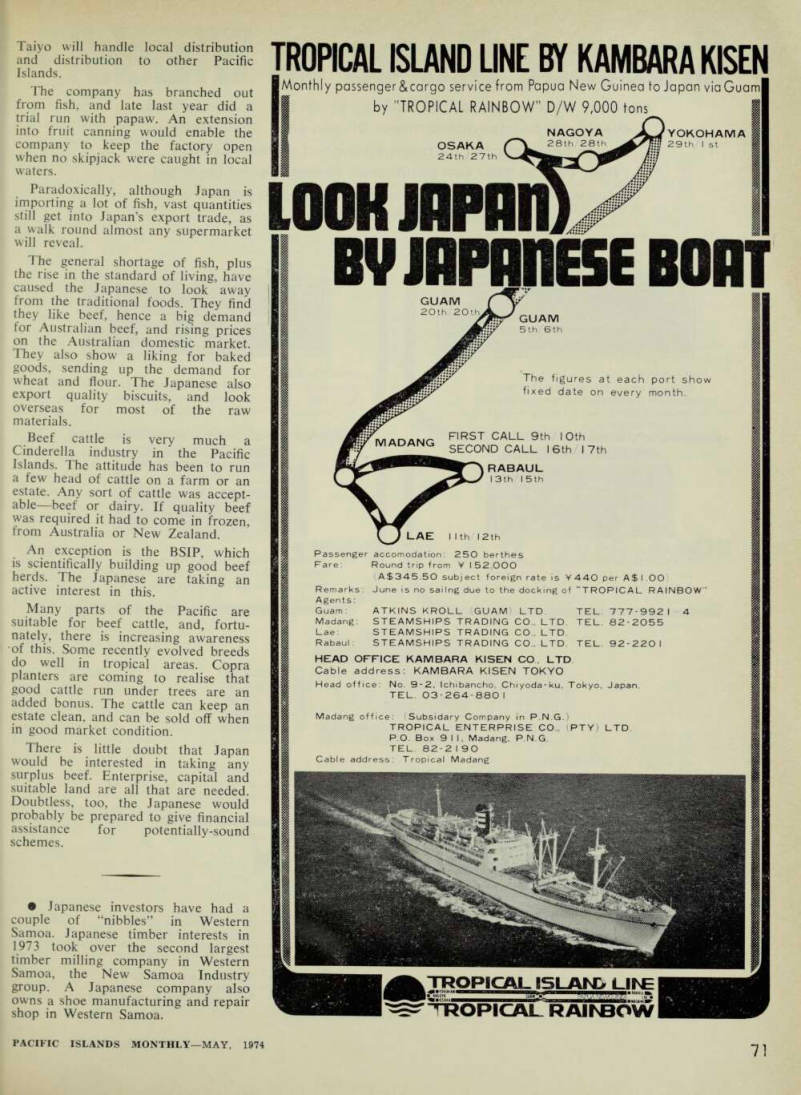
Left, men and women unload yellow tails which are sent to fishery markets all over the country by refrigerated trucks. This scene was at the Port of Mitohama in the Shizuoke Prefecture.
Japan’S Pantry
feed on plankton generated there.
Those waters would be included in a 200-mile limit to territorial waters and become inaccessible to foreign fishing boats.
Japan does not expect that develop ing nations, of which there are several in the Pacific, would all at once shut out the fishing boats of advanced nations by extension of territorial waters, but they could well demand tolls. As an alternative to tolls, advanced nations might conceivably start joint venture operations, with local interests.
In fact, this has already started in the BSIP, and there is some local capital in the Pacific Fishing Corp Ltd, based at Levuka. This is a logical move as fish is an important source of protein for developing nations suffering from low nutrition standards. Japan and other major fishing nations cannot take for granted unlimited catches in open international seas, and Japan re cognises that.
Pollution round Japan is of such a magnitude that recent surveys showed that more than 20 per cent of the fish caught in eight sea and river zones was contaminated by a particular type of pollution. The rate of pollution in these areas has risen at an alarming rate in recent years, endangering Japan’s chief source of protein and its most enjoyed food.
Publication of the results of the surveys was a severe shock, not only to the fishing industry, but to the public. There was an immediate decline in the demand for fish throughout Japan—as high as 20 per cent to 30 per cent in the Tokyo area. This may not be a long-term trend, bearing in mind the strong Japanese preference for fish. But it does give an incentive for countries in the pollution free areas of the Pacific to look closely at developing their marine resources.
A fish cannery in which the Japan ese have a substantial interest, was opened in the BSIP on August 25, 1973. It is operated by Solomon Taiyo Ltd. The cannery started slowly, pro ducing 50 cases a day. By November production had risen to 200 cases a day. It was expected to rise to 1,000 cases a day when staff had been trained. Canned fish will then be exported, as well as sold locally.
The Taiyo Company in Japan will be the distributing agent for some European countries, mainly England, Germany and Switzerland. Solomon
Taiyo will handle local distribution and distribution to other Pacific Islands.
The company has branched out from fish, and late last year did a trial run with papaw. An extension into fruit canning would enable the company to keep the factory open when no skipjack were caught in local waters.
Paradoxically, although Japan is importing a lot of fish, vast quantities still get into Japan’s export trade, as a walk round almost any supermarket will reveal.
The general shortage of fish, plus the rise in the standard of living, have caused the Japanese to look away from the traditional foods. They find they like beef, hence a big demand for Australian beef, and rising prices on the Australian domestic market.
They also show a liking for baked goods, sending up the demand for wheat and flour. The Japanese also export quality biscuits, and look overseas for most of the raw materials.
Beef cattle is very much a Cinderella industry in the Pacific Islands. The attitude has been to run a few head of cattle on a farm or an estate. Any sort of cattle was accept able—beef or dairy. If quality beef was required it had to come in frozen, from Australia or New Zealand.
An exception is the BSIP, which is scientifically building up good beef herds. The Japanese are taking an active interest in this.
Many parts of the Pacific are suitable for beef cattle, and, fortu nately, there is increasing awareness of this. Some recently evolved breeds do well in tropical areas. Copra planters are coming to realise that good cattle run under trees are an added bonus. The cattle can keep an estate clean, and can be sold off when in good market condition.
There is little doubt that Japan would be interested in taking any surplus beef. Enterprise, capital and suitable land are all that are needed.
Doubtless, too, the Japanese would probably be prepared to give financial assistance for potentially-sound schemes. • Japanese investors have had a couple of “nibbles” in Western Samoa. Japanese timber interests in 1973 took over the second largest timber milling company in Western Samoa, the New Samoa Industry group. A Japanese company also owns a shoe manufacturing and repair shop in Western Samoa.