Slow trickle
p. 66 · Read in the full issue
of goods is now a flood
The Japanese appliance and vehicle invasion of the Pacific Islands started slowly. The date cannot be fixed, but it was probably in the late 19505, coin ciding with an economic boom. Then names such as Datsun, National, Sony, Sanyo, Toyota (which Fiji people initially were inclined to con fuse with their own island of Totoya), Seiko, Toshiba, Canon, Mazda and others started to become household w®rds and known as something which could add to the quality of life.
For years about the only familiar Japanese name in a number of Pacific Islands was Banno —Banno Bros, who had been islands traders since before World War 11.
There was some early suspicion about these Japanese goods, a throw back to the days before World War II when almost any Japanese manufac ture was regarded as shoddy. Current day Japanese manufacturers soon showed that those “bad old days” were gone, that they were using the best of materials, that their tech nology was up to date and that they had an efficient labour force.
Initially there was only a trickle of Japanese goods; waiting lists were fairly common for Japanese household appliances and vehicles. When it be came apparent that good quality articles were available at reasonable prices the floodgates opened.
Traders from most parts of the Pacific, particularly from areas which were actively encouraging the tourist industry, flocked to Japan, to buy or to seek agencies, or waited impatiently till Japanese representatives turned up.
There was a sudden switch from traditional merchandising. In Suva, an Indian tailor who had a high reputa tion for workmanship, switched over to radios, tape recorders, portable television sets, binoculars and cheaper clothing. Shop windows became packed with appliances, and retailers enjoyed bonanzas when passenger liners visited the various islands.
Countries which went duty free on what they termed “luxury” goods, soon reaped a benefit. Governments may have suffered initial loss of customs revenue, but increased sales and increased profits of retailers soon offset this. A percentage of rising in comes found its way into government coffers to help boost economies as
government expenditure subsequently increased.
The term “luxury” was something of a misnomer for generally it was applied to transistor radios, tape recorders, binoculars, wristwatches and similar items. Many of these before the duty free days had been out of reach of most of the people in the under-developed territories.
Although local residents benefit from duty free goods, the system is one which, world-wide, is beamed at tourists. Duty free shopping is a bait for tourists, most of whom look forward to paying say $2O or $3O for a transistor radio in some city or town in the islands, than naying $5O and more for similar articles at home.
Most Japanese appliances exported to the Pacific Islands and sold duty free eventually find their way into Australian and New Zealand homes.
International travellers pick up these items duty free at some airports.
The Japanese car manufacturers cut deep swathes into the market share of established suppliers to the Pacific Islands, but it was not easy. The Japanese industry had to overcome initial suspicion on the part of buyers. One of the first cars sold in the Pacific Islands in the late 50s and early 60s was the Datsun, which looked as though it had come out of the Austin factory, so similar were its lines to some of the Austin models of those years.
But once they gained a foothold the Japanese manufacturer showed he was making a good product, which could stand up to the primitive roads in many islands, as well as being com fortable and well-finished.
Again Islands traders clamoured for agencies. It was not long before Japanese cars were as familiar on the roads as those from traditional suppliers.
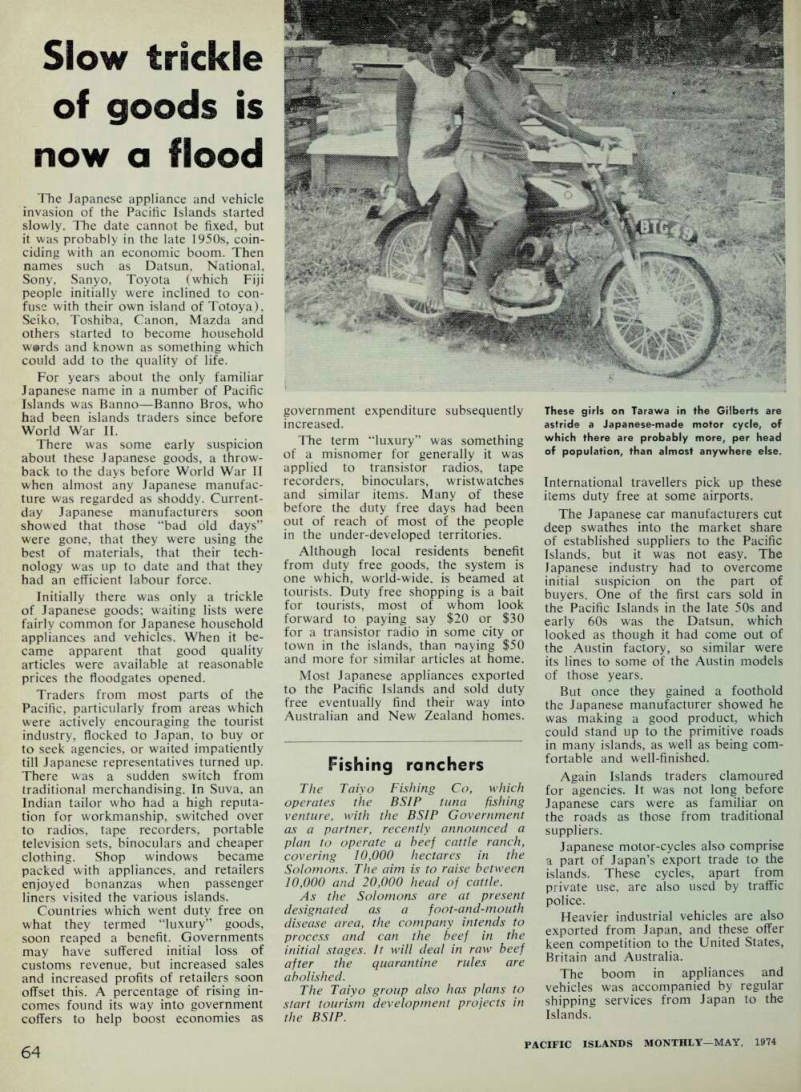
Japanese motor-cycles also comprise a part of Japan’s export trade to the islands. These cycles, apart from private use, are also used by traffic police.
Heavier industrial vehicles are also exported from Japan, and these offer keen competition to the United States, Britain and Australia.
The boom in appliances and vehicles was accompanied by regular shipping services from Japan to the Islands.
These girls on Tarawa in the Gilberts are astride a Japanese-made motor cycle, of which there are probably more, per head of population, than almost anywhere else.