Business and Development
pp. 99-105 · Read in the full issue


Australia Opens Door To Islands
Australia’s general election in December, 1972, brought the first Labor government for 23 years and a new spirit of co-operation with its Island neighbours. Forsaking its aloof attitude to the political and economic problems of the Islands, Australia is now declaring, “We want to be involved with you. How can we help?” Below, a special correspondent with the Federal Department of Overseas Trade explains Australia’s plan for answering the plea from Fiji’s Prime Minister, Ratu Sir Kamisese Mara—“We want trade not aid”.
The developing countries of the Pacific Islands can expect to obtain a greater share of the Australian market following recent measures by the Australian Government.
One of the most important of these measures was a revision and expansion of the existing system of tariff preferences for imports from developing countries, the new system coming into operation on January 1 this year.
The decision to introduce the changed system is consistent with Australia’s policy of helping the de veloping countries to gain increased access to the Australian market.
The original scheme of tariff pre ferences was first introduced in 1966, Australia being the first nation to adopt such a system.
Under the scheme a big range of aandicraft products were allowed ;ntry to Australia duty free and without quota restrictions.
The scheme also included tariff areferences for a selected range of nanufactured and semi-manufac ured goods which were subject to juotas. Under the new plan the luty-free entry of handicraft pro lucts remains unchanged, but the ariff preference measures have been extended to include all manufac ured a n d semi-manufactured irticles, including processed primary >roducts.
The only exceptions cover mainly •roducts where the developing coun ries are already competitive, or are ikely to quickly become competitive it general tariff rates of duty.
Under the new plan the initial nargin of preference is 10 per cent d valorem below the general tariff ates of duty, and it is Australia’s •bjective to increase this margin of 'reference by 10 per cent ad valo em at the end of each two-year •eriod until imports of particular
products from the developing coun tries become competitive in the Australian market.
The 25 per cent across the board tariff reduction on imported goods made by Australia in July last year will not affect the new scheme, as the 10 per cent margin is based on the new, adjusted general tariff rate.
Commenting on the revised scheme, the Minister for Overseas
Trade, Dr J. F. Cairns, said that im proved trade opportunities would re sult from the wider product cover age, the freedom from quota limitations and the controlled widening of margin of Developing countries would now have a firmer basis on which to expand their exports to Australia.
“The government hopes that the new system will be of particular
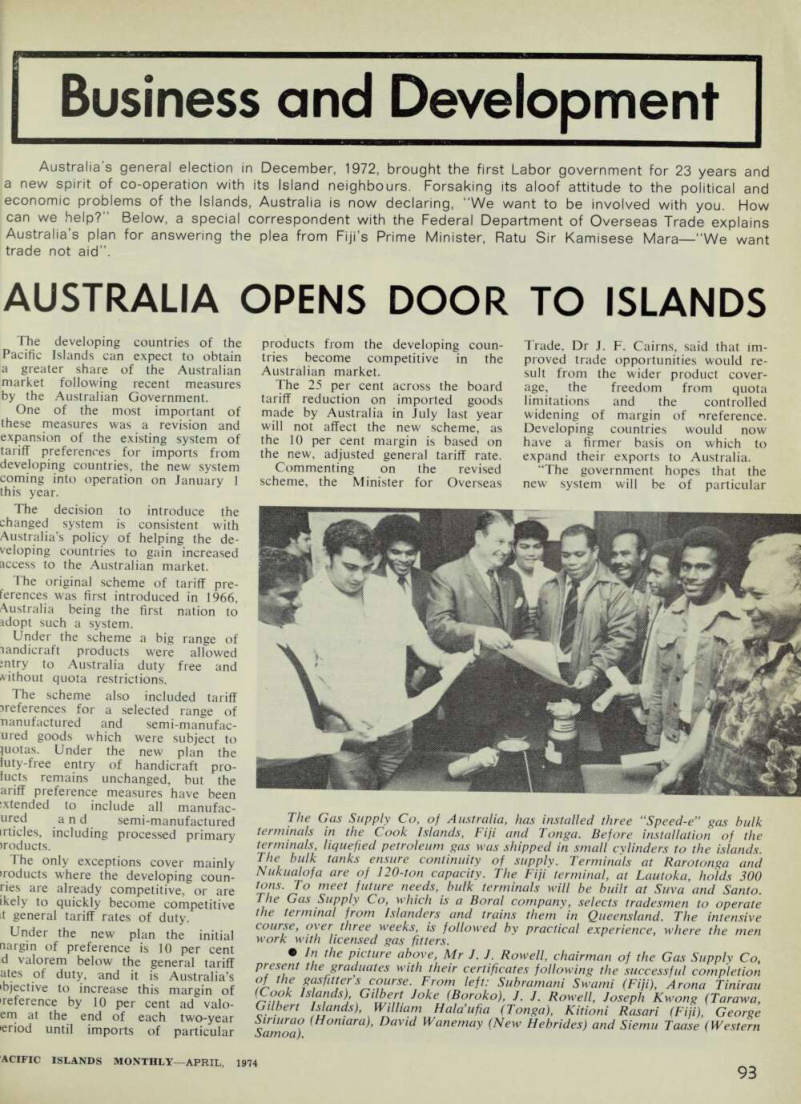
The Gas Supply Co, of Australia, has installed three “Speed-e” gas bulk terminals in the Cook Islands, Fiji and Tonga. Before installation of the terminals, liquefied petroleum gas was shipped in small cylinders to the islands.
The bulk tanks ensure continuity of supply. Terminals at Rarotonga and Nukualofa are of 120-ton capacity. The Fiji terminal, at Lautoka, holds 300 tons. To meet future needs, bulk terminals will be built at Suva and Santo.
The Gas Supply Co, which is a Boral company, selects tradesmen to operate the terminal from Islanders and trains them in Queensland. The intensive course, over three weeks, is followed by practical experience, where the men work with licensed gas fitters.
In the picture above, Mr J. J. Rowell, chairman of the Gas Supply Co, present the graduates with their certificates following the successful completion of the gas fitter’s course. From left: Subramani Swami (Fiji), Arona Tinirau (cook Islands), Gilbert Joke (Boroko), J. J. Rowell, Joseph Kwong (Tarawa, Gilbert Islands), William Hala’ufia (Tonga), Kitioni Rasari (Fiji), George Siriurao (Honiara), David Wanemay (New Hebrides) and Siemu Taase (Western samoa)
Promotional Help
help to countries in the Pacific and Asian regions who look to Australia as a natural trading partner” he said.
Australia has become increasingly aware that many exporters in the developing countries lack the de tailed knowledge of the Australian market and did not nave the re sources to obtain it, which is essen tial if they are to gain the maximum benefits from the new scheme.
For this reason, Dr Cairns also announced an important new com plement to it, in that the Department of Overseas Trade would provide help in obtaining this knowledge.
Trade inquiries can be referred to the Department for Market investi gation and also for help in the trade promotion field. The department will arrange commercial contacts for visiting exporters from the develop ing countries and will continue its :lose liaison with the Australian based commercial representatives of he governments of those countries.
These activities indicate the type af assistance which Australia is eady to provide to developing coun ries. Increased contact between ex )orters from those countries and \ustralia is expected to bring other iceds to light and the department vill assist with these within its re sources.
The Australian Government is dso aware that such marketing issistance and preferences will only >e of benefit to the developing coun ries if they have products for xport.
It is for this reason that Australia upports the three priorities collec ively identified by the Islands and iccepted in the Suva communique •f the South Pacific Forum, namely he development of further process ag of primary products, rationalis tion of import-substitution indus ries, and the establishment of xport-oriented manufacturing indus ries as a means of encouraging and eveloping viable economies.
Australia, as a member of the louth Pacific Forum, sees its role s participating actively in the work f the forum and the South Pacific Sureau of Economic Co-operation, articularly concerning efforts to dvance the economic viability and evelopment of the Island member ountries.
Australia is following a positive uiding role, offering constructive dvice and expertise where possible, nd necessary or specific proposals nd work priorities.
Australia is also willing to work closely with the Islands in finding solutions to their problems and recogmses that there are various means by which assistance might be pro-
greafer Scesf
ducts to Australia through the new system of tariff preferences and marketing assistance, there is potential for co-operation in achieving fair commercial access to each other’s markets for particular commodifies. There is scope for mutual recognition of the benefits which arise from private direct investment, particularly joint ventures linked with the Islands’ development plans.
Similarly, the advantages of mutual encouragement of co operation in consultancy and con struction services, including joint vent ures and the use of local sub contractors should be examined as a m f ai ] s °f making the maximum Poetical use of island resources, At the international level, there is scope for mutual support for the negotiation of international agree ments to improve the conditions of trade in primary products, to over come the uncertainties in the inter national commodity trade and to improve access to international markets.
Hopes for tuna
industry in Fiji
Fiji should have a commercial skipjack tuna industry within the next two years, following a survey extending over nine months. The survey team had as an adviser, Mr Robert Lee, manager of the United Nations Development Programme/ Food and Agricultural Organisation tuna project.
On its last trip the team, using the Tui Ni Wasaliwa, a new tuna re search boat belonging to the fisheries division of the Department of Agri culture and Fisheries, caught more than 18 tons of skipjack tuna in five days of fishing. The ship made four trips; on the first three the total catch was 12 tons.
Mr Lee said the fishing team showed that local fisheries staff, trained in pole fishing, could do an excellent job.
On its last trip the crew caught the bait in Kadavu waters, then fished in the southern Lau area.
Fiji’s Prime Minister, Ratu Sir Kamisese Mara, and the Minister for Agriculture, Fisheries and Forests, Mr Doug Brown, met the Tui Ni Wasaliwa when it returned to Suva after its last trip.
Odd man out of gas
in American Samoa?
American Samoa, hard hit by gasoline shortages in recent months, may finally get some relief.
Governor John M. Haydon has assented to a bill, sponsored by Senator Galea’i Poumele, which gives the Governor emergency powers to regulate and ration the use of petroleum.
Pointing out the lack of petroleum resources in the territory, as well as the lack of refining capabilities and shipping difficulties, the Governor said that “in the event of a delay in replenishing our fuel supplies, American Samoa would be in a "ather serious situation which would lecessitate control measures by the government”.
Hawaii and the territory of Guam dready are rationing gasoline in the so-called “Oregon” manner, issuing ?as by odd and even licence lumbers.
Better deal for
Cooks fruit growers
The lot of Cook Islands’ fruit pro filers could improve should New Zealand implement recommendations nade by a committee of inquiry into
the Cook Islands-New Zealand fresh fruit trade. One immediate benefit would be a rise of $1.12 for a 56 lb case of bananas supplied by the Cook Islands Primary Produce Board— from $2.80 to $3.92.
The committee of inquiry was a te- 1 ™ 11 effort by a Wellington lawyer, Mr David Shand. The Mmister of Trade and Industry, tabling Mr Shand s report m Parliament said the recommendations and complex issues involved would be studied “with some urgency”.
Mr Shand was required to go into the handling, pricing and cost of fresh fruit from production to consumption.
He concluded that poor handling in
NZ, slow unloading and rail transport were factors in poor-quality fruit reaching the NZ market, He recommended that fresh fruit shou ld be loaded last in the Cook Islands so that it could be unloaded fi rst in New Zealand. Fruit Distribu tors Ltd , which bought the fruit should be allowed to use road trans port in preference to the railways where this wou!d hdp to maintain a reasonable quality of fruit for the market The ships Moana Roa and Lorena should eventually be withdrawn from the Cook Islands run and replaced with newer, specially-designed ships.
There should be one or two other
points, outside Auckland, where fruit could be unloaded to help save dis tribution costs.
The present wholesale commission of 10 per cent could be reduced by a two-tier commission system. The maximum retail price of Cook Is lands’ bananas should be increased to 17c a pound, and rigidly tied to stricter quality inspection in the Cook Islands.
Mr Shand said in some respects Fruit Distributors had served the Cook Islands satisfactorily, and was not making, and had not made, ex cessive profits overall. But the obliga tions of the company towards the Cook Islands should be made more precise by annual price negotiations and medium-term supply agreements with the Cook Islands.
The report, although it applies to the Cook Islands, could be a blue print for other island groups which supply produce to New Zealand.
More teleohoneS
v
for T OtIQQ
a . aI ~V , Tonga is about to take a great leap
aee^Th^Asian 6
has aonroved a loan of P SUSI3 mil j£ s „ » which To °* a sU ®Ji : add SUS3OO,OOO, to improve and expand th telenhone service on Ton?a-
tapu, pSe SLe S
for two other groups and improve the radio telephone link between Tongatapu, Vavau and Haapai. a 2,200-line automatic exchange w jn replace Nukualofa’s manual switchboard and provide more lines so that Nukualofa may be connected w j t h all parts of Tongatapu. The old switchboard will be installed at Vavau to give that island its first telephone service, Pangai, in the Haapai islands, will receive a new manual switchboard.
Upgrading the radio-telephone link
covering the three major groups willl be a vast i m p rovemen t as inter-islandl communication at present is possible; ° nly for short periods 011 workin S= days.
The work will be carried out the Tele g ra P bs a °d Telephones? 3 P , 8 y .* The loan from the Asian Develop ment Bank is on very favourable; terms—l.s per cent interest. It is re payable m 30 years, which includes? a seven-year period of grace, c* * J .
■ drops Sterling
£—-, lL 0 lIC J n |L r rnc w J OUllu Fiji has broken another tie withi Britain. From February 25 she tiedl her currency to the US dollar instead! of the British pound sterling. The;
change immediately revalued Fijts
currency by li per cent, The change had been advocated ini
several circles for some time, as cur rency realignments in Australia and New Zealand had sent up the cost of living in Fiji. Fiji made some attempts to buy commodities else where, but with little success.
The general manager of the Central Monetary Authority in Fiji, Mr lan Craik, said traders buying in Aus tralia and New Zealand did not know exactly how much the goods would eventually cost because of the fluctuat ing value of sterling.
Other currencies, including the US dollar, had fluctuated in the last 20 months, but the US dollar was return ing to stability. The Fiji Government believed that fixing the value of the Fiji dollar in relation to the US dollar offered the best hope, for the time being, of some stability in exchange transactions with her principal trading partners.
Since a previous statement on the Fiji exchange rate policy on January 16, the Fiji dollar appreciated by about 6i per cent in relation to the US and Australian dollars.
Strife over Pogo Pago
fish cannery plan
From a Pago Pago correspondent An announcement by Castle and Cooke, Inc, of its intentions to build a SUS 7.6 million fish cannery in American Samoa has drawn a great amount of political cross-fire.
Bumble Bee Seafoods, a division nf Castle and Cooke, Inc, will oper ate the plant, which is scheduled to begin operation in January of 1976.
Fhe initial capacity of the plant will be about 100 tons of fish daily and company officials expect the plant to employ about 300 persons.
Star Kist, Inc and Van Camp Sea foods both operate fish canneries in Pago Pago at the present time, employing about 1,200 Samoans, *dth a payroll of more than S 3 mil lion per year.
A series of resolutions has been introduced in the American Samoa Fono, one requesting that Castle and Cooke look elsewhere for a ocation. Two other resolutions have welcomed the company to American Samoa.
Most of the opposition to the can nery proposition seems to be coming from American Samoa’s Delegate at-Large, A. U. Fuimaono, who is nased in Washington, (DC), and acts as a representative for the American Samoa Legislature in the United States.
Fuimaono said in Washington that :annery operations do not benefit the Samoan people and were a drain on the island’s power and water system.