British pacific Jet
pp. 93-95 · Read in the full issue
airways news
Escape From A Noisy World
Published By British Airways
A Pim Advertising Supplement
By Alan Reeve-Jones
rR those who know it, the road to Mid-Wales is one of the last sure escapes from a noisy and crowded world. Travelling west across the undulating lowlands of north Herefordshire, obstinately at right angles to the M 5 motorway, is a pleasure in itself, and a pleasure in creasing by the mile with each new promise of nobler and wilder country ahead.
There is no clear definition as to where the frontier between England and Wales lies. The main roads have signs saying Croeso i Gy mm (Wel come to Wales) on them, but out in the hills, where twisty lanes meander along ancient lines trodden by a million sheep, there is nothing.
We live in an age of road improve ments without precedent since the time of the Romans. The A 44 is now a first-class, though little used, route all the way to Aberystwyth. The worst bends are quickly disappearing and little towns and hamlets appear sur prisingly on a road that swoops and :limbs round vast and astoundingly beautiful lakes, sombre mountains, and areas of moorland expanse magnificent in their dignity and »olitude.
I came as a stranger to these places.
I expected little, for like so many people conditioned by the opinions of others I had already identified Wales vith Snowdonia and supposed that iouth of this towering beauty there :ould only be the anti-climax of lesser md more commonplace inducements. was so wrong. North Wales inspires iwe and respect. Mid-Wales has this )roperty too, but also leaves one with i sense of belonging. That is why visitors go back—as I must go back.
The lure begins shortly after leav ng the agricultural security of Leo ninster. Villages like Eardisland and s embridge, built almost exclusively of lalf-timbered houses, nestle amongst
apple orchards and tidy picturebook farms. The flatness begins to undulate.
Clumps of firs and pines appear with the deciduous trees; and after the announcement, a mile or so past Kington, that the Royal Oak pub is the last in England, a deep valley leads into the open end of the colossal horseshoe of high moorlands which is Radnorshire.
One of the first towns across the border, Llandrindod Wells, is scarcely two centuries old and owes its existence to the mineral springs that became fashionable with the nou veaux riches of the Midlands, fol loving the Industrial Revolution. The Rock Park Pump House Rooms are still there, although little used in comparison with earlier days of strutting Georgian society, but the wide streets and tall red-brick build ings, ornate with greenish domes and heavy stucco decoration, still reflect the grandeur of the age. It is a mild, peaceful place now.
North and west from here even this attempt at modernity stops. Fine old stone-built towns and villages, medieval churches, and brooding castle-mounds lead up to a rolling mountain skyline. Craggy outcrops of rock, the most ancient in Britain, stand out like sentinels on the moor, and here and there, where the land shallows before diving again 1,000 feet down to the valley, the grassy curves give way to blue, deep, isolated pools, rippled by the wind.
The obvious tourist centre for this part of the country is Rhayader, in Welsh Rhaedr Gwy —“The Water fall of the Wye”—an attractive pale grey market town commanding access to the huge complex of reservoirs making up the Elan Valley Water works. These man-made lakes, equal ling and often surpassing the generous artistry of nature, are drawn from the watersheds of the River Elan and its tributary, the Claerwen, above Caban Coch Dam, The Elan flows into the
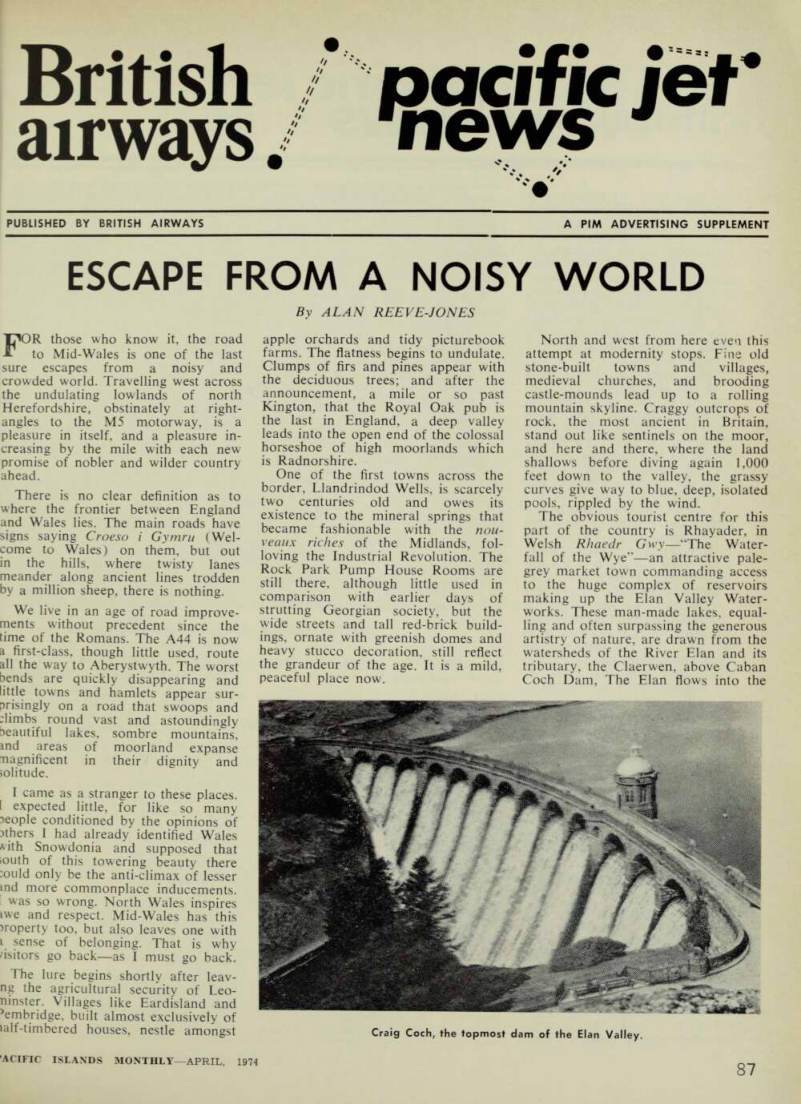
Craig Coch, the topmost dam of the Elan Valley.
Wye at a point some 3i miles below the dam and about H miles south of Rhayader. The four reservoirs supply the city of Birmingham via the Elan Aqueduct. To see this remark able lakeland properly, I discovered, one might begin at the Elan Valley Hotel, the focal point of most touring, fishing, and pony-trekking in the area.
To see the reservoirs, involving roughly a 20 mile round trip from the hotel, take the expert advice of Alan Lewis, the proprietor.
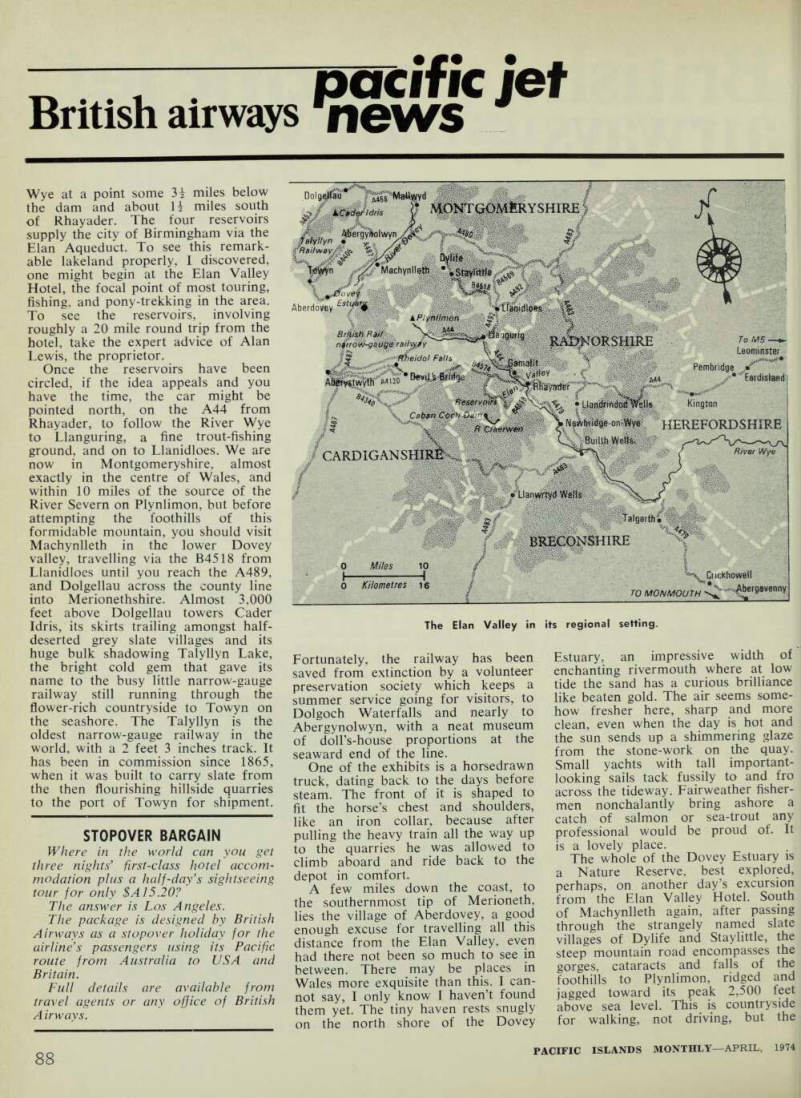
Once the reservoirs have been circled, if the idea appeals and you have the time, the car might be pointed north, on the A 44 from Rhayader, to follow the River Wye to Llanguring, a fine trout-fishing ground, and on to Llanidloes. We are now in Montgomeryshire, almost exactly in the centre of Wales, and within 10 miles of the source of the River Severn on Plynlimon, but before attempting the foothills of this formidable mountain, you should visit Machynlleth in the lower Dovey valley, travelling via the 84518 from Llanidloes until you reach the A 489, and Dolgellau across the county line into Merionethshire. Almost 3,000 feet above Dolgellau towers Cader Idris, its skirts trailing amongst half deserted grey slate villages and its huge bulk shadowing Talyllyn Lake, the bright cold gem that gave its name to the busy little narrow-gauge railway still running through the flower-rich countryside to Towyn on the seashore. The Talyllyn is the oldest narrow-gauge railway in the world, with a 2 feet 3 inches track. It has been in commission since 1865, when it was built to carry slate from the then flourishing hillside quarries to the port of Towyn for shipment.
Fortunately, the railway has been saved from extinction by a volunteer preservation society which keeps a summer service going for visitors, to Dolgoch Waterfalls and nearly to Abergynolwyn, with a neat museum of doll’s-house proportions at the seaward end of the line.
One of the exhibits is a horsedrawn truck, dating back to the days before steam. The front of it is shaped to fit the horse’s chest and shoulders, like an iron collar, because after pulling the heavy train all the way up to the quarries he was allowed to climb aboard and ride back to the depot in comfort.
A few miles down the coast, to the southernmost tip of Merioneth, lies the village of Aberdovey, a good enough excuse for travelling all this distance from the Elan Valley, even had there not been so much to see in between. There may be places in Wales more exquisite than this. I cannot say, I only know I haven’t found them yet. The tiny haven rests snugly on the north shore of the Dovey
Estuary, an impressive width of enchanting rivermouth where at low tide the sand has a curious brilliance like beaten gold. The air seems some how fresher here, sharp and more clean, even when the day is hot and the sun sends up a shimmering glaze from the stone-work on the quay.
Small yachts with tall important looking sails tack fussily to and fro across the tideway. Fairweather fisher men nonchalantly bring ashore a catch of salmon or sea-trout any professional would be proud of. it is a lovely place, The whole of the Dovey Estuary is a Nature Reserve, best explored, perhaps, on another day s excursion from the Elan Valley Hotel. South of Machynlleth again, after passing through the strangely named slate villages of Dyhfe and Stayhttle, the steep mountain road encompasses me gorges, cataracts and falls of the foothills to Plynlimon, and jagged toward its peak 2,500 feet above sea level. This is countryside for walking, not driving, but the
The Elan Valley in its regional setting.
view from the main summit, with North and South Wales in one panoramie sweep, amply pays for the energy expended.
Just south of here, and 12 miles from the coast at Aberystwyth, is Devil’s Bridge, where the fast-flowing Rheidol and its tributary, the Mynach, swirl into a natural basinlike cavity spanned by three bridges, one above the other. The lowest of these, deep down in the gorge is medieval; the second was built in 1753, and the third, carrying the present-day turnpike, in 1901. The most pleasant way to complete the journey to Aberystwyth now is to park your car and take a return trip through the Vale of Rheidol on British Rail’s narrowgauge steam train. The stop at the other end is long enough for a further jaunt, on the miniature cliff railways to the heights of Constitution Hill.
Now head back for Rhayader, across the empty moorland on the 84340 as a change from the A 44.
It is a wild, hilly road of bends and sheep and sudden dark woods, with green, spreading downland and lonely pools, a sprinkling of farmsteads, and mysterious tracks leading up and away to the mountains. About 12 miles out of Aberystwyth, turn eastwards along the now well-surfaced trail known as the Old Coach Road, because once stage coaches fought
through gales and blizzards to bring the mail and a few hardy passengers all the way from London. Bogs and marshes which today lend colour to the landscape were then a hazard for the horse that missed his footing or the coachman who drowsed at the reins.
At Rhayader there is everything for a memorable and inexpensive holiday.
If you like riding ponies, find “Trevor the Trek”. If it’s fishing, talk to Alan Lewis. If you’re interested in local events, read the “County Times and Gazette”. If you’d like to buy some charming Welsh earthenware to take home, go to the Dragon Pottery. If you want anything else—ask anyone.
If you feel like having a meal com parable with the best to be found in London, they’ll send you to the New Inn at Newbridge-on-Wye.
But the ride back to England is paved with more splendours yet. From Builth to Talgarth the mountains lessen their height, slowly and grumblingly, like thunder reluctant to go; but by the time Crickhowell is reached, and afterwards Abergavenny, the fields have spread with crops again, the sheep have gone, and the River Usk laughs along the side of the road for some distance, to turn away when the signposts point to Monmouth. The journey is done, for over to the east is Gloucestershire.