Apia, a pilferers' paradise
pp. 85-89 · Read in the full issue


From a special Apia correspondent
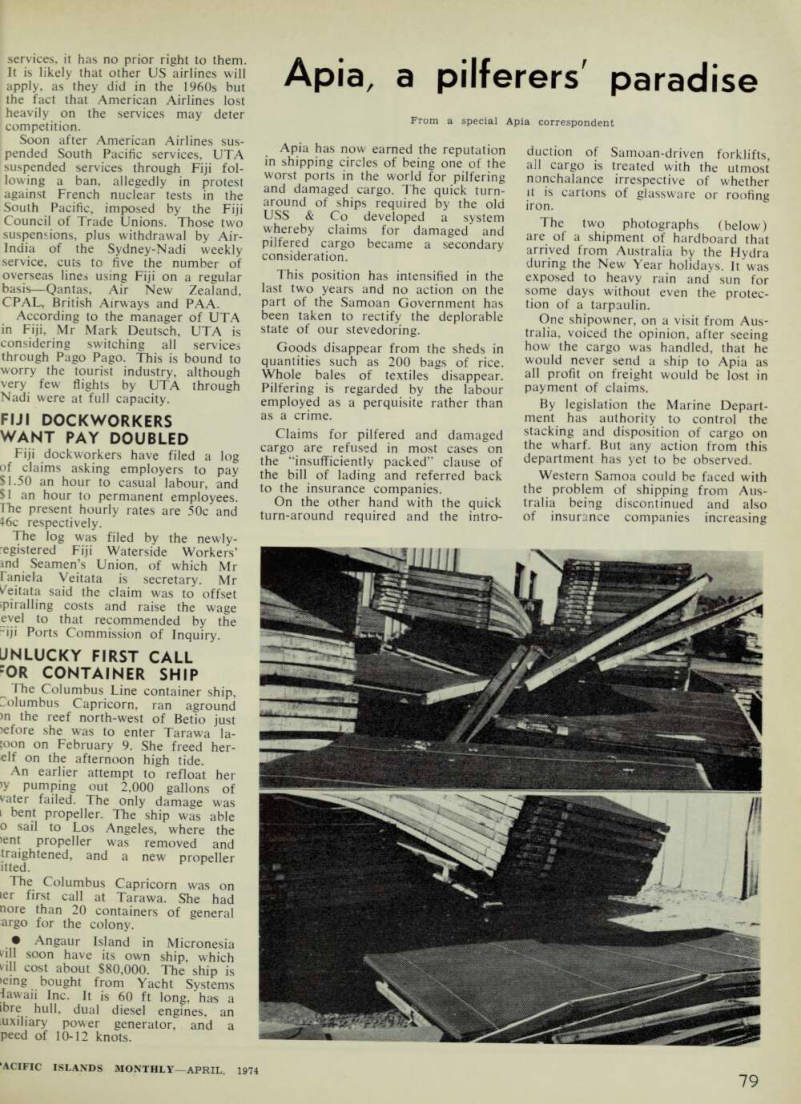
Apia has now earned the reputation in shipping circles of being one of the worst ports in the world for pilfering and damaged cargo. The quick turnaround of ships required by the old E 4 . .
This position has intensified in the last two years and no action on the part of the Samoan Government has been taken to rectify the deplorable state of our stevedoring.
Goods disappear from the sheds in quantities such as 200 bags of rice.
Whole bales of textiles disappear.
Pilfering is regarded by the labour employed as a perquisite rather than as a crime.
Claims for pilfered and damaged cargo are refused in most cases on the “insufficiently packed” clause of the bill of lading and referred back to the insurance companies.
On the other hand with the quick turn-around required and the intro-
duction of Samoan-driven forklifts all cargo is treated with the utmost nonchalance irrespective of whether it is cartons of glassware or roofine iron <w~> during the New Year holidays. It was exposed to heavy rain and sun for some days without even the protec tion of a tarpaulin, One shipowner, on a visit from Aus tralia, voiced the opinion, after seeing how the cargo was handled, that he would never send a ship to Apia as all profit on freight would be lost in payment of claims, By legislation the Marine Depart ment has authority to control the stacking and disposition of cargo on *he wharf. But any action from this department has yet to be observed, Western Samoa could be faced with the problem of shipping from Aus tralia being discontinued and also of insurance companies increasing
insurance rates to a higher than ever level, or of refusing all insurance on goods to Apia.
The Western Samoa Government instigates inquiries into minor deficiencies at the drop of the hat but they have yet to notice what trouble the stevedoring organisation is storing up for this country in the future.
Regional shipping is not the answer to the problem that is building up.
The answer is right on our domestic doorstep and that must be with an overhaul of our stevedoring and the handling of the imported cargo from ship to shed and delivery to the con signees.
Air Pacific Puts
Up The Fares
Air Pacific has offset higher fuel and operating costs by increasing fares on regional routes by an aver age of about six per cent. Baggage and air cargo rates have also been lifted. These increases followed higher fares imposed on local (Fiji) routes, in February.
The new fares, with the amount of the increase in brackets, is: Suva- Nukualofa, $43.50 ($2.20); Suva- Apia, $64.50 ($4.10); Suva-Vila, $85.50 ($5.40); Suva-Tarawa, $198.80 ($12.60); Suva-Nauru, $256.50
(sl6.3o); Suva-Port Moresby, $277.90 ($17.60); Suva-Honiara, $186.20 ($11,80); Suva-Brisbane, $325.40 ($20.70).
Nz Wages Rise
Echoes In Islands
Inflation in Fiji, Tonga and Samoa was given another boost on February 18 when the Union Steam Ship Co of NZ Ltd lifted freight rates by a total of 1U per cent. The actual freight rate rise was 4\ per cent, to which was added a bunker surcharge of 7 per cent.
The freight increase was imposed because of a general wage rise in NZ, while the bunker surcharge became necessary because of a huge increase in the cost of fuel.
The increase is likely to give further impetus to moves to set up a regional shipping line. Shipping officials from South Pacific Forum member countries have agreed that a report by the South Pacific for Economic Co-operation is a reason able basis for setting up a regional shipping line.
These officials, at a recent meeting at Nadi, endorsed the report. Their comments and the report were to be placed before the South Pacific Forum meeting in Rarotonga in late March,
Lord Howe's Strip
Raises The Dust
Work on the Lord Howe Island air strip would take about 30 weeks from the scheduled starting time in March, the Australian Minister for Defence, Mr Lance Barnard, announced late in February. The strip is being built by Australian Army sappers as a con struction agency for the NSW Gov ernment and the Federal Department of Transport. If all goes as scheduled, work should be finished early in October.
The proposal to lay the strip is still under fire on two aspects—harm to the environment, and commercial realities. Conservationists say a strip would permanently disfigure the island. From the commercial angle, the strip will be too short for any thing except nine or 10-seater air craft.
Fares would probably be too high for the island to continue to attract holiday-makers, the main source of revenue, from the mainland.
There seems little chance that the conservationists will be able to dis suade the federal government from going ahead with the strip. The gov ernment, said Federal Minister for the Environment and Conservation Dr Cass, in the House of Representa
lives in March, was faced with the alternative “let the people rot on the island or provide a regular shipping service”. But conditions made a ship ping service almost impossible.
An environment-impact study found that construction of the airstrip would not damage the island’s environment to any major extent, the minister said.
Samoan Is
Pal's Traffic Chief
Mr George S. Hunt has taken up the position of traffic superintendent for
Polynesian Air lines at Faleolo Airport. The first Samoan to fill the post he re places Mr Peter Clarke, who was on secondment from Air New Zealand for three years. Mr Hunt, in August, 1973, after becoming traffic superinten dent designate,
underwent intensive training and familiarisation at Suva and Apia. He holds a BA degree and Diploma of Education from Hawaii. He taught in Western Samoa, Hawaii and Aus tralia before joining Polynesian Air lines. He is married and has four children.
Mr Hunt