A MODERN MIGRATION: Ellice Islanders in
pp. 72-73 · Read in the full issue
Fiji have ties with Samoa and Tonga
FO’UA TOFINGA interviewed by MARJORIE CROCOMBE
M.C.: How did the people of Vaitupu in the Ellice Islands come to buy an island in Fiji?
F.T.: Many of the Gilbert Islands were already very short of land. We had no population problems ourselves at the time but could see them coming, so we wanted to get some land to expand. This was back in 1946.
M.C.: What was your own involvement in the purchase of Kioa island and the resettlement of the people?
F.T.: This goes back to the embryo stages. In 1945 the then Governor of Fiji, who was also High Com missioner for the Western Pacific asked me to come to Fiji to work in his office. We served the Gilbert and Ellice Islands, the Solomons, the New Hebrides and so on because this was the headquarters from which they were administered. Before that I had been working for the government in Tarawa.
One morning I saw an advertisement for the sale of Kioa Island in The Fiji Times, so I wrote to Major D. G. Kennedy. The government had assigned him to help the Banabans from Ocean Island to resettle on Rabi, an island they had bought in the Fiji group.
Kennedy was a particular friend of the Vaitupu people and on his way to Fiji with the Banabans from Ocean Island he had called at Vaitupu. Kennedy had suggested that they should buy Wakaya Island which was then up for sale—but I did not know that at the time. The proposal to buy Kioa was discussed with the Vaitupu people and the Resident Commissioner, and the people definitely wanted to buy Kioa. They had £3,000 that they had saved up from wartime work. The island was sold at an auction sale and Mr H. E. Maude and I went down there one Saturday morning. When the bidding got to £3,000 nobody else bid. Old man Neli Lifuka always says that this was God’s guiding hand, because that was all the money we had. So there we were on June 15, 1946 —we had bought the island.
The first group of Vaitupu people to come and settle on Kioa arrived on October 26, 1947. The Gilbert and Ellice Islands Government helped us with shipping.
There were about 30 altogether in the party including three women.
M.C.: Did you travel to Kioa with the first group?
F.T.: No. No. I wanted them to have the privilege of arriving first on that virgin island. At that time there was nobody living there.
M.C.: Was this migration to a new land recorded in song and story on Vaitupu?
F.T.: Yes—one of the first songs of that period describes how they arrived in this “land of birds” and had no one to welcome them on their arrival. They felt deeply homesick. In fact quite a few of the songs they wrote at that time convey their sadness, their nostalgia, and the loneliness because of the miles of ocean between themselves and their homeland of Vaitupu. The people who first went to Kioa were very homesick. Although they had very little encouragement from back home, they knew that they must hold on both for their own good and for the people back in Vaitupu. Some returned to Vaitupu for health or family reasons. Others went
back in the hope of getting employment on Ocean Island digging phosphate—not to use the money them selves, but to save it to send to Kioa. They were the lifeblood of Kioa for the first five years or so because most of the money that kept the early settlement going on Kioa till their own crops grew, was this money that they sent from Ocean Island. In the first five years they must have sent about $6,000 to Kioa.
M.C.; Did most people who came to Kioa remain there*] F.T.: Yes, the great majority of those who have ever migrated have been there ever since. The success of the resettlement is particularly due to men like Aka, whc led the first group of settlers, men like Ranga, Nike Taitai and Levoka Sakeu. These were among the mosi important of the leaders in the very early stages. None of them had any higher education or other advantages but they had great personal qualities.
From 1947 to 1968 the island of Kioa was ruled bj the matai of Vaitupu. After 1968 the resettled people or Kioa took over their own affairs, and in 1972 the Kioa people all became citizens of Fiji.
M.C.: Now about Ellice culture. Isn’t it closely relatec to Samoa and Tonga?
F.T.: Our traditional history in the Ellice ties in ver} closely with that of Samoa. One of our traditions claimi that the earliest people in the Ellice Islands were short small, dark people who were driven northward b} Polynesian immigrants. Various Tongan settlers travellec to the Ellice Islands at different times during our earl} history, but Samoan immigrants came there and settlet and were more important in our later history. Ou: language is closely related to Samoan, and has beei made even closer by the fact that even today the Ellic< people use the Samoan Bible and Samoan hymn book.
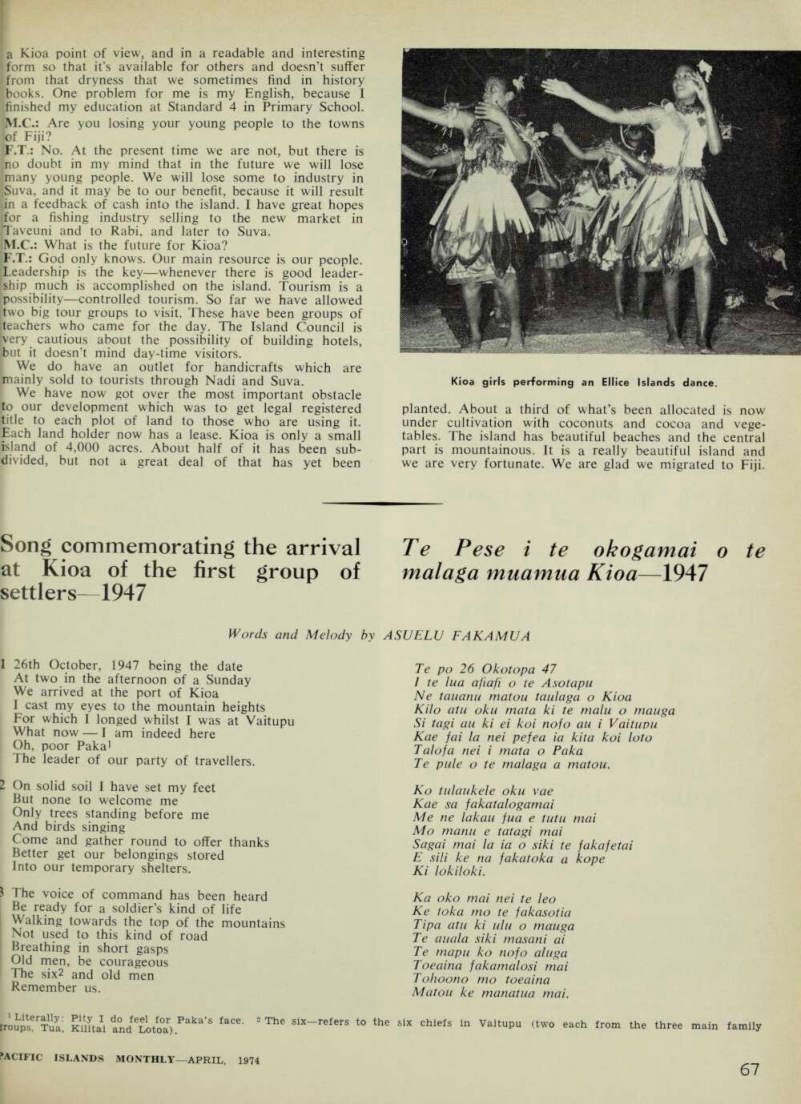
Our dance is a mixture. We have two main dana forms —one is the fatele and the other kind we call siva They both have their roots deep in Samoan culture Even though these are the main styles, the people com pose their own songs and dances following these genera patterns. More recently there is increasing departun from traditional Samoan dancing.
Some new ideas have been adopted. For instance som of our own fatele composed by people on Kioa or b; people from Kioa who have gone back to Vaitupu, havi incorporated some of the rhythm of the Fijian meke Even some of the actions have obviously been influence! by Fijian culture.
M.C.: Has anyone written the history of the resettlement F.T.: Mr White of the University of Oregon has don one study of the resettlement, but it was from a parti cular point of view. I have set myself two tasks—oh to write a report on the 25th anniversary celebrations and then to write the history of this resettlement fron
i An article on the history of the Ellice Islands in the Journa of the Polynesian Society in 1958 confirms the contacts wit.
Tonga and Samoa and says that many words in the old song show a strong linguistic relationship with Tonga. The late ties with Samoa were strengthened by the Ellice having bee. served mainly by Samoan missionaries for neary 100 year
a Kioa point of view, and in a readable and interesting form so that it’s available for others and doesn’t suffer I from that dryness that we sometimes find in history ,books. One problem for me is my English, because I jfinished my education at Standard 4 in Primary School.
M.C.: Are you losing your young people to the towns of Fiji?
F.T.: No. At the present time we are not, but there is |no doubt in my mind that in the future we will lose jmany young people. We will lose some to industry in |Suva, and it may be to our benefit, because it will result in a feedback of cash into the island. I have great hopes nor a fishing industry selling to the new market in iTaveuni and to Rabi, and later to Suva.
M.C.: What is the future for Kioa?
F.T.: God only knows. Our main resource is our people. (Leadership is the key—whenever there is good leader ship much is accomplished on the island. Tourism is a possibility—controlled tourism. So far we have allowed two big tour groups to visit. These have been groups of keachers who came for the day. The Island Council is wery cautious about the possibility of building hotels, [but it doesn’t mind day-time visitors.
We do have an outlet for handicrafts which are [mainly sold to tourists through Nadi and Suva.
We have now got over the most important obstacle to our development which was to get legal registered title to each plot of land to those who are using it.
Each land holder now has a lease. Kioa is only a small island of 4,000 acres. About half of it has been sub divided, but not a great deal of that has yet been
planted. About a third of what’s been allocated is now under cultivation with coconuts and cocoa and vege tables. The island has beautiful beaches and the central part is mountainous. It is a really beautiful island and we are very fortunate. We are glad we migrated to Fiji.
Kioa girls performing an Ellice Islands dance.