The Farmers Are The
pp. 41-43 · Read in the full issue
Samoans' Last Hope
From FELISE VA’A in Apia.
Faced with a trade deficit which is spiralling while its agricultural exports are shrinking, Western Samoa is plan ning big development in the agricul tural sector at the expense of govern ment services.
Money saved on maintenance of its services will be spent on development.
To the present government, de velopment means essentially agricul tural development which Finance Minister Sam Saili has rightly des cribed as their biggest and quickest money earner. Industrial development is of secondary importance because, as Saili argues, the market for industrial goods in Western Samoa is compara tively insignificant.
However, he considers export-type industries to be ideal and this is why the government is pushing for an in dustrial free zone, which at the moment is a remote possibility.
To promote productivity in the agricultural and industrial sectors, the government is providing a number of incentives, including a five-year tax holiday for planters and fishermen, the introduction of a second bank, possibly the First National City Bank of New York.
The income from the agricultural and industrial sectors, it is hoped, will enable infrastructural develop ment to take place at an increased rate over a long-term period. The present government’s relegation of infrastructure to a secondary position shows a marked contrast with the economic policies of the previous government.
The Tamasese government, under Tofa Siaosi, always stressed the im portance of infrastructural develop ment and, in fact, during that govern ment’s three-year term there was an unprecedented growth in such de velopment, especially with roads and airports.
Saili has argued repeatedly that infrastructural development, though desirable, is weak because it doesn’t generate the necessary income to pay for itself, whereas agricultural and in dustrial development would earn lots of money and make infrastructural development not only possible but profitable.
The previous government, however, took the opposite view, putting infra structural development first on the grounds that it made agricultural and
industrial development easier and more profitable.
Both viewpoints are valid, the only difference being in the emphasis.
As for agriculture, the Mataafa government certainly has cause for worry. Continuing drops in agricul tural exports have led to a balance of payments deficit, which is definitely going to continue in 1974. In 1973, export earnings for the first nine months came to $2.46 million as com pared with $2.33 million in 1972.
Saili hopes that the total agricul tural exports for 1973 will be $4 million, as compared with total ex ports of $3.3 million in 1972.
Even if he hits the target, it will still be far from satisfactory as Western Samoa in the early 1960 s was earning over $5 million annually from exports.
In 1973, less copra was exported, but it earned more. For the first nine months of 1973, 11,207 tons were ex ported compared with 12,082 for the same period in 1972. However, its worth was $1.17 million as compared with $922,000 for 1972.
Cocoa exports to September 30, 1973, were only 530 tons worth $391,000, compared with 1,403 tons worth $615,000 for the corresponding period in 1972.
Particularly depressing was the fact that only 28,273 cases of bananas worth $54,500 were exported for the same period, compared with 85,044 cases worth $183,250 for the first nine months of 1972. Taro exports, however, doubled and earned $237,000 to last September 30 while timber exports were about equal with those of 1972.
Saili said in his budget: “The per formance of the agricultural sector generally is sluggish and this sector has not come anywhere near to achieving the objectives set in the Second Five Year Development Plan.”
Naturally, the question arises, “What went wrong in the agricultural sector?”
It would seem that the decline was due to many factors; hurricanes, for instance, but the last hurricane was in 1968 and things should have im proved by now.
Perhaps another major reason is the lack of a steady market. The New Zealand market is unstable because it can absorb only so many cases of
bananas from Western Samoa. Plan ters have never forgotten an incident I some years ago when hundreds of cases of Samoan bananas were [ stranded on the wharf and subse quently sold at give-away prices be cause the New Zealand banana quota from Western Samoa had been filled.
This was a big set-back for the planters and resulted in a lot of small plantations being abandoned. Now the New Zealand market is crying out for bananas, but the Samoan planters don’t have them and have little in centive to grow more, which is why the Western Samoa Government has been talking about a trade agreement with New Zealand guaranteeing that it will be able to absorb so many cases of Samoan bananas year in and year out.
Another thing which is discourag ing Samoan planters is what is con sidered to be a poor price paid by Fruit Distributors of New Zealand for Samoan bananas. The planters are complaining that Fruit Distribu tors are exploiting them, making out rageous profits while the planters are getting only a minimal sum. So they ask, why sell overseas when they are probably making more by selling to the local market?
The Mataafa government’s solution is typical. It believes in incentives for the planters, for example, by giving the Agriculture Department $690,810 for agricultural develop ment, the largest development in crease (26.4 per cent) given to any department.
In addition there is a tax holiday of five years starting January, 1974.
The Development Loan Fund (to be used only for agricultural develop ment) has been expanded. It has been given an extra $lOO,OOO by the government, and another SUS 2 million later this year from the Asian Development Bank.
The budget thus clearly favours the planters. In fact, it appears that the planters are being spoilt. The government's generous policy towards them could prove to be a risk in the end because thousands of Samoans are leaving the villages every year for New Zealand, and there is a steady stream towards the urban areas like Apia, thus causing a radical redistribution of the popula tion which could thwart government plans.
Many plantations have been aban doned because the people find “the good life” in New Zealand or in Apia. This trend must be anticipated.
There are strong doubts whether the government’s containment policy will work. This policy, of which Mataafa is the main proponent, is that the Samoan people should be
forced to live within the traditional Samoan system.
People should be discouraged from leaving the villages, and Samoans should not be able to cut their ties with their aiga (traditional family).
There is, therefore, emphasis on centralising power in the hands of the
matai (chiefs), but little attention has been given by the government to the matter of protecting human rights, eg, the right to have beards and long hair which many villages prohibit.
The government’s policy of con tainment is bound to fail because even if the matai succeed in their aims, it is bound to create more re sentment.
Clearly the government needs an alternative policy geared to the new urban realities of the 19705. This calls for infrastructural development and industrialisation in selective areas.
The agricultural sector may have reached its peak of efficiency, taking everything into account, and more in put might merely mean the fulfilment of the economic law of diminishing returns. Industrialisation is the most effective means of diversifying the economy and this is likely to be seriously considered by Samoan ad ministrations in the 19705.
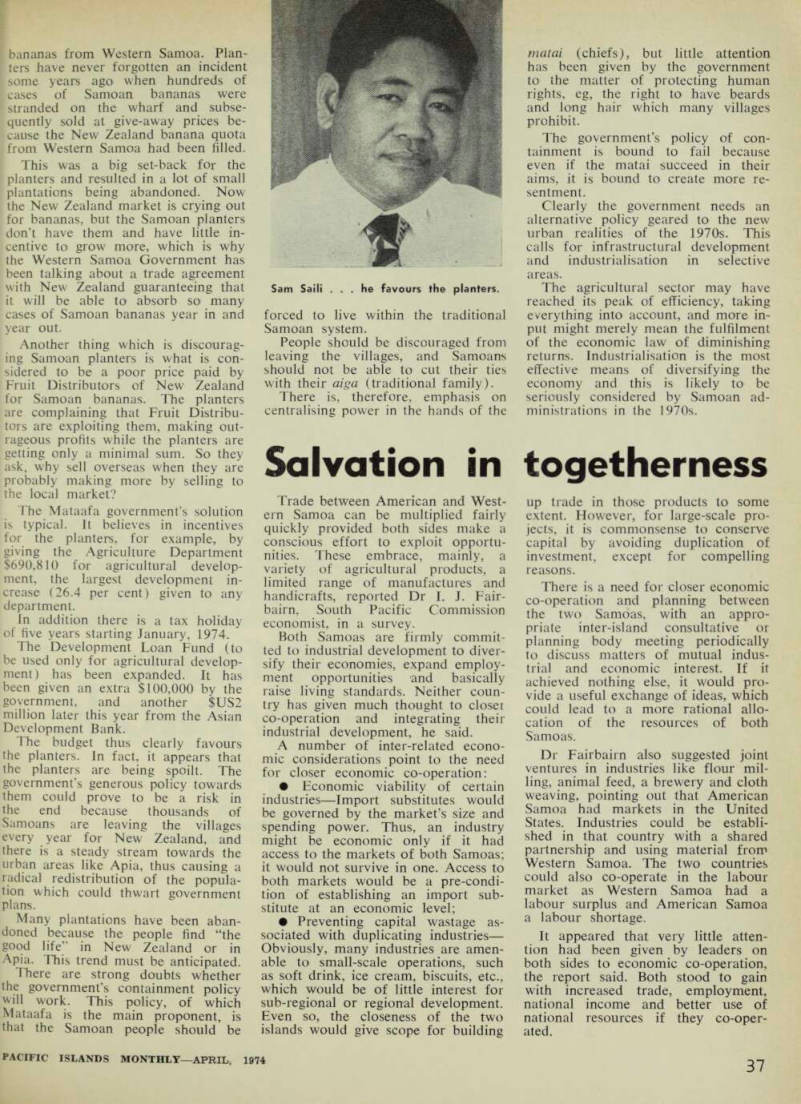
Sam Sail! ... he favours the planters.