The Mailbag
pp. 27-37 · Read in the full issue


The Islanders' Dilemma
The necessities of life compel us to think about many things, but the true test is what we think about voluntarily. A deep frustration is felt by so many Island people of the older generation who find the new life-style of the educated young hard to take and harder yet to adjust to.
They often feel that the whole world about them is falling in on top of them. Ancient traditions and customs which were the very glue of their social structure and which are so very important to them mean so very little to the younger generation.
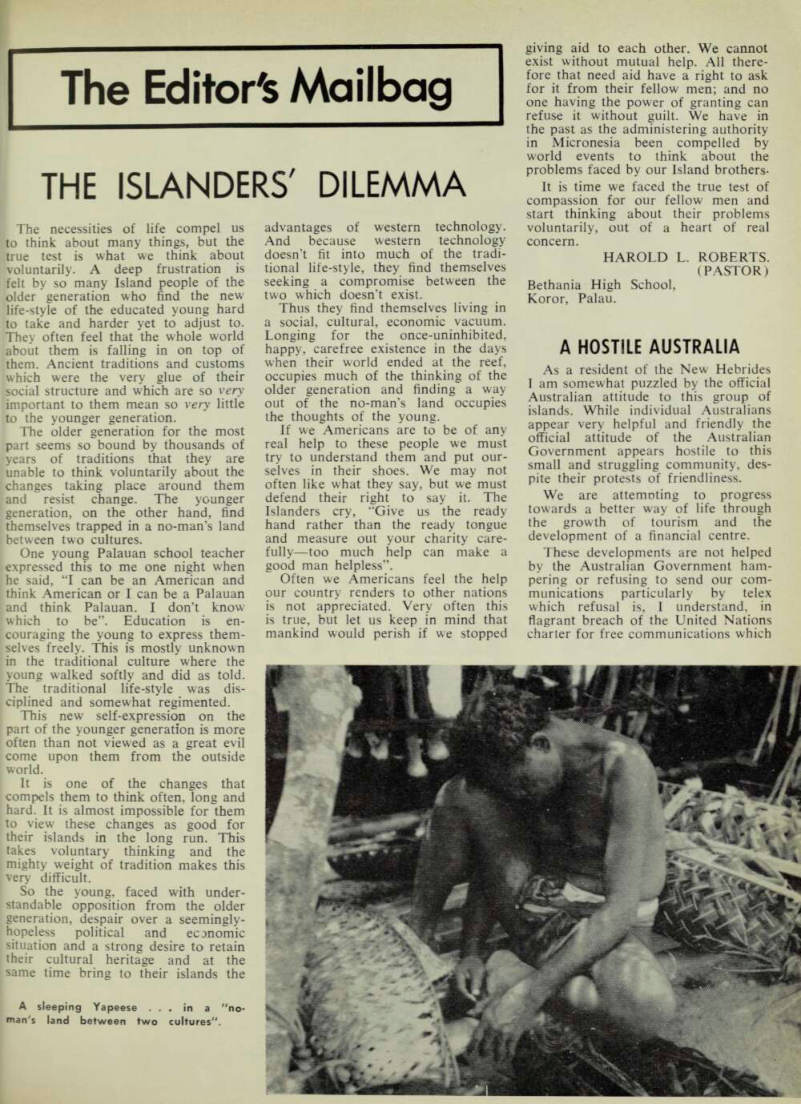
The older generation for the most part seems so bound by thousands of years of traditions that they are unable to think voluntarily about the changes taking place around them and resist change. The younger generation, on the other hand, find themselves trapped in a no-man’s land between two cultures.
One young Palauan school teacher expressed this to me one night when he said, “I can be an American and think American or I can be a Palauan and think Palauan. I don’t know which to be”. Education is en couraging the young to express them selves freely. This is mostly unknown in the traditional culture where the young walked softly and did as told.
The traditional life-style was dis ciplined and somewhat regimented.
This new self-expression on the part of the younger generation is more often than not viewed as a great evil come upon them from the outside world.
It is one of the changes that compels them to think often, long and hard. It is almost impossible for them to view these changes as good for their islands in the long run. This takes voluntary thinking and the mighty weight of tradition makes this very difficult.
So the young, faced with under standable opposition from the older generation, despair over a seemingly hopeless political and economic situation and a strong desire to retain their cultural heritage and at the same time bring to their islands the
advantages of western technology.
And because western technology doesn’t fit into much of the tradi tional life-style, they find themselves seeking a compromise between the two which doesn’t exist.
Thus they find themselves living in a social, cultural, economic vacuum.
Longing for the once-uninhibited, happy, carefree existence in the days when their world ended at the reef, occupies much of the thinking of the older generation and finding a way out of the no-man’s land occupies the thoughts of the young.
If we Americans are to be of any real help to these people we must try to understand them and put our selves in their shoes. We may not often like what they say, but we must defend their right to say it. The Islanders cry, “Give us the ready hand rather than the ready tongue and measure out your charity care fully—too much help can make a good man helpless”.
Often we Americans feel the help our country renders to other nations is not appreciated. Very often this is true, but let us keep in mind that mankind would perish if we stopped
giving aid to each other. We cannot exist without mutual help. All there fore that need aid have a right to ask for it from their fellow men; and no one having the power of granting can refuse it without guilt. We have in the past as the administering authority in Micronesia been compelled by world events to think about the problems faced by our Island brothers- It is time we faced the true test of compassion for our fellow men and start thinking about their problems voluntarily, out of a heart of real concern.
Harold L. Roberts.
(Pastor)
Bethania High School, Koror, Palau.
A Hostile Australia
As a resident of the New Hebrides I am somewhat puzzled by the official Australian attitude to this group of islands. While individual Australians appear very helpful and friendly the official attitude of the Australian Government appears hostile to this small and struggling community, des pite their protests of friendliness.
We are attemoting to progress towards a better way of life through the growth of tourism and the development of a financial centre.
These developments are not helped by the Australian Government ham pering or refusing to send our com munications particularly by telex which refusal is, I understand, in flagrant breach of the United Nations charter for free communications which
A sleeping Yapeese ... in a "no man's land between two cultures".
Letters
they profess to recognise. Vital mes sages and even the shipment of sup plies have been refused by the Aus tralian Government or their unions, even when these are required for disaster relief.
Funds required for development purposes and investment here cannot be sent owing to the refusal of the Australian Government and they have even refused to allow the repayment of our own money or the payment of interest on these when these funds are urgently required by the New Hebridean residents who originally deposited them in, or lent them to, concerns in Australia and now require them for helping to build a better society here.
As mentioned above, individual Australians are assisting considerably in the development of the New Hebrides and in the joining together of residents here to work together, to forget racial, tribal and religious differences in order to seek economic and political progress for all. There are, however, somewhat puzzling ex ceptions, particularly in connection with religious organisations which have entered the political arena and who, through their local represen tatives and, on occasion, education officials in nearby localities, appear to be preaching racial discord and hatred. It would be extremely interesting to learn how they can reconcile Christianity with some of the extreme political views preached by them.
A. Leman.
Vila, New Hebrides.
Sheer Ecstasy
After receiving the February issue of my new PIM subscription, I sin cerely regret that I had not become a subscriber at an earlier time. The scope of PlM’s coverage is indeed impressive.
In the February issue I was im mediately struck by the Indian couple appearing cn the cover. I felt certain that I had met or known the gentle man, yet I was unable to place him until I checked the credit inside the cover. Vimal Sharma was a language instructor in Hindi in the Peace Corps training in which I participated during the latter part of 1968 here in Hawaii.
After that three-month experience,
Letters
none of us could forget “Bimbo” as we came to know him.
The same issue of PIM brought to me the sad news of the passing of Mr James Madhavan. Although I met Mr Madhavan only once, I came to know that he was a highly respected representative in Macuata on the island of Vanua Levu where I spent my first year as a Peace Corps Volunteer. Macuata and the whole of Fiji lost a valuable representative of the people when it lost James Mad havan.
Little did I know that another sur prise was in store for me when I read the Cruising Yachts section of the January issue which I picked up at the news-stand. As I perused the page, I couldn’t help but wonder whether or not my aunt’s and uncle’s good friends were ever mentioned in this particular section. My eye caught the picture at the bottom of the page, the yacht looked familiar, and, sure enough, the caption confirmed that Chuck and Van Carter had indeed
reached the South Pacific. I clipped and quickly sent the story to my aunt and uncle in California who have known the Carters for many years.
As you can tell, my interest in PIM is nothing less than ecstatic. Keep up the good work.
David Rhudy.
Honolulu, Hawaii.
Polynesian Settlement
In regard to Robert Langdon’s re view of The Settlement of Polynesia by Levison, Ward and Webb (PIM, Jan, p 69) it seems to me that both Mr Langdon and the authors missed an aspect of society which could and almost certainly did initiate voyages into the complete unknown through out prehistory. These are the voyages of people expelled from society for two reasons: the first—military de feat; the second—exile which especi ally in the smaller islands and the tight societies like Samoa must have been considered tantamount to capital punishment.
The remnants of losing sides in war must have frequently taken to the sea with no idea of a destination as an immediate alternative to being
ground up by war clubs or being put into the ground oven for the victory feast of the winning side. They might not have had much hope of arriving anywhere but anything was preferable to staying where they were. Of course, conditions of starvation and going astray on known routes of sea travel could have been a large factor in the discovery of new lands.
Exile in some form must have been common. Captain Gray, in his Amerika Samoa and Its Naval Ad ministration discusses what must have been a fair example in chapter 18— The Case of the Skipjack in which a low-ranking Samoan who, after catch ing a skipjack, was cooking it for himself and family rather than turn ing it over to his chief as provided by Fa’a Samoa. Normal punishment of such a case was that the house and crops including coconut trees of the offender should be forthwith destroyed and provision made that he could not in the future live, farm or fish there. Generally, the penalty was supported by all Samoa but in this case it was not, and that is another story.
The point is that this type of thing must have been widespread and been the cause of significant numbers of people finding themselves and family at sea with return impossible on pain
Letters
of death. Without going into the pros and cons of navigation, etc, it seems a fair guess that a percentage of them made it to somewhere.
Over a span of several hundred years or maybe a couple of thousand, we could expect that most of the islands in the latitudes habitable and navigable by those primitive tropical people, must have been visited and those capable of supporting a popu lation were nearly all inhabited at the time of Western contact. And one of the triggers that could have propelled them into completely unknown areas and lands was fear of staying in their homeland and once at sea, ignorance of geography, navigation, and the handling of their vessel led to many kinds of terminations to their voyages.
And once the exiles were settled, succeeding generations certainly felt some urge to return to the homeland, and even would have had they some clues as to where it was. I remember some years ago there was a sort of spate of young people in Easter Island clandestinely preparing boats and some even getting away to voyages to Tahiti. I believe at least one boatload was picked up within two days of Tahiti—rather disgusted with their grandmother who had given them the course to Tahiti and told them the voyage would take 33 days. Since they were 33 days out of Easter Island when picked up, and could not even see Tahiti, their grand mother had a sizable credibility gap!
The approach of Messrs Levison, Ward and Webb in The Settlement of Polynesia is an interesting and new contribution to the literature on the subject. It is very doubtful that com puter technology is now advanced enough for this method to be useful in this field; and comprehensive facts of known drift voyages must be ex tremely difficult to come by.
Anthropology in both the Western Hemisphere and Oceania seems to be suffering from more than a paucity of data. This may be overcome to some degree; after all, sensible work is only about 100 years old, and the tech niques and technology are certainly not fully developed. Also, if affluence continues to increase more talent will be trained and available to attack the subject. New discoveries must be ex pected.
The other affliction suffered by the discipline of anthropology seems to be that anthropologists seem to be un
commonly contentious and con temptuous when they attain status in the field. The hostility of anthro pologists in general against Thor Heyerdahl and his theories and work would appear to stem as much from academic jealousy of his financial success as to their understandable dislike of some of the far-out theoris ing in Aku Aku.
If anthropology is to be considered a science by those of us outside the field, they are going to have to stop the infighting and stop issuing flat statements of “did” and “did not!”
Don’t call anyone a “charlatan” or “nut” until there is reasonable proof.
George R. Jacobs.
Glendale, Calif.
The Mccoskers
I am at present collecting material before writing an historical biography based on the life of my parents Stan and Marjorie McCosker. As they spent a great deal of their lives in the Islands of New Guinea, particularly New Britain, readers of PIM may be able to help.
My father first went to Rabaul, New Britain, in 1924 as plantation manager for the Melanesian Com pany. In 1929 my parents married in Rabaul. They then lived at Witu, (Ningan), and Londip. In 1936 with W. and F. King they bought Matala plantation 50 miles from Rabaul on the south coast. My parents lived
Letters
there until 1956. During the last war my father served first with NGVR and later ANGAU.
I am sure there are “oldtimers” who remember well my parents and I would like to contact these and also any men who fought with my father in the war. Could readers please write if they knew my parents or tell me about any “Befores” who may have known them. I am most anxious to contact any members of the Gilmour family, late of Put Put, New Britain.
Anne Mccosker.
Green Tiles, Mill Lane, Chalfont St Giles, Bucks, England.
Cart Cook's Club
I read the brief Tropicalities en titled “Thar’s gold in them thar huts! [sic.]” (PIM, Jan p 12) with great interest and enjoyed the photo of the Tongan club.
However, I would like to make a comment concerning Laurie Marsh all’s point about Tongan clubs and Cook, and the point that Marshall “was sure that, if Cook had been able to choose which Tongan club took his life, he’d have picked the one pictured here in PIM.”
While doing my dissertation re search on a Tongan topic in the Mitchell Library in 1970 and 1971 I came across a photo and the follow ing information: from “Cook, James —small picture file—Relics 27 and 28:”
Photo of a framed document— document reads; “Capt Cook was killed on the 14th Feb, 1779 by the Indians of Owhyee—he was first stabbed, and with a club gave him a blow on the back of the head.
“This is the identical Club given to me by the late Admiral John Hun ter.” [With a comment by Mander- Jones]: “The Department of Ethno graphy at the British Museum has identified the club from a photo graph as being Tongan.”
Cook was apparently killed with a Tongan club, but not one of the elaborate “leaf-stalk” clubs depicted in Tropicalities.
Incidentally, there is probably more “artifact gold” in “them thar museums” around the world than in some of the islands. The voyagers (and missionaries) of the 18th and
Letters
19th Century were quite efficient in their “artifact gathering.”
Charles F. Urbanowicz
California State University.
Arts Festival Filmed
In reply to Ata Matai’s letter (PIM, Feb, p 31): The Me’etu’upaki? I love it on film! And the New Hebrides as well! Mine is only a super 8 film but it captures the variety and richness of Pacific Dancing; catches the danc ers from close-up, underneath, side ways; shows some of the crafts — people and their work etc.
I am an ethnic dancer; meaning that my interest goes to the dancers of all nations and how they act as a true mirror of life: history, religion, social structure etc. Resident now in Australia, I was an eager visitor to the Pacific Festival.
It was an eye-opener and of shatter ing impact to me. When I first saw the Me’etu’upaki I fell into the grip of trembling awe: here was some thing from the beginning of time, from the very well-spring of crea tivity!
The sitting dance of the women of Lau with their nodding flower quills was of similar impact!
The dynamic men’s dances, the use of the flicking small head movements: everything was a complete revel ation!
As to the meaning of the multitude of items performed: it was most dif ficult to find out. I kept asking and investigating: and have now three different explanations of the Laka- Laka!
No one seemed quite sure as to the exact meaning of the many gestures and words in the Fijian mekes. I still wonder whether they are sung in an ancient type of Fijian language, not used now for everyday speech.
My little film lasts for an hour. I have shown it with an explanatory lecture to my circle of people here, whose wonder and interest was greatly aroused.
I am deeply aware that the waves of violent changes in the world are also touching now the Pacific Islands.
I would love to go out making a film on the arts and crafts of the people, and would bring to this venture a concerned and loving mind and eye.
Have you any idea how I could get this to be subsidised?
Wera Goldman
Bondi 2026, Australia.