the Solomons big change
p. 10 · Read in the full issue
Back to party politics for the Solomons big change
From a special correspondent in Honiara
By the time this is published the Solomon Islands will almost cer tainly have chosen their first chief minister and formed their first cabinet within a ministerial system of government.
These changes became likely fol lowing the report of a special select committee on constitutional develop ment which was presented to the Governing Council in November 1972. The report itself was sup posedly put to the test during the general election of May-June 1973 and finally endorsed by the new Governing Council during its first meeting in July.
The constitutional changes mark an important step in the Solomon Islands’ political development. The new Legislative Assembly will have more powers than the old Govern ing Council and it should be able to exercise considerable influence, if not control, over the executives’ activi ties.
On the other hand the formation of a cabinet of ministers, led by the chief minister and presumably com manding the support of a majority of the parliamentarians, will place greater emphasis on executive pow ers than was the case under the old constitution. Undoubtedly it will be some time before the exact nature of the relationship between legis lature and executive is clarified.
Accompanying. but independent
of, the constitutional changes has been the emergence of political par ties. Contrary to some popular opinion, political parties are not new to the Solomon Islands—although successful ones may be. Since Mariano Kelesi and Eric Lawson tried to set up a Democratic Party in 1965, there have been a number of sporadic attempts to organise par liamentary political groups. Peter Salaka’s Labour Party, the more re cent Solomon United National Party led by David Kausimae and even Joe Bryan’s People’s Protection Party are all examples of political parties which never really got off the ground.
The 1973 general election marked the first real upsurge in political party fortunes. Well before the elec tion a group of civil servants, includ ing the president of the Civil Ser vants’ Association, had begun to form a loose association. Although no attempt was made to organise an electoral alliance or to announce any common policies, a certain commit ment was made by the group to seek collectively for more rapid advance ment, particularly political advance ment, for the Solomon Islands.
Out of about 13 election candi dates who had belonged to the civil servants’ group, 10 were successful in the general election. Of equal significance was the defeat of a num ber of the members of the previous
Governing Council, including three
of its five committee chairmen.
Originally, six out of the 24 parlia mentarians elected in the 1973 general election had previous parlia mentary experience, but a successful petition to the High Court and subsequent by-election has now re duced that number to five.
The new Governing Council there fore began life with almost a com pletely new set of faces. From the beginning it became apparent that the old members who had been re elected did not wield much influence over the new members. Initially the ex-civil servants’ group of members behaved with some circumspection and did not immediately seek to organise a political party. A spirit of compromise seemed to be ex pressed in the election of the five committee chairmen, three of whom
came from among the old members.
Unless there are radical changes during March it seems likely that the United Solomon Islands Party will be in a position to control the elec tion of chief minister and the appointment of the cabinet of ministers. In February USIPA re examined its own leadership and elevated Philip Solodia Funifaka into the premier position, suggesting that he will be the party’s nominee for chief ministership. It seems probable, however, that the present senior secretary for social services, Fred Osifelo, will be appointed as the first Speaker of the Legislative Assembly.
As Osifelo and Solodia Funifaka are both from the same part of Malaita, it is likely that USIPA will decide to nominate another one of its lead ers for the position of chief minister.
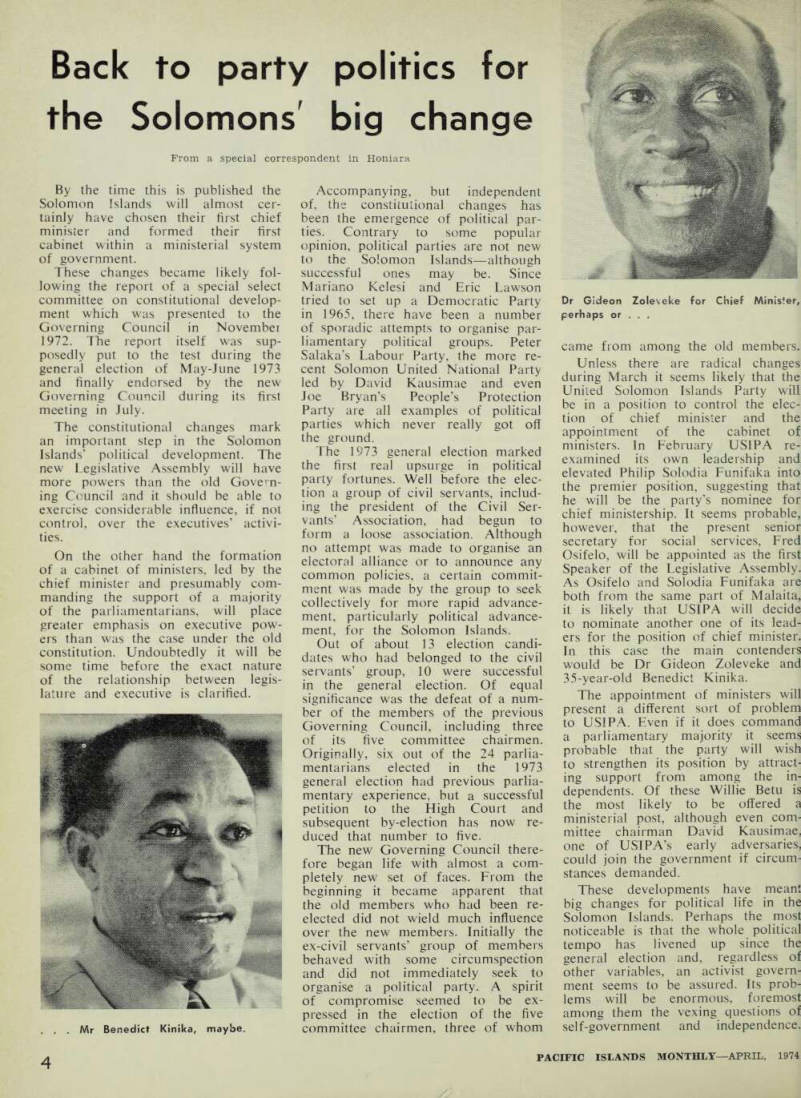
In this case the main contenders would be Dr Gideon Zoleveke and 35-year-old Benedict Kinika.
The appointment of ministers will present a different sort of problem to USIPA. Even if it does command a parliamentary majority it seems probable that the party will wish to strengthen its position by attract ing support from among the in dependents. Of these Willie Betu is the most likely to be offered a ministerial post, although even com mittee chairman David Kausimae, one of USIPA’s early adversaries, could join the government if circum stances demanded.
These developments have meant big changes for political life in the Solomon Islands. Perhaps the most noticeable is that the whole political tempo has livened up since the general election and, regardless of other variables, an activist govern ment seems to be assured. Its prob lems will be enormous, foremost among them the vexing questions of self-government and independence.
... Mr Benedict Kinika, maybe.
Dr Gideon Zoleveke for Chief Minister, perhaps or ...