says Somare
You invest on our terms' says Somare
By a staff writer
Future foreign investment in Papua New Guinea will be on Papua New Guinea’s terms. This message came through loud and clear when the PNG Chief Minister, Mr Michael Somare, addressed the Australian Institute of Directors in Sydney on March 14. He conceded his country needed foreign invest ment and loans to meet its commit ments to its people.
“But we are resolved to channel that investment for the greatest poss ible benefit to the people of Papua New Guinea”, Mr Somare said. In vestment would not be allowed till a company complied with registra tion requirements.
A new agency, the National In vestment and Development Author ity, would work towards setting priorities for investment. In some fields, such as petroleum and natural gas, PNG would actively seek foreign investment because only overseas companies had the capital and organised skills to develop the country’s resources.
But there were some areas, such as road transport and agriculture, where foreign participation would be actively discouraged. Investment priorities would spell out those dis tinctions.
Mr Somare said any major invest ment would not only be expected to employ the maximum number of New Guineans, but would also be required to provide training to in crease the number of skilled citizens, PNG could not afford to allow major companies to acquire a trained work force simply by in creasing wage rates and attracting workers from other industries. That would have a disastrous effect on efforts to control inflation.
Mr Somare said investors would also increasingly be required to buy supplies from local sources, when ever supplies were available at com petitive prices. The highlands could produce almost all vegetables, yet millions of dollars were spent each year on imported vegetables. As part of the investment policy, steps would be taken to ensure that food bought for company use came from PNG.
“We will make sure that our re sources are exploited in a way that contributes to our own goals and
needs”, the Chief Minister said.
“One most important basic principle is that these resources belong to the people of Papua New Guinea. In some industries we already have New Guineans who can do the work required, but we still need foreign
corporations to supply the capital
and overall management and market ing knowledge. In other industries, such as mining, and oil and gas production, we have few trained people, and we may choose that foreign companies should assist while training our citizens.
“But we will keep control of the way in which our resources are de veloped. We also intend to be sure that resource development does not create a small privileged class of New Guineans. We want the benefits to go to the mass of the people. For this reason, there will be increasing emphasis on taxation of resource projects so that the benefits can be redistributed to the people through government projects. There will also be increasing emphasis on govern ment ownership of resource ventures, in partnership with foreign corpora tions”.
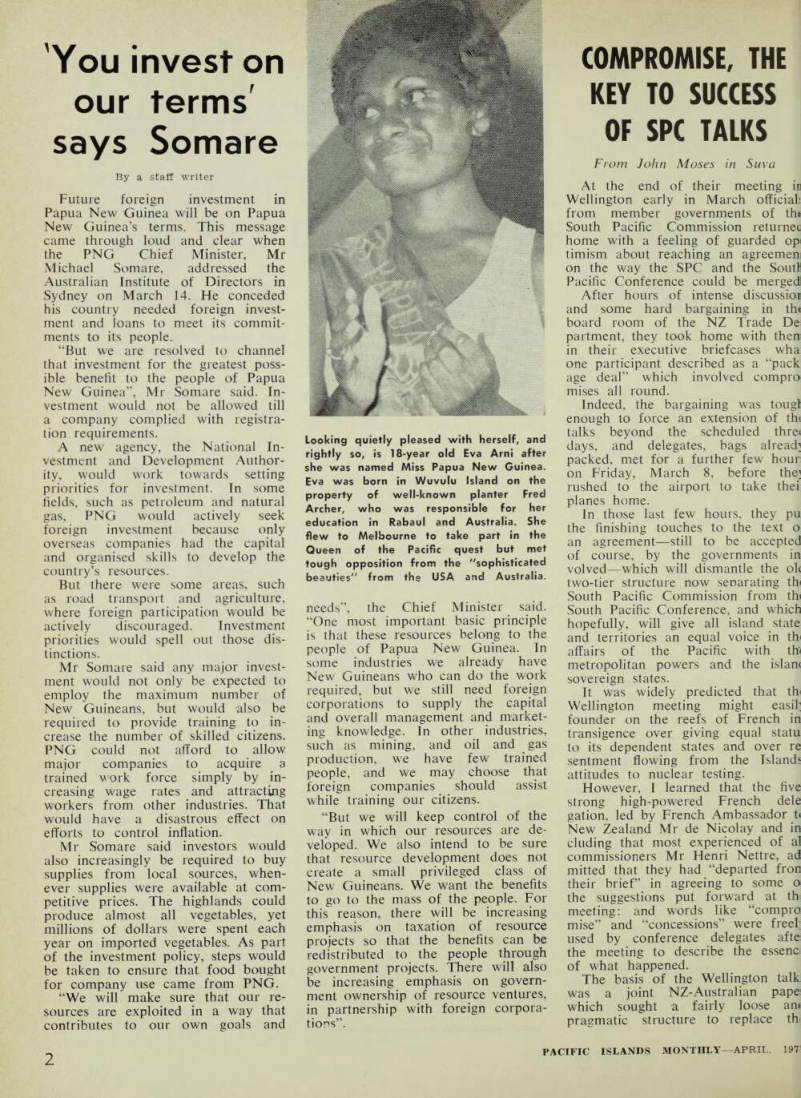
Looking quietly pleased with herself, and rightly so, is 18-year old Eva Arni after she was named Miss Papua New Guinea.
Eva was born in Wuvulu Island on the property of well-known planter Fred Archer, who was responsible for her education in Rabaul and Australia. She flew to Melbourne to take part in the Queen of the Pacific quest but met tough opposition from the "sophisticated beauties" from the USA and Australia.