land problem
Racist bill to solve PNG's land problem
The PNG Government is wasting no time in bringing into operation some of the more controversial pro posals of the Commission of Inquiry into Land Matters although the com mission’s final report has yet to be adopted in the House of Assembly.
The government is now establish ing a special section within the Lands Department with the main purpose of ensuring prompt follow up action immediately the commiss ion’s recommendations are approved by the Assembly.
Meanwhile, the bulky Land Acquisition Bill has thudded on to the desks of Assembly members who have been asked to approve it. They will probably do this in the May meeting. The bill is designed to take away land from expatriates and put it into the hands of New Guineans.
In as much as it is designed to assist one race at the expense of others, it is, of course, racist. It confines itself to properties at present held by
expatriate interests.
“We are dealing here with prob lems which arise from the colonial administration by Australia”, said Land Minister Thomas Kavali, “and not with future foreign investment which is encouraged in accordance with the government’s investment guidelines.
“It is thought that potential in vestors will be impressed by the
government’s willingness to deal with the present problems which repre sent a genuine threat to foreign in vestment”.
The threat the minister talks about is the threat posed by hostile New Guinean squatters on expatriate owned plantations and land, particu larly in the Gazelle Peninsula.
Mr Kavali said these activities were a threat to law and order be cause the New Guineans affected by alienated land said the government was unwilling or unable to solve their problems and, thus, took mat ters into their own hands.
Whether or not the bill can re solve these problems remains to be seen. The PNG Post-Courier asks whether the bill won’t inspire others “to squat on land probably never before in dispute, with hopes of
equal success”.
There is also the effect on over seas investment despite the minister’s assurances. Who is to know whether future governments won’t be tempted to use the powers on the Statute Book in other ways? It is fairly in volved legislation requiring more safeguards than the usual bill. For example, it provides a compensation formula for the acquisition of land plus an additional compensation factor to allow the government to take into account the amount of funds available or likely to be avail able when paying compensation. As the Australian Government has been asked for a lump sum to enable acquisition to take place, there will be some doubt as to the amount of money in the kitty for this factor.
The bill applies to “undeveloped land, or land used wholly or partly for primary production or for any
other prescribed purpose”.
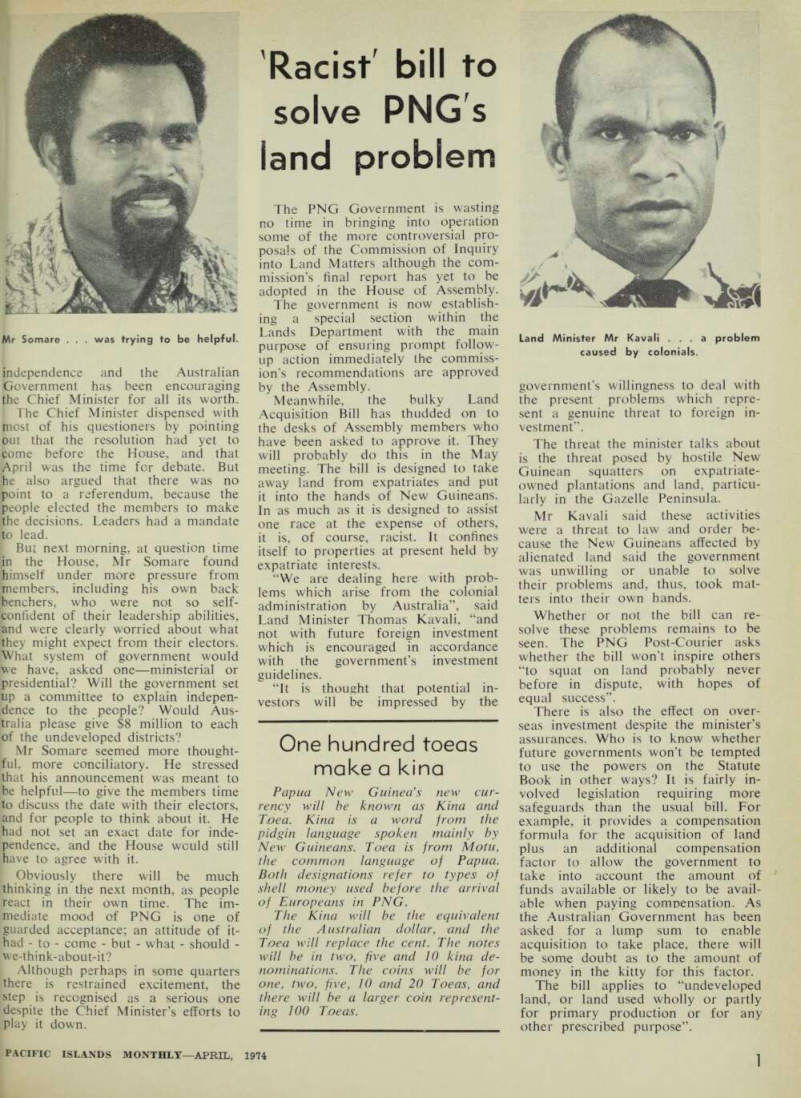
Land Minister Mr Kavali ... a problem caused by colonials.