Pacific Islands Monthly
pp. 6-7 · Read in the full issue
Its Definitely-Probably-Possibly
-Maybe December 1 For Png!
Within 12 hours of announcing the target date for PNG independence as December 1, 1974, Chief Minister Michael Somare was making it clear that the date wasn’t “exact”, and that if the House of Assembly doesn’t agree with it then the government will find another date.
It may have to. December 1 is a nice, round date that comes exactly 12 months after self-government, and enables the necessary legislative machinery of the Australian Govern ment and the UN Trusteeship to operate smoothly—but a lot of people in Papua New Guinea are frightened of taking the step.
Just how strong their objections are we probably won’t know until the end of April, when there is a special sitting of the Assembly to debate Mr Somare’s target date, and along with it, the all-important report of the Constitutional Planning Committee.
The committee’s report was meant to be introduced at the February/March sittings of the House, but the task of putting the final details together turned out simply to be too much for the committee. But by mid-March most sections of the report were in the hands of the Chief Minister for cabinet perusal.
Mr Somare’s target date announce ment was a last-minute decision, pressed upon him by continual de mands for him to clear up apprehen sion and uncertainty by giving the country a clue to his thinking. He made his announcement to the Assembly on March 12, the evening before the House adjourned. The drama of it wasn’t lost on Somare the politician, who began his an nouncement urbanely and increased the speed and dramatic quality of his delivery until he finally thundered, “Mr Speaker ... I intend to move in the April sittings of this House that this House supports the Ist Decem ber, 1974, as the date on which Papua New Guinea should become independent!”
He continued to thunder: “Papua New Guinea has all the prerequisites
Prom a Port Moresby correspondent of an independent country. We have the leaders, as demonstrated by the able men on both sides of this House. We have the manpower re sources—just look around at our people succeeding in every field, assisted where necessary by over seas skilled officers who have agreed to stay and assist us through the first difficult years until our training institu tions have turned out enough skilled young men and women to satisfy our needs.
“Ours is an extremely rich country when you consider the resources we have available for development.
Financial assistance has been promised from Australia for the next three years which will be suf ficient to maintain and improve the government services throughout PNG until existing and planned projects contribute substantially to our re venue.”
The Chief Minister stressed at least twice that the step to independence was not a large step, and the timing was not a major issue. This is in accordance with his view that the major political step took place last December 1 when PNG became self governing, and that independence is
nothing much more than a mad inery measure. But the House’s n action to his target date showe that perhaps the electorate doesn agree with him, and that it thinl independence is something to b feared.
There were cheers from the mini: terial benches and boos from th Opposition at the announcement, an the 25 minutes allowed for questior were often noisy and disorderly, wit Speaker Barry Holloway frequentl calling for order.
The burden of their complain was that this was not an issue to b decided by the Chief Minister or pei haps even the House—that ther should be a referendum of the peopli Opposition Leader Tei Abal went s far as to suggest that the Chit Minister was tricking the peoph who, he claimed, had been led t believe that independence wouldn come before September of next yea Tei also' wanted to know whether th date was the Chief Minister’s or Aui tralia’s.
The first accusation was unfair, th second had the seeds of truth in ths the Australian Prime Minister an the Chief Minister both want earl
independence and the Australian Government has been encouraging the Chief Minister for all its worth.
The Chief Minister dispensed with tnost of his questioners by pointing out that the resolution had yet to come before the House, and that April was the time for debate. But he also argued that there was no point to a referendum, because the people elected the members to make the decisions. Leaders had a mandate to lead.
But next morning, at question time in the House, Mr Somare found himself under more pressure from members, including his own back benchers, who were not so self confident of their leadership abilities, and were clearly worried about what they might expect from their electors.
What system of government would we have, asked one—ministerial or presidential? Will the government set up a committee to explain indepen dence to the people? Would Aus tralia please give $8 million to each of the undeveloped districts?
Mr Somare seemed more thought ful, more conciliatory. He stressed that his announcement was meant to be helpful—to give the members time to discuss the date with their electors, and for people to think about it. He had not set an exact date for inde pendence, and the House would still have to agree with it.
Obviously there will be much thinking in the next month, as people react in their own time. The im mediate mood of PNG is one of guarded acceptance; an attitude of it had - to - come - but - what - should we-think-about-it?
Although perhaps in some quarters there is restrained excitement, the step is recognised as a serious one despite the Chief Minister’s efforts to play it down.
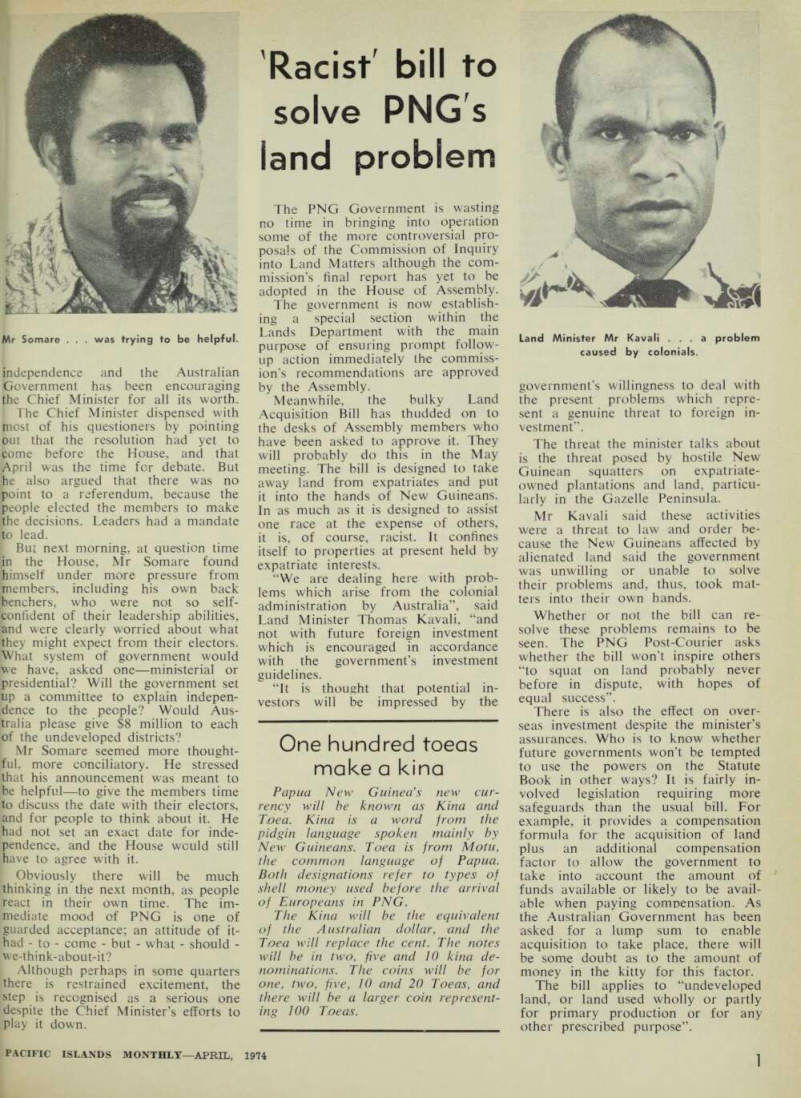
Mr Somare ... was trying to be helpful.