Tough talk
p. 15 · Read in the full issue
in Noumea
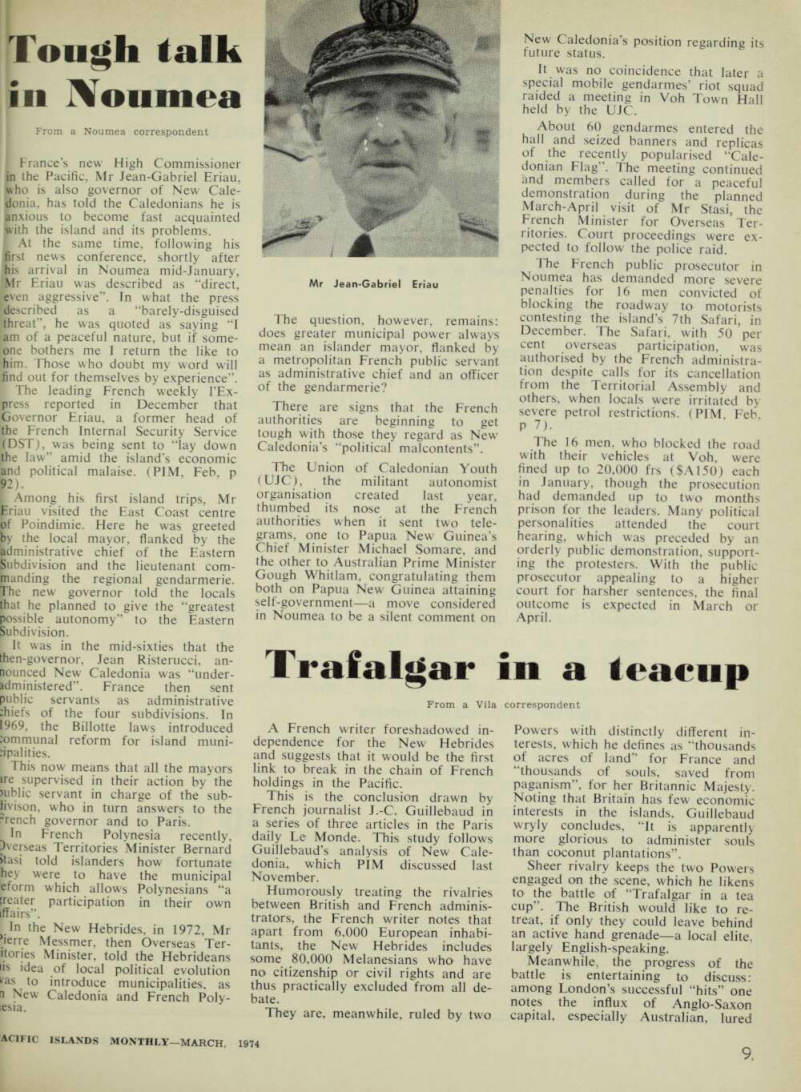
From a Noumea correspondent France’s new High Commissioner in the Pacific, Mr Jean-Gabriel Eriau, who is also governor of New Cale donia, has told the Caledonians he is lanxious to become fast acquainted with the island and its problems. At the same time, following his first news conference, shortly after his arrival in Noumea mid-January, Mr Eriau was described as “direct, even aggressive”. In what the press described as a “barely-disguised threat”, he was quoted as saying “I am of a peaceful nature, but if some one bothers me I return the like to him. Those who doubt my word will find out for themselves by experience”.
I The leading French weekly I’Ex ‘press reported in December that Governor Eriau, a former head of the French Internal Security Service (DST), was being sent to “lay down the law” amid the island's economic and political malaise. (PIM, Feb, p 92). t Among his first island trips, Mr Eriau visited the East Coast centre of Poindimie. Here he was greeted by the local mayor, flanked by the administrative chief of the Eastern Subdivision and the lieutenant com manding the regional gendarmerie.
The new governor told the locals that he planned to give the “greatest possible autonomy” to the Eastern Subdivision.
I It was in the mid-sixties that the then-governor, Jean Ristemcci, an nounced New Caledonia was “under administered”. France then sent public servants as administrative chiefs of the four subdivisions. In 1969, the Billotte laws introduced communal reform for island muni npalities.
This now means that all the mayors ire supervised in their action by the )üblic servant in charge of the sub livison, who in turn answers to the French governor and to Paris.
In French Polynesia recently, Overseas Territories Minister Bernard ftasi told islanders how fortunate hey were to have the municipal eform which allows Polynesians “a [reater participation in their own iffairs”.
I In the New Hebrides, in 1972, Mr ierre Messmer, then Overseas Ter itories Minister, told the Hebrideans ns idea of local political evolution yas to introduce municipalities, as a New Caledonia and French Poly icsia.
The question, however, remains: does greater municipal power always mean an islander mayor, flanked by a metropolitan French public servant as administrative chief and an officer of the gendarmerie?
There are signs that the French authorities are beginning to get tough with those they regard as New Caledonia’s “political malcontents”.
The Union of Caledonian Youth (UJC), the militant autonomist organisation created last year, thumbed its nose at the French authorities when it sent two tele grams, one to Papua New Guinea’s Chief Minister Michael Somare, and the other to Australian Prime Minister Gough Whitlam, congratulating them both on Papua New Guinea attaining self-government—a move considered in Noumea to be a silent comment on
New Caledonia s position regarding its future status.
It was no coincidence that later a special mobile gendarmes’ riot squad raided a meeting in Voh Town Hall held by the UJC.
About 60 gendarmes entered the hall and seized banners and replicas of the recently popularised “Cale donian Flag”. The meeting continued and members called for a peaceful demonstration during the planned March-April visit of Mr Stasi, the French Minister for Overseas Ter ritories. Court proceedings were ex pected to follow the police raid.
The French public prosecutor in Noumea has demanded more severe penalties for 16 men convicted of blocking the roadway to motorists contesting the island’s 7th Safari, in December. The Safari, with 50 per cent overseas participation, was authorised by the French administra tion despite calls for its cancellation from the Territorial Assembly and others, when locals were irritated by severe petrol restrictions. (PIM. Feb.
P 7).
The 16 men, who blocked the road with their vehicles at Voh, were fined up to 20,000 frs (SAISO) each in January, though the prosecution had demanded up to two months prison for the leaders. Many political personalities attended the court hearing, which was preceded by an orderly public demonstration, support ing the protesters. With the public prosecutor appealing to a higher court for harsher sentences, the final outcome is expected in March or April.
Mr Jean-Gabriel Eriau