Sea Disasters
pp. 13-14 · Read in the full issue
Uncover Gaps In
Safety Rules
From a Suva correspondent
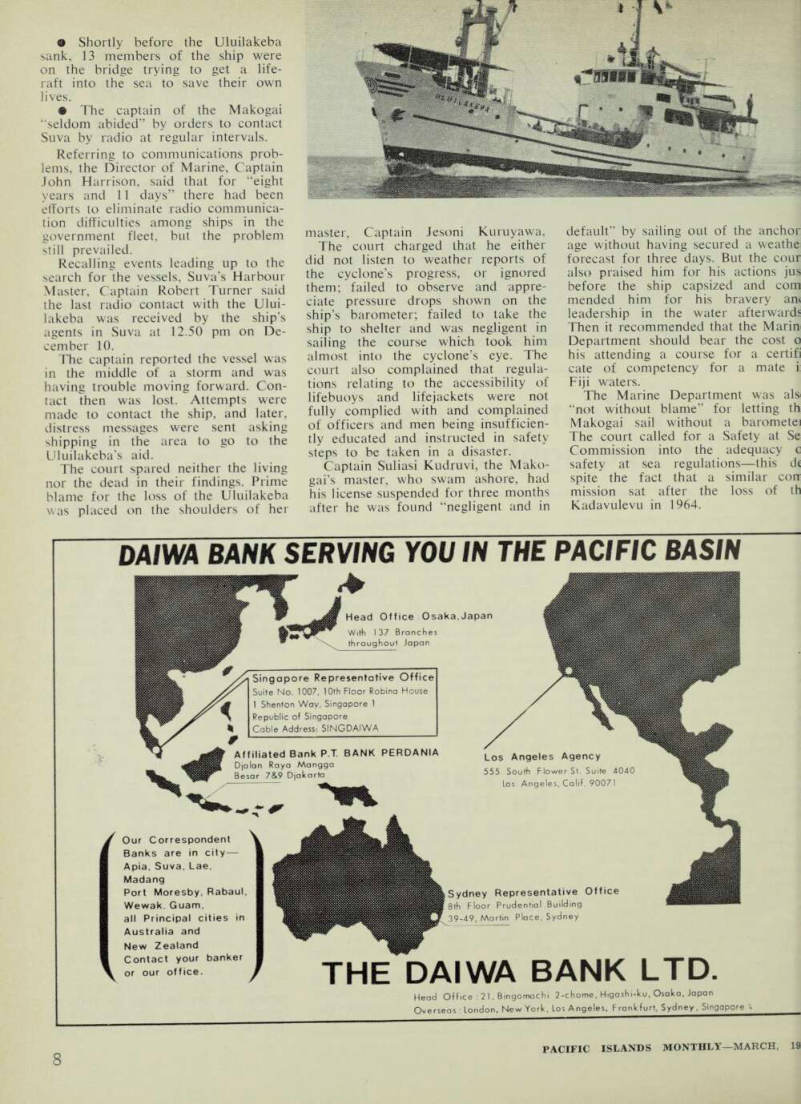
Events following the sinking of two ships in Fiji waters during Cyclone Lottie last December have prompted the Prime Minister, Ratu Sir Kamisese Mara, to call for a re-examination of the air-sea rescue system Fiji inherited from the Royal New Zealand Air Force.
Ratu Sir Kamisese made the suggestion while giving evidence to the court of inquiry into the loss of the 212-ton passenger and cargo vessel Uluilakeba, and the govern ment medical launch Makogai, in southern Lau on December 10.
The double disaster claimed 70 lives. (The official list, which earlier put the toll at 84, was described during the inquiry as being in correct.) Five were lost from the Makogai and 65 from the Uluilakeba.
More than 50 witnesses, includ ing the Prime Minister, testified at the 11-day investigation, which ended in Suva on January 31.
Among other things, the inquiry— held before a magistrate with two senior marine officers as assessors— provided an interesting insight into the laws and regulations affecting air sea rescue procedures, safety measures and communication with shipping in Fiji waters.
For example, the court was told:— 9 Loss of communications with vessels in Fiji waters was not an un usual occurrence and “officials would not necessarily think a ship was in distress if they did not hear from her for a few days.” ® Fiji regulations covering ships’ equipment specified little except for lifesaving appliances. There were no regulations about machinery and hull survey. ® There was nothing in the law about a ship’s manning scale apart from references to a master and chief officer. • Crew members of the Uluilakeba were never drilled for an emergency. ® The captain of the Uluilakeba, Captain Jesoni Kuruyawa (who was one of those drowned) jumped off the ship while passengers and crew were still aboard.
O While the Uluilakeba was being battered by the cyclone, the crew re ceived no order to abandon ship or distribute life jackets. (OV er)
9 Shortly before the Uluilakeba sank, 13 members of the ship were on the bridge trying to get a life raft into the sea to save their own lives. • The captain of the Makogai “seldom abided” by orders to contact Suva by radio at regular intervals.
Referring to communications prob lems, the Director of Marine, Captain John Harrison, said that for “eight years and 11 days” there had been efforts to eliminate radio communica tion difficulties among ships in the government fleet, but the problem still prevailed.
Recalling events leading up to the search for the vessels, Suva’s Harbour Master, Captain Robert Turner said the last radio contact with the Ului lakeba was received by the ship’s agents in Suva at 12.50 pm on De cember 10.
The captain reported the vessel was in the middle of a storm and was having trouble moving forward. Con tact then was lost. Attempts were made to contact the ship, and later, distress messages were sent asking shipping in the area to go to the Uluilakeba’s aid.
The court spared neither the living nor the dead in their findings. Prime blame for the loss of the Uluilakeba was placed on the shoulders of her
master, Captain Jesoni Kuruyawa, The court charged that he either did not listen to weather reports of the cyclone’s progress, or ignored them; failed to observe and appre ciate pressure drops shown on the ship’s barometer; failed to take the ship to shelter and was negligent in sailing the course which took him almost into the cyclone’s eye. The court also complained that regula tions relating to the accessibility of lifebuoys and lifejackets were not fully complied with and complained of officers and men being insufficien tly educated and instructed in safety steps to be taken in a disaster.
Captain Suliasi Kudruvi, the Mako gai’s master, who swam ashore, had his license suspended for three months after he was found “negligent and in
default” by sailing out of the anchor age without having secured a weathe forecast for three days. But the cour also praised him for his actions jus before the ship capsized and com mended him for his bravery am leadership in the water afterwards Then it recommended that the Marin Department should bear the cost o his attending a course for a certifi cate of competency for a mate i Fiji waters.
The Marine Department was alsi “not without blame” for letting th Makogai sail without a barometei The court called for a Safety at Se Commission into the adequacy c safety at sea regulations—this d€ spite the fact that a similar corr mission sat after the loss of th Kadavulevu in 1964.