Complexion beauty that
pp. 92-95 · Read in the full issue

will last a lifetime
Every woman can now achieve and hold a smoother and younger complexion thanks to the scientific development of a tropically moist oil blend.
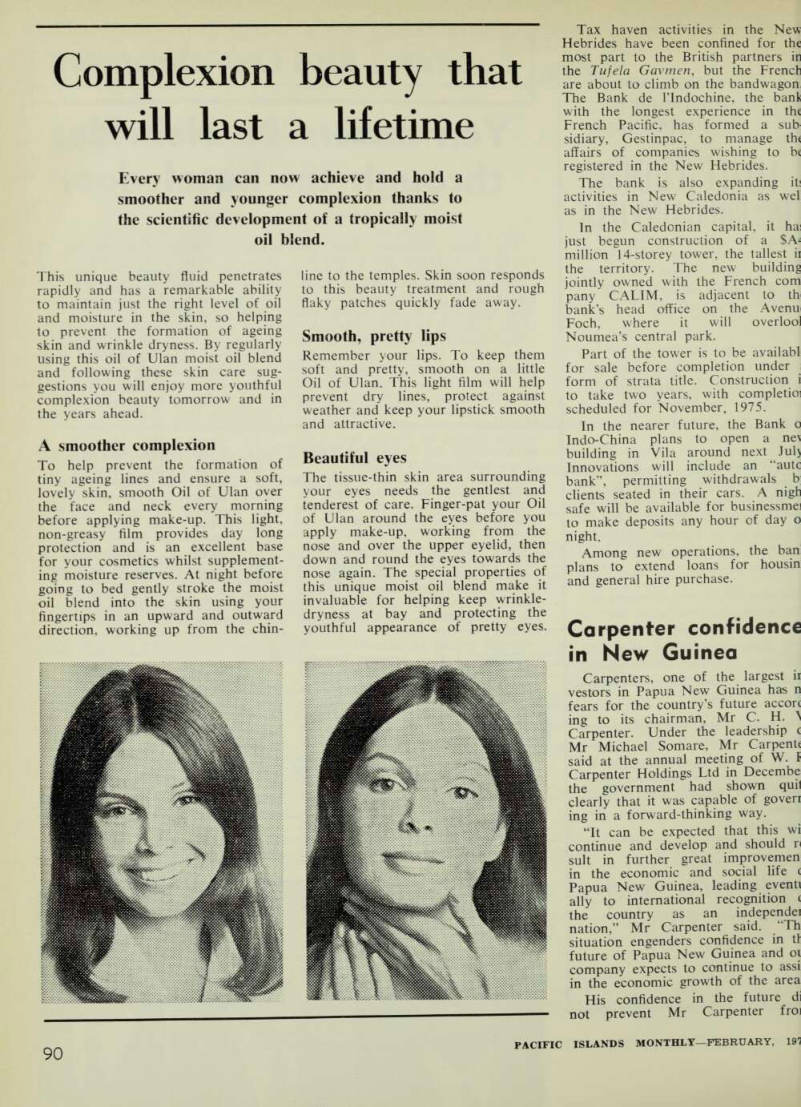
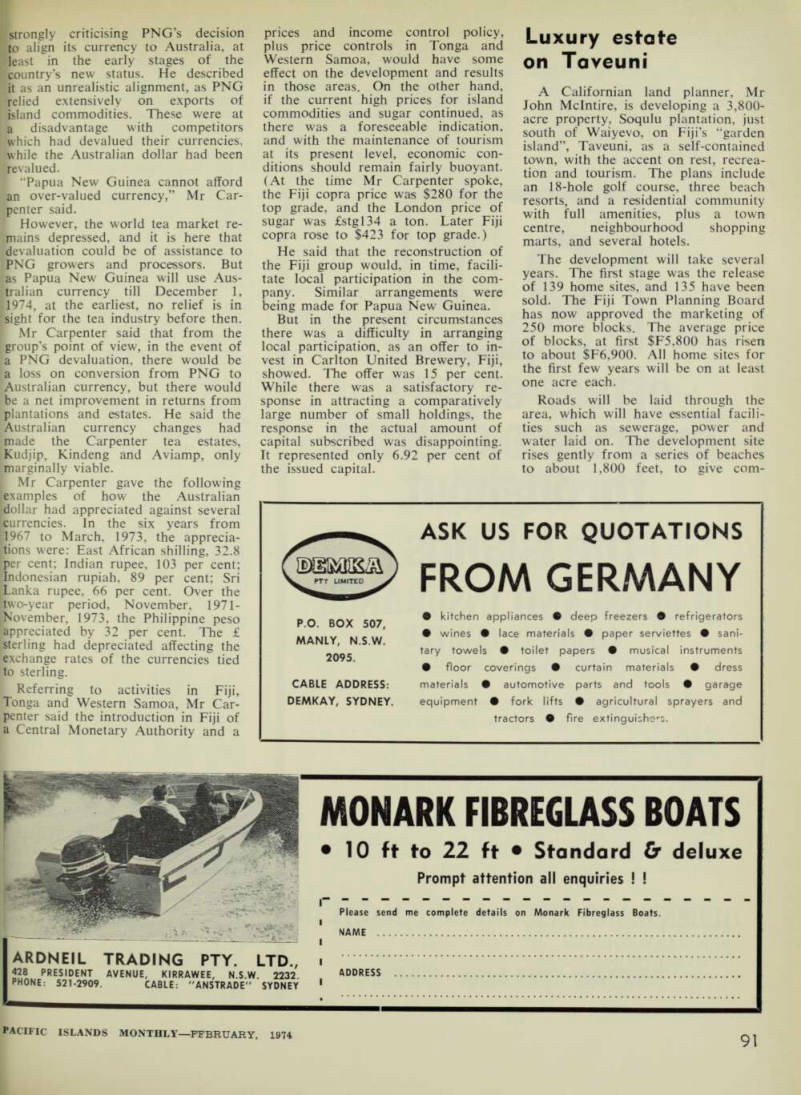
This unique beauty fluid penetrates rapidly and has a remarkable ability to maintain just the right level of oil and moisture in the skin, so helping to prevent the formation of ageing skin and wrinkle dryness. By regularly using this oil of Ulan moist oil blend and following these skin care sug gestions you will enjoy more youthful complexion beauty tomorrow and in the years ahead.
A smoother complexion To help prevent the formation of tiny ageing lines and ensure a soft, lovely skin, smooth Oil of Ulan over the face and neck every morning before applying make-up. This light, non-greasy film provides day long protection and is an excellent base for your cosmetics whilst supplement ing moisture reserves. At night before going to bed gently stroke the moist oil blend into the skin using your fingertips in an upward and outward direction, working up from the chin
line to the temples. Skin soon responds to this beauty treatment and rough flaky patches quickly fade away.
Smooth, pretty lips
Remember your lips. To keep them soft and pretty, smooth on a little Oil of Ulan. This light film will help prevent dry lines, protect against weather and keep your lipstick smooth and attractive.
Beautiful eyes The tissue-thin skin area surrounding your eyes needs the gentlest and tenderest of care. Finger-pat your Oil of Ulan around the eyes before you apply make-up, working from the nose and over the upper eyelid, then down and round the eyes towards the nose again. The special properties of this unique moist oil blend make it invaluable for helping keep wrinkle dryness at bay and protecting the youthful appearance of pretty eyes.
Tax haven activities in the New Hebrides have been confined for the most part to the British partners in the Tufela Gavmen, but the French are about to climb on the bandwagon, The Bank de I’lndochine, the bank with the longest experience in the French Pacific, has formed a sub sidiary, Gestinpac, to manage the affairs of companies wishing to be registered in the New Hebrides.
The bank is also expanding it; activities in New Caledonia as wel as in the New Hebrides.
In the Caledonian capital, it ha; just begun construction of a million 14-storey tower, the tallest ii the territory. The new building jointly owned with the French com pany CALIM, is adjacent to th« bank’s head office on the Avemn Foch, where it will overlool Noumea’s central park.
Part of the tower is to be availabl for sale before completion under ; form of strata title. Construction i to take two years, with completioi scheduled for November, 1975.
In the nearer future, the Bank o Indo-China plans to open a nev building in Vila around next Jul> Innovations will include an “autc bank”, permitting withdrawals b; clients seated in their cars. A nigh safe will be available for businessmei to make deposits any hour of day o night.
Among new operations, the baff plans to extend loans for housin and general hire purchase.
Carpenter confidence
in New Guinea
Carpenters, one of the largest ir vestors in Papua New Guinea has n fears for the country’s future accorc ing to its chairman, Mr C. H. \ Carpenter. Under the leadership c Mr Michael Somare, Mr Carpenff said at the annual meeting of W. f Carpenter Holdings Ltd in Decembe the government had shown quit clearly that it was capable of goven ing in a forward-thinking way.
“It can be expected that this wi continue and develop and should n suit in further great improvemen in the economic and social life c Papua New Guinea, leading eventi ally to international recognition c the country as an independei nation,” Mr Carpenter said. “Th situation engenders confidence in tl future of Papua New Guinea and oi company expects to continue to assi in the economic growth of the area His confidence in the future di not prevent Mr Carpenter froi
strongly criticising PNG’s decision to align its currency to Australia, at ■least in the early stages of the new status. He described it as an unrealistic alignment, as PNG relied extensively on exports of Hand commodities. These were at a disadvantage with competitors Iwhich had devalued their currencies, while the Australian dollar had been revalued.
I “Papua New Guinea cannot afford an over-valued currency,” Mr Car penter said. [ However, the world tea market re imains depressed, and it is here that devaluation could be of assistance to PNG growers and processors. But as Papua New Guinea will use Aus tralian currency till December 1, 1974, at the earliest, no relief is in i sight for the tea industry before then.
Mr Carpenter said that from the group’s point of view, in the event of a PNG devaluation, there would be a loss on conversion from PNG to Australian currency, but there would be a net improvement in returns from plantations and estates. He said the 'Australian currency changes had made the Carpenter tea estates, Kudjip, Kindeng and Aviamp, only marginally viable.
Mr Carpenter gave the following examples of how the Australian dollar had appreciated against several currencies. In the six years from ■967 to March, 1973, the apprecia tions were: East African shilling, 32.8 per cent; Indian rupee, 103 per cent; Indonesian rupiah, 89 per cent; Sri Tanka rupee, 66 per cent. Over the two-year period, November, 1971- November, 1973, the Philippine peso appreciated by 32 per cent. The £ sterling had depreciated affecting the exchange rates of the currencies tied to sterling.
Referring to activities in Fiji, Tonga and Western Samoa, Mr Car penter said the introduction in Fiji of a Central Monetary Authority and a
prices and income control policy, plus price controls in Tonga and Western Samoa, would have some effect on the development and results in those areas On the other hand if the current high prices for island commod.ties and sugar continued, as the . re r S in a f °T l ? d ,‘ catlon ’ and with the maintenance of tourism at its present level, economic conditions should remain fairly buoyant. (At the time Mr Carpenter spoke, he Fiji copra price was $2BO for the top grade and the London price of sugar was £stgl34 a ton. Later Fiji copra rose to $423 for top grade.) He said that the reconstruction of the Fiji group would, in time, facilitate local participation in the company. Similar arrangements were being made for Papua New Guinea.
Bit in the present circumstances there was a difficulty in arranging local participation, as an offer to invest in Carlton United Brewery, Fiji, showed. The offer was 15 per cent.
While there was a satisfactory respouse in attracting a comparatively large number of small holdings, the response in the actual amount of capital subscribed was disappointing.
It represented only 6.92 per cent of the issued capital.
I MYMri . ocfmf/a “" UAUr 7 CbraTe
qh TdVCUtli
A Californian land planner, Mr John Mclntire> is developing a 3,800acre t S oqulu plantation, just south of Waiyevo, on Fiji's “garden island .. Xave J ni as a self-contained town> with the accent on rest, recrea ti and tourism The lans include 18 . ho e go |f course, three beach resortSj and B a resid ential community ih J„ ameniti plus a tow ' neighbourhood shopping marts> ’ an(J se B veral hotels . i i , . , The development will take several Vf 3 , 1 !' T he flrs stage was the release 0f ,j 39 h om «.! lt s?’ and J 3s have been f ld - The F, )> Town Planning Board has now approved the marketing of 23 °. . mo . re bl f <K * s ; ™l| o a ™ r ?« e P. rlce f f b ' ocks - at $F \ BOO ha .s rl « n •? about $F6,900. All home sites for the h ls * few y ears W 1" be on at least one acre each * Roads will be laid through the area, which will have essential facili ties such as sewerage, power and water laid on. The development site rises gently from a series of beaches to about 1,800 feet, to give com
manding views of the sea, and across Somosomo Strait to Vanua Levu and Rabi Island.
Mr Mclntire’s spacious beach front home, which features the imaginative use of native timbers, will reflect the architectural tone of the project. He used local labour as a first step to wards building up a skilled work force.
The golf course will be ready in 1975 or 1976. It is not expected that membership will be restricted to Soqulu residents. Initial plans are to invite hotel chains to erect the hotels.
Marketing would be aimed mainly at Americans; but it is also expected Australians and Japanese, seeking somewhere “to get away from it all” will show interest in buying a site.
Tonga bank
goes 'Swiss-style'
The new Bank of Tonga will operate secret bank accounts, similar to the Swiss system. Foreigners will be able to open accounts using a secret code number known only to the owner of the account and one or two bank officers.
King Taufa’ahau Tupou IV said the bank would operate differently from any other bank already estab lished in the neighbouring islands.
The bank will open for business in Nukualofa on July 1, offering full banking services in addition to the numbered account service. Mr Car son Flint, on secondment from the Bank of New South Wales for three years, became general manager of the bank on January 4.
Mr Flint was manager of the Five Dock (NSW) branch of the bank till the end of May, 1973, after which he went to head office to prepare for the position in Tonga. The deputy general manager is Mr B. D. Holt, from the Bank of New Zealand. The Bank of Hawaii will supply the ac countant, who has yet to be named.
The board of the bank will com prise Dr S. Tapa, Acting Minister of Finance, Mr Cecil Cocker, Tonga Government Statistician, Mr D. M.
Arnold, general manager of the Bank of NSW, Mr B. M. Smith, general manager of the Bank of NZ, and Mr Clifton D. Terry of the Bank of Hawaii.
France lays
down the law
The French weekly L’Express, equivalent to American Newsweek, in its issue of December 17-23 reports on Caledonian problems: “Whoever speaks of economic crisis implies social malaise then, often, political unrest. The government has thus chosen a former director of the DST (Internal Security Service), Mr Gabriel Eriau, aged 59, as High Commissioner in New Caledonia.
This Pacific island is sick from its
monoproduction: nickel . . .
“To avoid complete breakdown, th« government has allowed, in the 1974 national budget, a credit allowance of 100 million French francs for New Caledonia (SAI4 million) ... Bui these isolated measures do not assure the economic future of the island.
“A delegation of local elected mer came to Paris last week to ask the government to speed up the realisa tion of nickel smelting projects: ir the north of the island . . . Patino
... and in the south . . . Canadian IINCO and French SNPA . . .
“Mr Pierre Messmer (Prime Minister) did not receive the visiting [New Caledonian Assembly members. On the island, Mr Eriau will have to [lay down the law.”
Fiji taking coals
from Newcastle
The petroleum industry is losing a [major Fiji customer to coal—Fiji In- I dustries Ltd, the Lami cement manu facturer. The company will spend about $140,000 to switch its plant from oil to coal power—for straight economic reasons, the manager of Fiji Industries Ltd, Mr B. P. Smith, said.
While the cost of oil had a major bearing on the decision to change over, the uncertainty of future sup plies, as well as prices, hastened the decision. Last November, the com pany paid $14.83 a ton for fuel. It was $39 a ton in January and ex pected to be $52 in March. While coal will not give any saving on cur rent fuel costs, it is expected to result in major savings in future, Fiji Industries will import about 26,000 tons of coal a year from New castle.
Review of Fiji
copra troubles
The Fiji copra industry faces many problems, not the least of which is declining production in face of high prices, so the government has accepted a recommendation from the Coconut Advisory Council for an other industry review. A difficulty is to find the right man to do the re view.
The last review, in 1963, by Lord Silsoe, brought a number of reforms in pricing and grading, and did much to lift the quality of Fiji copra. But the industry continued to decline.
Copra production is one-quarter to one-third below the target set in De velopment Plan 6, and 40 per cent of commercial trees are past their best.
Concerted Islands
approach to EEC
There would be an advantage in African, Caribbean and Pacific groups sticking together solidly in trade nego tiations with the European Economic Community. Three South Pacific Prime Ministers have come to this conclusion after a meeting in Apia, where they reaffirmed the merit of presenting a joint South Pacific re gional case to the EEC. Ratu Sir Kamisese Mara, of Fiji, Prince Tui’pelehake, of Tonga, and Fiame
Mata’afa, Western Samoa, reviewed negotiations about possible South Pacific association with the EEC, the appropriate level of representation necessary at EEC headquarters in Brussels, and the prospects for a satis factory mechanism to stabilise export receipts for items the Islands sent to the EEC.
On tariff policy, the Prime Minis ters recognised that treatment of EEC exports would need to be in line with terms to be negotiated with the EEC. • The Premier of the Cook Is lands, Sir Albert Henry, recently opened the Trailways 80-bed hotel in Rarotonga.
Australian
trade mission
An Australian trade mission to the Pacific Islands is scheduled to visit Hawaii, Fiji, New Zealand and New Caledonia during May-June, 1974.
The 20-member group is sponsored by the New South Wales Government and will include representatives of food and manufacturing industries, besides banks and the Department of Agriculture. The Island tour follows a November, 1970, mission to Papua New Guinea, the Solomons, Fiji and New Caledonia.