wrangle with traders
pp. 77-85 · Read in the full issue

Transpac in a freight rates wrangle with traders
An odd situation developed when Transpacific Lines Inc (Transpac) tried to confirm temporary increases in freight rates granted in February, 1973, for the US Trust Territory.
Transpac asked Mr A 1 Hansen, a shipping consultant, to make a study of costs in preparation for a govern ment review of the temporary in creases.
Mr Hansen, apart from supporting the temporary increases, discovered that an additional 12 per cent rate increase would be necessary. Much of this would go to paying off a 52.5 million debt which Transpac claimed was mostly inherited from the for mer management of Marine Char tering Co, San Francisco. The 52.5 million debt is to be spread over five years which has to run before the Transpac franchise with the Trust Territory Government expires.
Mr Hansen and other Transpac men explained the study to a meeting of the Majuro Chamber of Commerce.
Some members took exception to Transpac paying debts of some other concern, saying it would be much better to declare bankruptcy, and start again. Mr Hansen, however, said the government made the de cision.
Mr Eric Pyne, Marshall District Co-operative Officer, said that his concern, and the concern of anyone using Transpac, was not with the price increase, but rather the continued in efficiency of the shipping. He claimed the co-operative found it necessary to slaughter more than 2,000 chickens because Transpac failed to deliver feed.
Mr Masatoki Stephen, Trukese member of the Transpac board, said everyone claimed the new high prices on shop shelves were because of shipping rates, but that was not the case. He said the merchants were to blame for the high prices because of their mark-ups.
Transpac men had charts to show what price increases on certain items would be with the hike of 12 per cent in freight rates. A 50 lb bag of rice should cost an additional .175 c; spam should cost another ic a can; canned fish should go up .003 c a can and a 14 oz bottle of catsup should be exactly .1c more.
Senator Amata Kabua, of the Con gress of Micronesia, had the last word when the meeting closed. He
told the Transpac men; “You have heard in this meeting that we are not concerned about the price in crease and are only seeking improved efficiency. Lest you leave here with a mistaken notion, let me point out that your price increase is of concern to us, as well as your efficiency. You have a sacred responsibility to the people here because of the special franchise nature of your operating agreement. Do not underestimate our concern for costs”.
Obviously all is not well with Transpac. There have been reports of differences, bordering on violence between the German officers and the Micronesian crew of the Lotte Reith.
The visit to Saipan in November of President Hammer deßoburt, of Nauru, could have implications for Transpac. He was accompanied by representatives of Nauru Pacific Lines, and went there to discuss the possibility of expanding the line’s service to the Trust Territory. Nauru Pacific Lines is at present limited to calling at Majuro.
Nauru has the capacity to take on an additional service, running parallel with Transpac from the United States, west coast to all major ports in Micronesia, Nauru Pacific Lines*
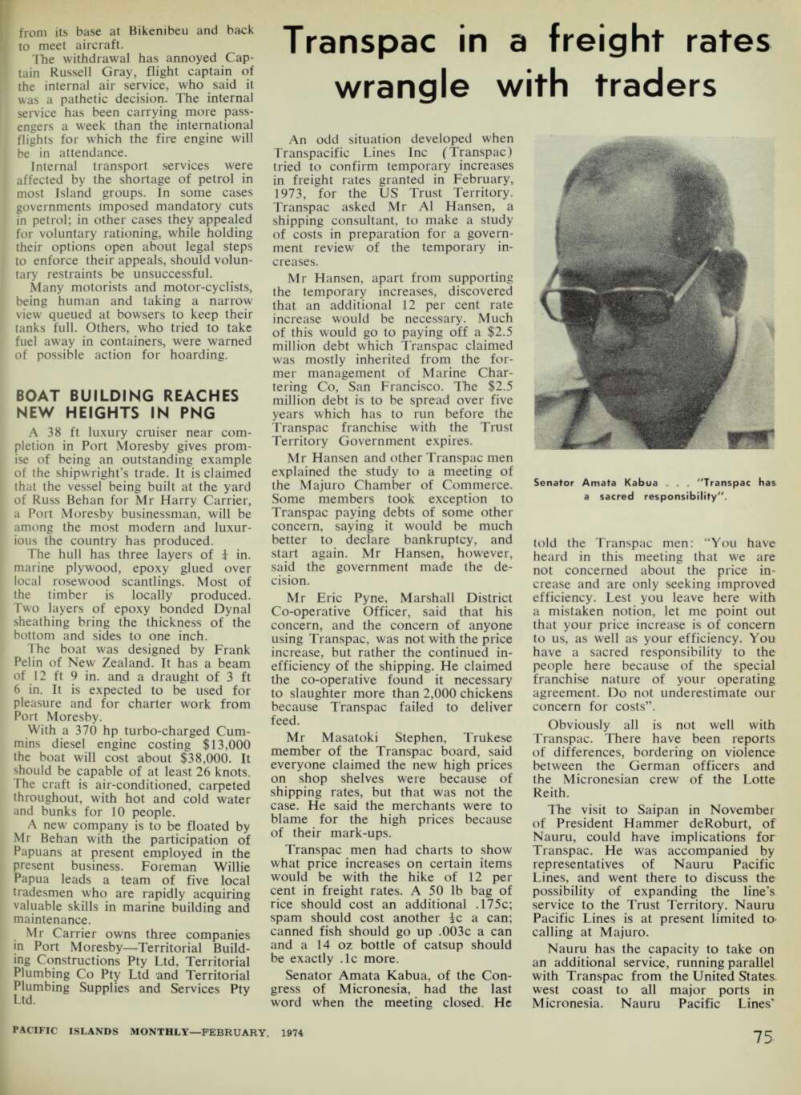
Senator Amata Kabua . . . "Transpac has a sacred responsibility".
major services operate from Australia to Pacific Islands ports. Currency realignments have lifted the cost of Australian products, as well as send ing up freight rates, in the Pacific Islands.
With American goods cheaper in the Islands, importers will be looking more to the US and Canada for sup plies. A natural corollary is a de mand for shipping space.
Ship Fire Marred
A Cruise
Nine-hundred and sixty-nine Aus tralian and New Zealand holiday makers had an enjoyable South Seas Christmas-New Year cruise marred when their ship, the Chandris Line’s Patris, caught fire in the main gener ating room on December 29. The ship had just left Vila.
Two generators were damaged by water as firemen won an hour’s fight with the fire, which was in the third generator. The ship then drifted for 29 hours while the generators dried out. Rather than return to Vila, the master decided to sail to Suva where there are better repair facilities.
Chandris flew six engineers from Greece to Fiji to help the Suva trades men repair the damaged generators.
Other engineers were flown from Greece to Sydney to await the return of the liner from the cruise, and carry out major repairs. The ship sailed to Suva on two generators, one of which failed on arrival. This was New Year’s Day.
Without full generating capacity some of the ship’s service was re stricted, and there were a few com plaints about stale food and over flowing lavatories. But the majority of passengers defended the ship, and claimed that meals were excellent, in spite of some shortages in refriger ation.
Uluilakeba Sinking
Isolates Lauans
The southern Lau Islands of Fiji lost their only marine link with Suva when the Uluilakeba sank with the loss of 79 lives in Hurricane Lottie on December 11. They were unable to get their copra to Suva to take ad vantage of the record high prices, which reached $423 a ton for top grade.
Now Rabi Holdings Ltd and Prin cess Shipping Ltd have agreed in principle to split the Uluilakeba’s services with the Komaiwai and the Fijian Princess. Whether the services become permanent depends on talks with the Marine Department, In the past the inter-island services
have omitted southern Lau services because they were not profitable.
This led to the Marine Co-operative Association, in which Lauans are the main shareholders, buying the Uluilakeba.
Even though the Uluilakeba ran at a loss during its 10 years service, it provided the vital link with Suva.
Should the association wish to buy another ship it will find it an expen sive proposition.
Meanwhile, an Indian firm has two ships for sale, one of 800 tons and the other of 200 tons, and has offered them to Fiji. A final decision about buying one or both of them rests with the Fiji Government.
Qantas May Get
Fiji Charter Flights
The Fiji Government, going against the wishes of the Society of Fiji Travel Agents, has given Qantas per mission to operate block inclusive tour charter flights on a one-year trial. The society’s opposition was based on claims that a monopoly for Qantas would damage the Fiji tourist industry.
Qantas will be restricted to one return flight a week on the Sydney- Nadi service, using a Boeing 707, with a maximum capacity of 172 pas sengers. Only genuine holiday-makers from Australia or Fiji, who pay a single inclusive fare of not less than the current Sydney-Nadi individual excursion fare, may travel on the flights.
The number of the holiday-makers on each flight to Fiji must be within the Fiji tourist industry’s capacity to
handle them. At least 50 passengers on each flight have to spend at least a week in either Taveuni or Vanua Levu. Another condition is that Qan tas reserves a specified number of seats on each flight for Fiji people wanting an inclusive holiday tour in Australia.
Qantas is required to give a firm undertaking to the Fiji Government that it will, through the International Air Transport Association, try to lower fares between Fiji and Aus tralia on scheduled services, covering special excursion, group and inclusive tour fares. It is now up to Qantas to say if it will accept the Fiji Govern ment’s conditions.
Freight Rates Up
For Png Coasters
Freight rate increases for ships operating along the Papua New Guinea coast were approved in Jan uary by the Minister for Transport, Mr Jephcott, There was to be a rise of two per cent on January 17, which was to be followed by a further hike of 10 per cent on February 1. The rises were granted to cover increased costs since the last rise, six per cent, two years ago. The PNG Ship Owners’ Association asked for a rise of 15 per cent.
The Papuan Planters Association was not altogether happy about the latest increases. The president, Mr Evan Cleland, said it was not clear whether the new rates would apply only to coastal shipping between rural areas and main ports, or only be tween main ports.
If they were to apply from rural
areas to main ports the rise was astounding, he said.
Mr Cleland said the latest rises were on top of a unilateral freight increase imposed on the Papuan coast in November 1973, If the rates applied from rural areas to main ports the whole population would be affected.
Shipping Pool
For Png Service
New Guinea Australia Line and Conpac will pool resources where possible to give a wider and more efficient shipping service to Papua New Guinea from Australia. New Guinea Australia Line is a China Navigation Co subsidiary, and Con pac is a joint venture of Burns Philp and Australia West Pacific Line.
Conpac loads at Melbourne, Syd ney and Brisbane for Port Moresby and Lae, using the Tenos and Nimos.
New Guinea Australia Line, from Sydney and Brisbane, using the Coral Chief, Island Chief, New Guinea Chief and Papuan Chief, services Port Moresby, Samarai, Lae, Madang Rabaul, Kavieng, Kieta, Honiara and Gizo.
The two companies will retain their separate agents in all ports and offer shipment to trade on their individual bills of lading. They de scribe the joint venture service as an
operational agreement between them “designed to provide the trade with a continuous, reliable and economic shipping service”.
They will provide a regular and evenly-spaced service to all ports.
One job which is likely to be tack led is the setting up of an efficient loading point in Sydney. Conpac, loading in Sydney from new wharves has been able to turn ships round quickly, but NGAL from older wharves has been subject to delays, with vehicles queueing along the streets, waiting to get to the load ing point.
The deputy chairman of NGAL, Mr Edward Scott, and the resident director in Sydney of Conpac, Mr Anders Hillstrom, went to Port Moresby to make a joint announce ment about the joint service. Mr Scott, while there, warned there could be a further increase in freight rates on top of the 2\ per cent surcharge imposed in December.
Mr Scott said he hoped any further increases would be less than 2i per cent. He added that PNG had had a “wonderful trot” over freight rates.
Freight rises on shipping lines oper ating from centres such as Hong Kong had risen by up to $2 a ton, while on the Australia-PNG run the increases had only been about 80c a ton.
Samoan Dories
Declared Unsafe
The US Coast Guard cracked down hard on American Samoa dory fleet recently and ordered 13 ships not to go to sea till they met the safety requirements of American Samoa. In a sudden inspection of the boats at the dory dock, inspectors found something wrong with all the boats.
Some were not properly registered and numbered. Others had not the required number of life preservers, failed to carry a radar reflector or were guilty of other violations. The Coast Guard said it would intercept any boat leaving the harbour to make sure it had a proper clearance, which included complying with safety re quirements.
Polynesian Airlines
Sells A View
There’s no point in flying all the way from Western Samoa to New Zealand if you can’t see the spec tacular seascape below in daylight.
Thus rationalises Polynesian Airlines.
So they have introduced early morn ing services from Apia to Nadi three times a week, flying, what’s more, at the very considerate height of 10,000 ft so passengers can fully appreciate the beautiful coral islets and lagoons
below. At Nadi, Polynesian’s HS74Bs connect with onward flights to Auck land and Sydney, still in broad day light although at somewhat higher altitudes.
Tarros Container
Charter Extended
The Union Steam Ship Co of NZ has taken up a 2i year charter of the Tarros class container ship, Union South Pacific. The USS Co had the ship on a temporary charter basis, and only confirmed the charter for the long term just before Christmas.
The Union South Pacific services Suva, Lautoka, Apia and Pago Pago from Auckland.
She was chartered from Sea Con tainers Inc, which now has a sub sidiary company based in Goldfields House, Sydney. Sea Containers will lease container ships to Pacific Islands and Australian companies. The mana ging director of the Sydney company is Mr Arvid Rasmussen, who became well known in Pacific shipping circles as traffic manager for Karlander.
A Princess
For Micronesia
The MS Micronesia Princess, the first of eight ships to be built for the US Trust Territory, was officially launched recently at Pusan, South Korea, by Mrs Bethwel Henry, wife of the Speaker of the House of Rep resentatives in the Congress of Micro nesia. The ship was about 60 per cent finished at the time of the launch ing, and delivery is expected by the end of June.
The MS Micronesia Princess, 242 ft and 2,050 tons, is being built by Daesun Shipbuilding and Engineer ing Co Ltd. It was designed, and will be specially equipped to meet the re quirements of transoceanic support and intra-district services.
The ship will operate to the outer islands of each district from district centres on approved schedules, carry ing special heavy lift cargo and diffi cult cargo on special runs. After 1978 it will operate as part of a total inte grated Micronesian transport system.
The Micronesia Princess has space for 36 20 ft containers, and cargo capacity of 800 tons. Special addition al container designs have been de veloped to enable her to carry extra refrigerated containers, as well as special 20 ft x 8 ft mobile cabins, which can serve alternately as extra passenger staterooms, multiple berth bunk rooms, extra galley, dispen saries and water reservoirs.
The ship is designed to carry a crew of 12 for long voyages and a smaller crew for the shorter hauls.
The maximum deck passenger capac
ity is more than 100. The passenger cabins can accommodate 12. Her speed is about 15 knots.
Air Fares Rise In
Samoa And Tonga
Polynesian Airlines have introduced a return excursion fare of SWS2O (SUS 33) between Apia and Pago Pago and group and student discounts for the route. The normal one-way Apia-Pago Pago fare has been in creased to SWSI4 (5U523.4). In line with international practice, a 10 per cent fare has been introduced for infants.
The airline has asked the Western Samoa and American Samoa govern ments for permission to increase fares to offset an average rise of 86.3 per cent in fuel costs. The new fares will be applied as soon as they are approved.
In Tonga, internal air fares have also been raised because of a heavy increase in the cost of aviation fuel.
On January 14 the Tongatapu-Vavau fares were lifted to $22.30 single and 544.60 return, and Tongatapu-Eua $5.40 and $lO.BO.
The Tonga Tourist and Develop ment Co’s airline incurred a heavy loss in its first 12 months of oper ation.
Transport Briefs
• Two landing craft from the Australian Government will give the Papua New Guinea Defence Force improved maritime mobility. They may be used for loading and unload ing across beaches, discharging fairly heavy cargo from ships standing off shore, and transport on the major rivers. The landing craft should be ready early in 1975. • Australian Army sappers will lay an airstrip at Lord Howe Island this year. The strip will be about 3,000 feet long and will cost about $3 million. Earlier estimates were that the strip would cost $5 million, but with the army doing the job and treating it as an exercise the cost will be lowered considerably. Part of the exercise will be for the army to transport the materials to the island.
The strip will not extend into the lagoon. • Reef Shipping Co, of Auckland, has a new freighter, the Fijian Swift, which it may use for the Fiji export banana trade. The Fijian Swift is a replacement for the Jean Phillipe, which Reef Shipping sold recently to Singapore interests. The Fijian Swift has capacity for 1,200 tons of cargo.
It is owned by Fijians, and Fiji cadet officers may be recruited.