Magazine Section
pp. 59-103 · Read in the full issue
When Newspapers Waged
War In The Cooks
By W. G. Coppell
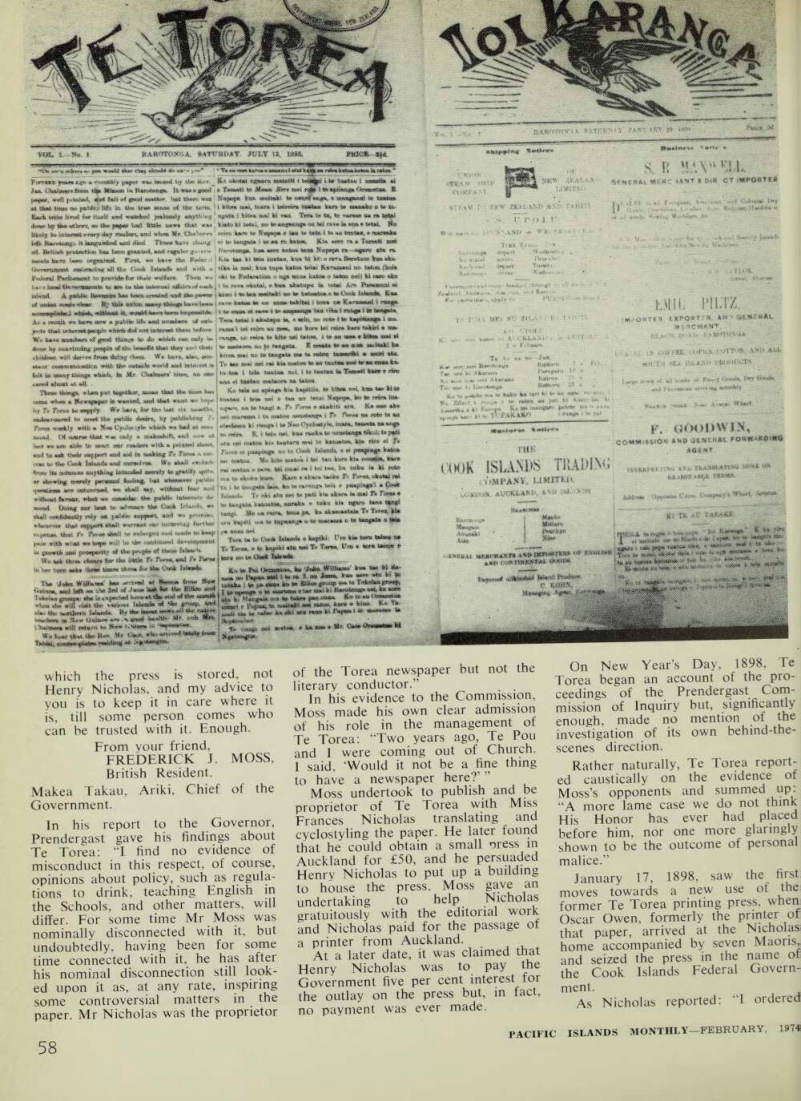
On January 26, 1895 the first issue was made of Te Torea, to all intents and purposes the first commercial newspaper in the Cook Islands. Te Torea first saw print as a 4-page newsheet, being handwritten and cyclostyled on poor quality paper, with Henry Nicholas, a trader who had lived on Rarotonga since the 1870 s, as its publisher, Te Torea always included items in both English and the vernacular, and was published every Saturday in its handwritten form until a letter press edition appeared on July 13, 1895.
The first notice to the public said: “Te Torea will be published every Saturday. It is to tell the news and to give the people an opportunity of exchanging ideas on all public affairs.
Our motto will be—‘Do unto others as you would that they should do unto you’.”
The editor of Te Torea clearly lent his weight to the innovations sponsored by Mr F. J. Moss, the British Resident, by bringing out editorials which patently supported his policies. The public, for instance, were urged to support the Public Schools Act: “The Act is a good one, and will, we hope, do great good.
No one, who has many children over five years of age, can complain of having to pay, as his children will be taught without further expense.”
His interest in both Te Torea and the judicial processes eventually were to be major contributors to Moss’s removal from office as British Resident, and it is interesting to read the Te Torea editorial of October 3, 1896: “In a recent issue we published a letter from John Strickland, of Aitutaki, saying that the Government there had fined him for giving a ring as a present to a girl friend. He paid the fine but the Government wouldn’t give the ring back. So he bought the ring from the government and gave it again to the girl, who in her turn gave it to another friend. Then this
This is the second of an occasional series of articles on newspapers in the Islands in the early days. Dr Coppell, who is now lecturing in education at Macquarie University, Sydney, was formerly Deputy Director of Education in the Cooks, the scene of a newspaper war in which the pen proved mightier than the British Resident.
good kind native government fined both girls.”
Moss fell out with a number of European residents on Rarotonga, and he also aroused the animosity of some of the Ariki (paramount chiefs).
Petitions were forwarded to the Governor in New Zealand seeking the removal of Moss.
In part. Moss’s difficulties were exacerbated by the fact that he had fallen out with the Rev J. J. K.
Hutchin, the London Missionary Society representative at Rarotonga. 111-feeling had arisen between the two men over the establishment of the public schools, the liquor question and, in particular, the High Court Bill.
The Chief Justice of New Zealand, Sir James Prendergast, conducted an inquiry at Rarotonga in December, 1897, during which the involvement of the British Resident in the publica tion of Te Torea was revealed.
The impending inquiry drastically affected Te Torea and on November 6, 1897, it announced: “It is with extreme regret we have to announce that with the present issue Te Torea will cease to exist. During the two years of our existence we have endeavoured to make ourselves use ful to the community as a whole and while believing generally that our humble efforts have been appreciated, the remuneration received has not been at all commensurate with the expense entailed and we have to re
luctantly confess that for some time Te Torea has not been a paying concern.”
However, the enterprise was not entirely moribund as on November 20, 1897 the paper again appeared in its original cyclostyled handwritten form: “We find, however, so un animous a wish that the paper be continued that we have decided to accede to the wishes of our friends and relaunch the little bird upon the sea of journalism.”
Te Torea continued to be produced in cyclostyled form until its ultimate demise on February 21, 1899. One of the accusations made against Moss at the inquiry was that he had used Te Torea for his own purposes although the press had, in fact, belonged to the Federal Government of the Cook Islands. The printing press, meantime, remained locked in a shed owned by Henry Nicholas, and the correspondence between Makea Ariki and Moss foreshadows actions which followed: British Resident’s Office, Rarotonga, January 13, 1898.
Sir, The printing-press and all that belongs to it is in the hand of Henry Nicholas. If they are the goods of the Government I wish to bring them to an open place, so that as to print the word of the Government. It is not right that the Government goods should re main with him, and do not work.
Let us know your thoughts, so as I can send my men to take it away tomorrow. Sufficient.
Salutations!
MAKEA, Ariki,
Chief of the Government.
The British Resident.
British Resident’s Office, Rarotonga, January 14, 1898.
Salutations!
I have today
received your letter, dated the 13th January.
I have the key of the place in
which the press is stored, not Henry Nicholas, and my advice to you is to keep it in care where it is, till some person comes who can be trusted with it. Enough.
From your friend,
Frederick J. Moss
British Resident.
Makea Takau, Ariki, Chief of the Government.
In his report to the Governor, Prendergast gave his findings about Te Torea: “I find no evidence of misconduct in this respect, of course, opinions about policy, such as regula tions to drink, teaching English in the Schools, and other matters, will differ. For some time Mr Moss was nominally disconnected with it, but undoubtedly, having been for some time connected with it, he has after his nominal disconnection still look ed upon it as, at any rate, inspiring some controversial matters in the paper. Mr Nicholas was the proprietor
of the Torea newspaper but not the literary conductor.”
In his evidence to the Commission, Moss made his own clear admission of his role in the management of Te Torea: “Two years ago, Te Pou and 1 were coming out of Church. 1 said, ‘Would it not be a fine thing to have a newspaper here?’ ”
Moss undertook to publish and be proprietor of Te Torea with Miss Frances Nicholas translating and cyclostyling the paper. He later found that he could obtain a small nress in Auckland for £5O, and he persuaded Henry Nicholas to put up a building to house the press. Moss gave an undertaking to help Nicholas gratuitously with the editorial work and Nicholas paid for the passage of a printer from Auckland.
At a later date, it was claimed that Henry Nicholas was to pay the Government five per cent interest for the outlay on the press but, in fact, no payment was ever made.
On New Year’s Day, 1898, Te Torea began an account of the pro ceedings of the Prendergast Com mission of Inquiry but, significantly enough, made no mention of the investigation of its own behind-the scenes direction.
Rather naturally, Te Torea report ed caustically on the evidence of Moss’s opponents and summed up: “A more lame case we do not think His Honor has ever had placed before him, nor one more glaringly shown to be the outcome of personal malice.”
January 17, 1898, saw the first moves towards a new use of the former Te Torea printing press, when Oscar Owen, formerly the printer of that paper, arrived at the Nicholas; home accompanied by seven Maoris* and seized the press in the name of the Cook Islands Federal Govern ment.
As Nicholas reported: “I ordered
him (Owen) away from the premises.
I stood in front of the door. I pushed I him away and he struck me twice in 1 the face with his fist, the natives (seven in number) standing round.
Owen then called to the natives to breach open the house. Pora and Piaputa said, ‘We have now got I orders to break it open from the Ariki’, and Pora then burst it open with his shoulder and foot, using all the force at his disposal.”
Moss gave public notice that all ! concerned in the seizure would be charged with forcible entry, and that it was “an offence against the public peace and a grave wrong against the Protectorate flag.”
Henry Nicholas sought compensa tion for the seizure of the press and took a civil case against Oscar Owen and his sons. Moss recommended to the New Zealand Governor that: “As prosecution of the glaring breach of law and defiance of authority in connection with the seizure of the printing plant and its subsequent usage can only be dealt with in the High Commissioner’s Court, I re spectfully represent the need for a sitting of the High Commissioner’s Court in Rarotonga at the earliest moment possible, for the maintenance of law and authority in these islands.”
When the case came before the court, presided over by the High Commissioner for the Western Pacific, the honours came out very much in favour of the Te Torea party. First, Oscar Owen was found guilty of contempt of court for publishing the Some Tall Lying” article; secondly, m the case—H. Nicholas v Oscar Owen for forcible entry, Owen again found himself adjudged at fault: “His Honor again warned accused and ordered him to find sureties, himself for £lOO and two others of £5O each to keep the peace for twelve months towards everyone, and Henry Nicholas in particular.”
It appeared also that Moss fined a number of the Ariki for their part m the affair. However, they refused to pay, and appealed to Moss’s suc cessor, Lieutenant-Colonel Gudgeon, who took their part in his recom mendations to the Governor.
In first issue of January 19, ,8, loi Karanga made it abundantly clear to its readers that its raison detre was political in nature: “A few words will suffice to explain our entrance into the arena of journalism, for a long time past it has been keenly felt that the establishment of an impartial and independent journal has become a real necessity in Raro tonga. 101 KARANGA claims to be able to supply that desideratum. As our name implies, ‘We repeat what we hear’.”
The new paper published a number of vitriolic comments about the Moss administration, several of which parodied the British Resident. For instance, on April 2, 1898, a fictitious public notice stated: “Government notifications and Departmental trans actions are to be kept as much as and as long as possible from the knowledge of the people of Rarotonga and the Cook Islands in general. By
Order, Frederick J. Moss,
British Resident.”
On May 14, 1898, it was reported that Moss had said: “In order to gratify my personal dislike of the ‘loi Karanga’ newspaper I will not allow the public to become acquainted with Government notifications through the medium of that journal, and they will be posted on the notice board of the Post Office only.” loi Karanga was not prepared to forget that Moss had been the driving force behind Te Torea, and on July 9, 1898, reported that Mr James W. Wilkie had complained in New Zealand about Moss’s behaviour: “This Mr Moss did in his usual and bombastic and arrogant style, and, in his self-confessed capacity as editor-in-chief of the Torea news paper, endeavoured to ridicule the statements of Mr Wilkie and heaped the vilest abuse on that gentleman through the columns of the same journal.”
The two newspapers were to con duct a running battle over the en suing months. On April 23, 1898, it was claimed in Te Torea that the Postmaster was being influenced not to allow the paper to pass through his
office as it “does not fully meet the views of some who are deeply interested in our welfare.”
Te Torea was prepared to take up the cudgels with its rival and come to the defence of Moss: “Cowardly and malignant in the extreme is without question the action of the ‘Saturday Rag’ when it speaks of statements being published by us ‘with the knowledge of the British Resident’.
“Let us tell this ‘Rag’ in as plain language as possible that Mr Moss knows nothing whatever of what is to be published in Te Torea any more than does any other of our readers until the paper is delivered to them.”
Te Torea was eager to establish that it was now the paper which did not depend upon official patronage for its existence: “As to ourselves, we at once very clearly and distinctly inform our contemporary that when we undertake to publish a newspaper, and ask the public to support it, we do it without the aid of stolen pro perty and without the advice of Doctors and office-seekers.”
Moss, despite the deterioration in his position, was not averse to placing official restraints on the activities of loi Karanga, As that paper reported.
Moss had ordered the loi Karanga reporter out of the election meeting of the Rarotonga Hospital Board on June 27, 1898. loi Karanga replied to this action by Moss with a vituperative fusillade: “Since it is our humiliating lot to chronicle in these pages that the British Resident, along with his ignorant official Maori tool, had been charged by the people he was sent to advise, with pilfering public funds, we have never seen the name of Beretane brought so low before the Maori race.”
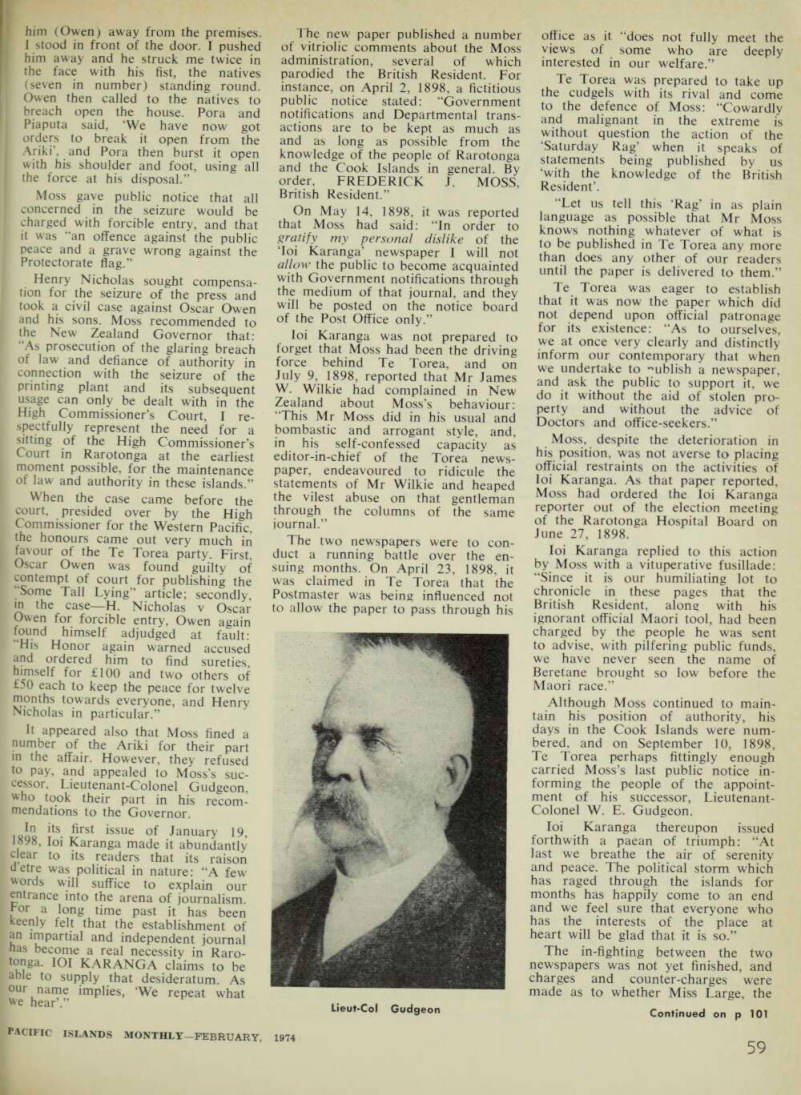
Although Moss continued to main tain his position of authority, his days in the Cook Islands were num bered. and on September 10, 1898, Te Torea perhaps fittingly enough carried Moss’s last public notice in forming the people of the appoint ment of his successor, Lieutenant- Colonel W. E. Gudgeon. loi Karanga thereupon issued forthwith a paean of triumph: “At last we breathe the air of serenity and peace. The political storm which has raged through the islands for months has happily come to an end and we feel sure that everyone who has the interests of the place at heart will be glad that it is so.”
The in-fighting between the two newspapers was not yet finished, and charges and counter-charges were made as to whether Miss Large, the
Continued on p 101
Lieut-Col Gudgeon
teacher at the London Mission Society school at Tereora, had called for three cheers to mark the dis missal of Frederick J. Moss on the arrival of a party of tourists from New Zealand. The outcome was that H. Ellis, who was now conducting the business of Te Torea, sued Oscar Owen of loi Karanga for libel. loi Karanga stated; “To attack defenceless and unprotected females seems to be a disease with some people, and we are sorry to find that Rarotonga possesses an individual afflicted with this despicable com plaint. We are led to make these remarks by having our attention called to a statement published in A
Scurrilous And Ownerless
Rag.”
In its editorial on October 3, 1898, loi Karanga reported that the libel case—Ellis versus Owen—had been heard before Mr H. Hunter, the Judicial Commissioner, who found in favour of Ellis. It seems that the Te Torea party, although limited by physical resources, had not com pletely conceded the game, and that they had trapped Owen by means of journalistic skullduggery. loi Karanga claimed that Mr Hunter had been misled by the fact that Te Torea had dated an issue for July 20 but did not in fact publish it until July 23. loi Karanga complained: “Mr Hunter, in commenting on the case, used these words, ‘What was the use of our remarks, when an apology had already appeared?’, being led astray by the date of plaintiff’s paper and the falsehood told him by the plaintiff, that the statement and apology had both been published before the remarks appeared.”
Ellis’s triumph appears to have been short-lived as he was sentenced to 14 days imprisonment on March 3, 1899 for contempt of court, and he became the first occupant of the gaol which was then proclaimed on Raro tonga.
The precise ownership of loi Karanga remained a mystery, and Charles Banks wrote to Moss from Rarotonga in May 1899 that the elder Owen had left Rarotonga, and although the paper was run by “young Owen and Large”, it was not published who the proprietors were, and “Stephen Savage says he has £6 per month and that the Govern ment owns the paper.” loi Karanga did not long survive its rival. From April 29, 1899, it was stated that Stephen Savage was manager, and the paper ceased pub lication on August 25, 1900.
Official notices were thereafter published in the Cook Islands Gazette, and Savage, among other official duties, assumed that of Government Printer. Other than the church newspapers and magazines, there was to be no further serial publication in the Cook Islands until The Akatauira (The Morning Star) appeared in 1936.
That there had been powerful and implicitly official forces responsible for the life of loi Karanga is revealed in a despatch from Gudgeon to the British Resident, in 1901: “In order to economise, I have discontinued the “loi Karanga” newspaper and taken Mr Savage, the printer, as my secretary.”