benefits from its
p. 45 · Read in the full issue
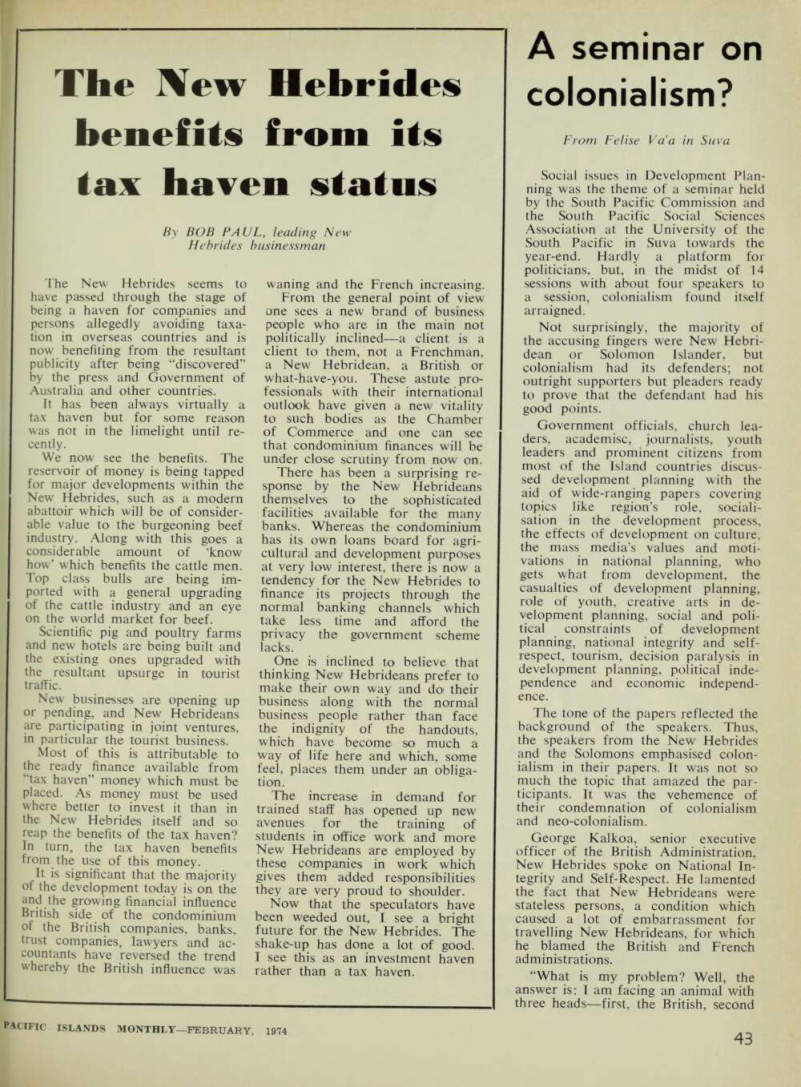
The New Hebrides benefits from its tax haven status
By BOB PAUL, leading New Hebrides businessman
The New Hebrides seems to have passed through the stage of being a haven for companies and persons allegedly avoiding taxa tion in overseas countries and is now benefiting from the resultant publicity after being “discovered’’ by the press and Government of Australia and other countries.
It has been always virtually a tax haven but for some reason was not in the limelight until re cently.
We now see the benefits. The reservoir of money is being tapped for major developments within the New Hebrides, such as a modem abattoir which will be of consider able value to the burgeoning beef industry. Along with this goes a considerable amount of ‘know how’ which benefits the cattle men.
Top class bulls are being im ported with a general upgrading of the cattle industry and an eye on the world market for beef.
Scientific pig and poultry farms and new hotels are being built and the existing ones upgraded with the resultant upsurge in tourist traffic.
New businesses are opening up or pending, and New Hebrideans are participating in joint ventures, in particular the tourist business.
Most of this is attributable to the ready finance available from “tax haven” money which must be placed. As money must be used where better to invest it than in the New Hebrides itself and so reap the benefits of the tax haven?
In turn, the tax haven benefits from the use of this money.
It is significant that the majority of the development today is on the and the growing financial influence British side of the condominium of the British companies, banks, trust companies, lawyers and ac countants have reversed the trend whereby the British influence was
waning and the French increasing.
From the general point of view one sees a new brand of business people who are in the main not politically inclined—a client is a client to them, not a Frenchman, a New Hebridean, a British or what-have-you. These astute pro fessionals with their international outlook have given a new vitality to such bodies as the Chamber of Commerce and one can see that condominium finances will be under close scrutiny from now on.
There has been a surprising re sponse by the New Hebrideans themselves to the sophisticated facilities available for the many banks. Whereas the condominium has its own loans board for agri cultural and development purposes at very low interest, there is now a tendency for the New Hebrides to finance its projects through the normal banking channels which take less time and afford the privacy the government scheme lacks.
One is inclined to believe that thinking New Hebrideans prefer to make their own way and do their business along with the normal business people rather than face the indignity of the handouts, which have become so much a way of life here and which, some feel, places them under an obliga tion.
The increase in demand for trained staff has opened up new avenues for the training of students in office work and more New Hebrideans are employed by these companies in work which gives them added responsibilities they are very proud to shoulder.
Now that the speculators have been weeded out, I see a bright future for the New Hebrides. The shake-up has done a lot of good.
I see this as an investment haven rather than a tax haven.