Samoan Fono Fight
pp. 41-43 · Read in the full issue

Experience Wins In
From FELISE VA’A in Apia
The budget debate in Western Samoa’s Parliament just before Christmas was one of the fiercest since independence in 1962. It was so important that the Leader of the invisible “Opposition” party in the House, Tupuola Efi, had to postpone his trip to open the Fiji seminar on Social Issues in Development Plan ning.
Under fire were the Mataafa gov ernment’s economic policies, and the man responsible for most of them, Minister of Finance Sam Saili, who has adopted a very conservative economic approach.
The government’s basic strategy was to create a favourable balance of payments. There had been a bal ance of payments deficit of about $1.6 million in 1972. The Mataafa government has decided that this trend must be stopped now. Its whole economic policies are, therefore, geared around this objective.
On the other hand, the opposition maintains that creating a balance causes unnecessary hardships to the nation. Even if there was a deficit, the opposition argued, Western Samoa would not be in any danger as there were reserves to fall back on and loans could be got from the Inter national Monetary Fund to help off set deficits. It wanted the purse strings loosened to maintain the present stan dard of living and to develop the country. It did not believe in creating a balance of payments for its own sake while people were out of jobs.
Tupuola Efi introduced a motion of no confidence in the government a motion believed to be the first of its kind in Western Samoa’s post
independence history.
The motion read: “Because of the
gross mismanagement of the country by this present government, resulting in the very high cost of living, inade quate wages and rising unemployment causing great hardship to the people, this Legislative Assembly has no confidence in the Prime Minister and the Cabinet of Ministers of the Government of Western Samoa.”
The motion also asked that the assembly be not dissolved; the ap pointment of Fiame Mataafa FM II be terminated, and that parliament elect a successor.
One by one, many MPs unleashed their fury on the Prime Minister and cabinet members. The atmosphere
became so heated that the speaker, Toleafoa Talitimu, had to call on them to remember the dignity of Samoa. Mataafa argued that customs and traditions should have prior con sideration in any parliamant discuss ions. This however, did not stop the
Opposition attack.
Tupuola said the country was going through a time of suffering and hard ship which only a blind member could not see. He blamed the Minis ter of Finance, saying that the minis ter had cut down drastically on import allocations, forcing up prices in the stores because of the high demand created by scarcity of goods and indu
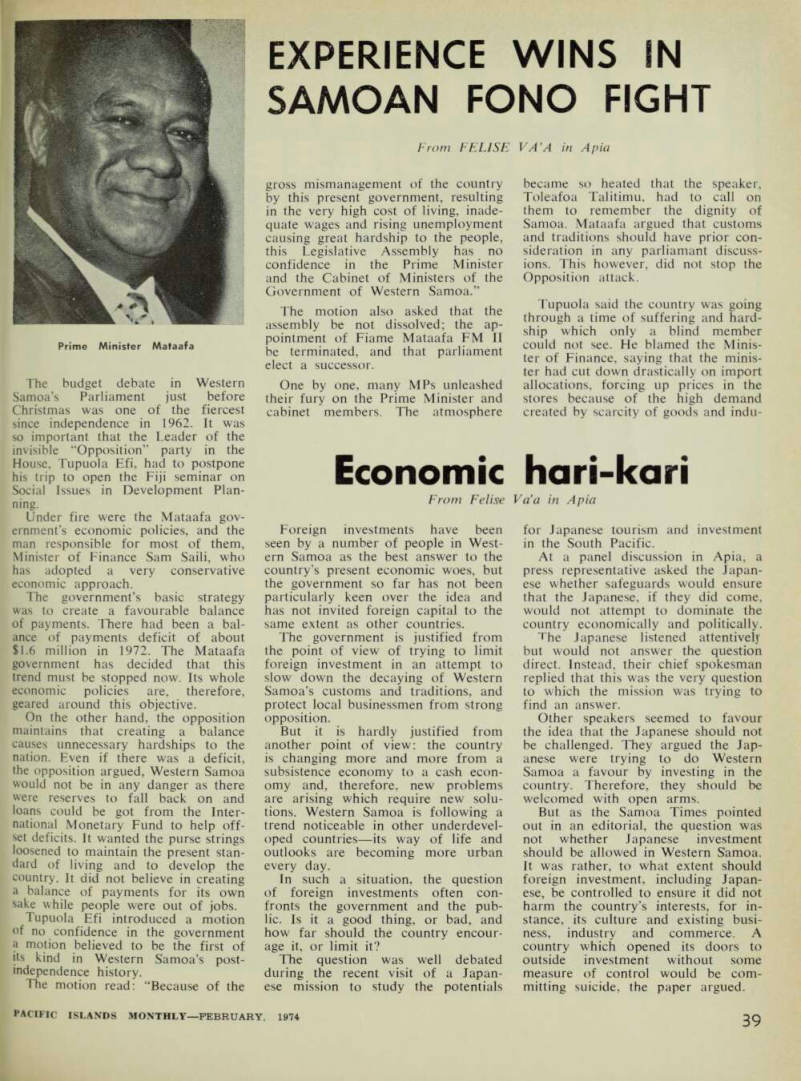
Prime Minister Mataafa
cing some merchants to cut out some essential services.
Tupuola also expressed concern at rising unemployment, directly a re sult of the government’s attempt to save money, he alleged.
“It’s very easy to write your pencil and wipe out jobs. But what consider ation has been given to the father who has lost his job? His wife and children? Without jobs, people will steal, not so much because they be lieve in it but because they simply have to survive,” Tupuola contended.
He lamented the fact that the poorest would pay the dearest.
Forecasting an explosive social situation in 1974, ex-Secretary to Government Lauofo Meti charged that the budget proposals would re sult in the laying-off of teachers, drivers and casual workers in the Public Works Department and fewer school places and hospital beds, while Leota Pita, publisher of the South Seas Star, accused Minister Saili of making money the people’s master rather than their slave. Merely be cause he wanted to protect his reser ves, the minister had become insen sitive to the sufferings of the Samoan people, he said.
With its existence, and the Budget, at stake, the Mataafa government fought back vigorously, the Cabinet ministers taking almost a week to re turn the fire. The attack had been well sustained but so was the defence, especially in the hands of veterans like Prime Minister Mataafa and Minister of Lands Lesatele Rapi.
And the veterans saved the Cabinet from a humiliating defeat. Before the ballot on the Appropriations Bill’s second reading, the Opposition thought they could count on 22 members to defeat it, and allow Tupuola’s ‘no confidence’ motion to be brought in automatically. Unfor tunately for him, however, five Opposition supporters decamped.
Two didn’t turn up, and three voted for the government, giving it a win by nearly 26 votes to 17.
Their hopes dashed, the Opposition attempted a graceful withdrawal and the bill went through without any further serious opposition. Next day, with all its business for 1973 settled, parliament adjourned.
Government’s narrow win should be of grave concern to them, espec ially as Tupuola remarked afterwards that he had not withdrawn his ‘no confidence’ motion. Probably he means to reintroduce it in 1974.
The Opposition’s defeat has left a bitter taste for the leader, Tupuola Eh- He has been accused by his enemies of trying to disturb the
traditional equilibrium in Samoan politics, an equilibrium which gener ally favours the Tama Aiga (or the four highest ranking chiefs). To a Samoan this could be one of the most hurtful criticisms to be made against him and no doubt Tupuola has felt its sting.
On the other hand Tupuola is gen erally recognised as the Opposition leader and he feels his duty is to criticise the government within a parliamentary framework.
Tupuola himself has dared to chal lenge the Tama Aiga.
“A person should not be made a prime minister simply because he is a Tama Aiga. The criterion should
really be, does he have the ability to lead the nation?” is his argument.
After the fight, Tupuola, in a speech at the seminar at Suva (p 43) explaining his non-appearance at the opening, said the attempt to over throw their government “would have come off if the Speaker had allowed a call for division. The Speaker’s ruling was hard to fault—a division is permissible only after a debate; there cannot be a debate on the first reading. A voice vote is a voice vote whereas a division is a debate. Hence, the intended defeat of the Budget and the motion of ‘no confidence’ that was to follow were thwarted. Here is a classic case of tyranny of freedom.”