Copper Town's Golden Days Ahead
pp. 21-23 · Read in the full issue

From a Bougainville correspondent
Arawa, Bougainville’s copper town, which isn’t officially a town until June when its first Town Council will be elected, is catching up with its instant population of 5,000, climbing out of the mud and taking shape as the leading population centre of the island.
Its first big function is due in February—the visit of the Queen, Prince Philip and the “newly-weds”.
Financed by a 60 per cent govern ment and 40 per cent Bougainville Copper grant, Arawa sits on the coast between Kieta and the ‘com pany’ town of Panguna. Most govern ment offices have moved from Kieta into Arawa which is now the centre of administration and services. It can boast a 250 bed hospital, a high school, technical college, district police headquarters and the finest department store in PNG.
Initially, the dispatch with which Bechtel Western Knapp Engineering, m two years, supervised the con struction of the open cut mine’s in frastructure at the huge porphry ore body on the precipitous Crown Prince Range, two residential towns, a port and power house plus an incredible 16 miles of port-mine access highway, failed to impress Arawa’s first resi dents. They often struggled in a sea
of mud, in a climate with 200 inches of rainfall a year.
The mine, an around the clock operation, pays its workers well. The population is a changing one but there seems little anxiety in Bougain ville Copper over lack of manpower other than the current demand for Australian tradesmen.
Some wives from Papua New Guinea, Australia, New Zealand, England and every part of the world in this homogenous community suffer the malaise of many suburban house wives. Families are young and keep the maternity ward busy. The women miss mum and their relatives, the city shops, public transport. Already women from areas in PNG are build ing up migrant clans of family and kin. Or else Papuan husbands must fork out for that trip to Port Mores by for a son’s first haircut and other traditional celebrations. An Australian husband shouts his wife an extra trip ‘south’ above the annual leave to see grandpa, if he can manage it after buying her a car.
With modern attributes such as water and sewerage to every house, commercial garbage collections and electricity, it is an expensive place for the low-wage public servant. The fruit and vegetable market demon
strates how well the Bougainvilleans geared themselves to meet the needs of the early 11,000-man construction workforce.
Baskets are stuffed with excellent produce but the prices aid the cost squeeze. The townspeople’s answer is to cultivate every patch of spare ground for planting kau kau, corn and beans. Roosters and hens peck around backyards and Sunday fishing on the beach is a popular pastime.
Housing is allotted in the town by job status with no racial barriers.
Changing attitudes are apparent with early resentment by expatriate public servants of their better endowed ‘company’ neighbours lessening. This may be due to the former’s dim inishing numbers in PNG’s localisation programme.
That old bugbear of many single men and few single females has pro duced the tiresome curse of prowlers and several cases of sexual moles tation which disturbed many people.
Bougainville Island has attracted many thousands of job seekers. In particular the Highlander, faced with recent famine and a scarcity of paid jobs at home, arrives on the island with no change from his one-way boat ticket or air fare. He wanders past job sites which display no gat
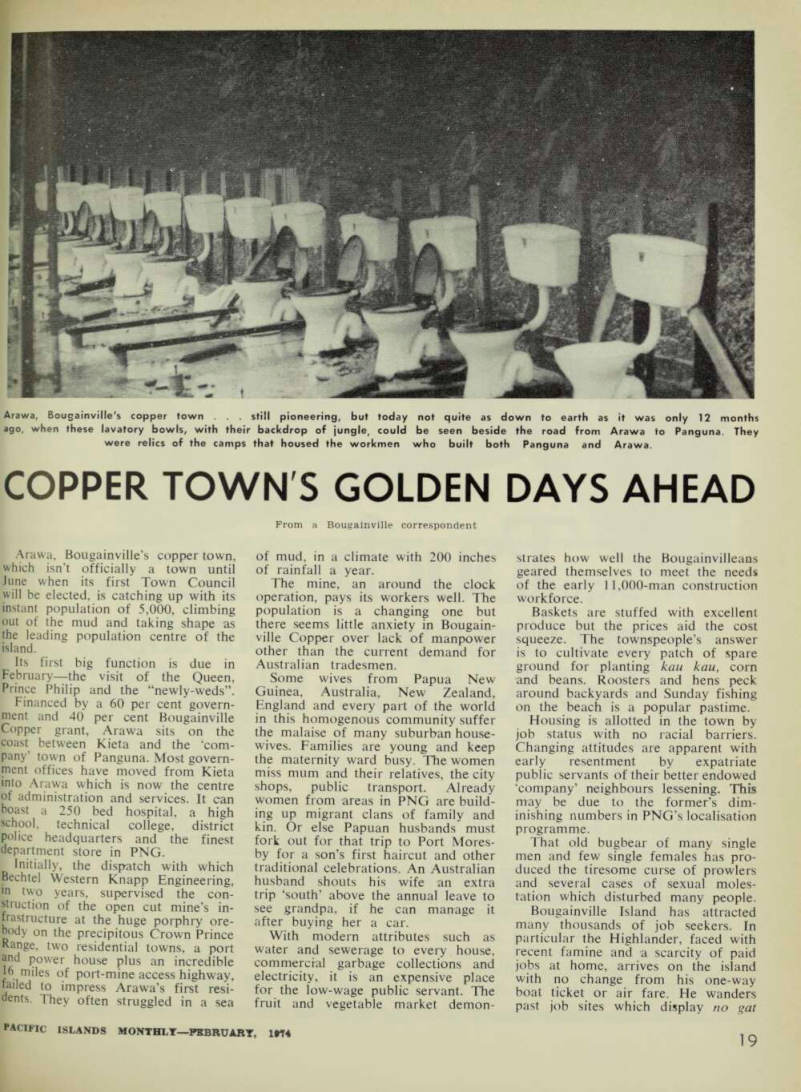
Arawa, Bougainville's copper town . still pioneering, but today not quite as down to earth as it was only 12 months ago, when these lavatory bowls, with their backdrop of jungle, could be seen beside the road from Arawa to Panguna. They were relics of the camps that housed the workmen who built both Panguna and Arawa.
Racial prejudices
wok signs. The unskilled construction boom is over.
The lucky ones find gardening, domestic or short-term labour with a contractor. The others rely on the generosity of friends for a while but end up stealing food from gardens or houses, sleeping in the bush and lopping the plentiful coconuts to survive. Many end up in court on vagrancy charges. Neither can they assert their manhood as the local women prefer their own men, pros titution is not common and, again, clients need cash.
Racial prejudices are voiced in letters to the editor of the Arawa Bulletin criticising police methods.
An emotional call came from the Bougainville Special Political Plan ning Committee for a system of work passes, police roundups, restricted travel by shipping and airline com panies and better accommodation for government workers.
The black men of Bougainville, resenting the changes in their once orderly society, blame the Highland ers’ violent habits, and demand the repatriation of all those they term redskins, for their lighter skin colour.
Before the 1960s the crime rate on the island was low and police still
describe it as low in comparison with other urban areas.
Dr John Guise, PNG’s Minister for the Interior, has introduced legis lation to repatriate Port Moresby’s unemployed law breakers. Anew district assembly on Bougainville may well follow suit. Local men are given preference at the mine and there is a growing desire among the villagers to work for a cash wage.
Arawa today can look forward to increased community facilities. Sports fields, an indoor basketball court, squash courts and a community hall are now in use. A fully-elected Town Council, made up of seven wards, soon will be pushing hard for rapid development and more help from the government. This could be the reason that council elections were postponed by the politicians until June 1974.
This lush beautiful island has orchids of world fame, giant butter flies of sapphire blue and brown velvet. The towering volcanoes tes tify to the rich yields of cocoa and copra and the copper bonanza. Fish teem among the coral reefs. Its first inhabitants are gaining in self-express ion of their desires.
The newcomer who likes the flavour of small town life in an unusual set ting, plus the amenities, minus the clamour of the cities, would be happy in the new town of Arawa, Bougain ville, PNG.