Tropicalities
pp. 13-17 · Read in the full issue
Sir Albert
has a flutter
Christmas Eve brought more than Father Christmas and his presents to the Cook Islands. It also brought legal betting on sports in the shape of the Totalisator through which the islanders can have their flutter on horses in the Cooks, in New Zealand and presumably, in other countries like Australia.
Parliament passed the necessary legislation on December 21 and the tote opened for its first performance on Christmas Eve. Some of the pun ters queued for half an hour before the windows opened. The doubtful honour of being the first to put his money on was Premier Albert Henry (now Sir Albert) who thus gave it his official blessing. First bets were on the Queen Elizabeth II Handicap run at Auckland on Christmas Day with a commentary broadcast in the Cooks. There were no reports that Sir Albert was on a winner. In the first 10 minutes of business more than $lOO was wagered.
The Totalisator Board, which has Dr Joseph Williams as its chairman, must have been pleased with the first
day’s operations which yielded $633.50 of which the board gets 20 per cent and the successful gamblers shared $5OO. The Cook Islands News, which is now devoting much space to the race cards and results, repor ted that investments on the Cooks tote gave a much higher return than those in New Zealand, particularly for the third horse, Not Again, which paid $21.40 for a dollar compared with a dividend of $4.95 in Auck land.
According to the Minister of Soc ial Services Mr T. A. Henry, all sur plus money made by the tote after paying the winners, who get 80 per cent of the gross takings, with five per cent going for tax and 15 per cent for expenses, will be paid into a fund to provide grants for local sports clubs and other organ isations. There may be something left after expenses are paid because all the tote workers are giving their services without charge.
There was a national raffle held at Raratonga on Christmas Eve also with a profit target of $2,500 to go to the Cook Islands Sports Associat ion.
How about a football pool?
Drums roll
for Eddie Lund
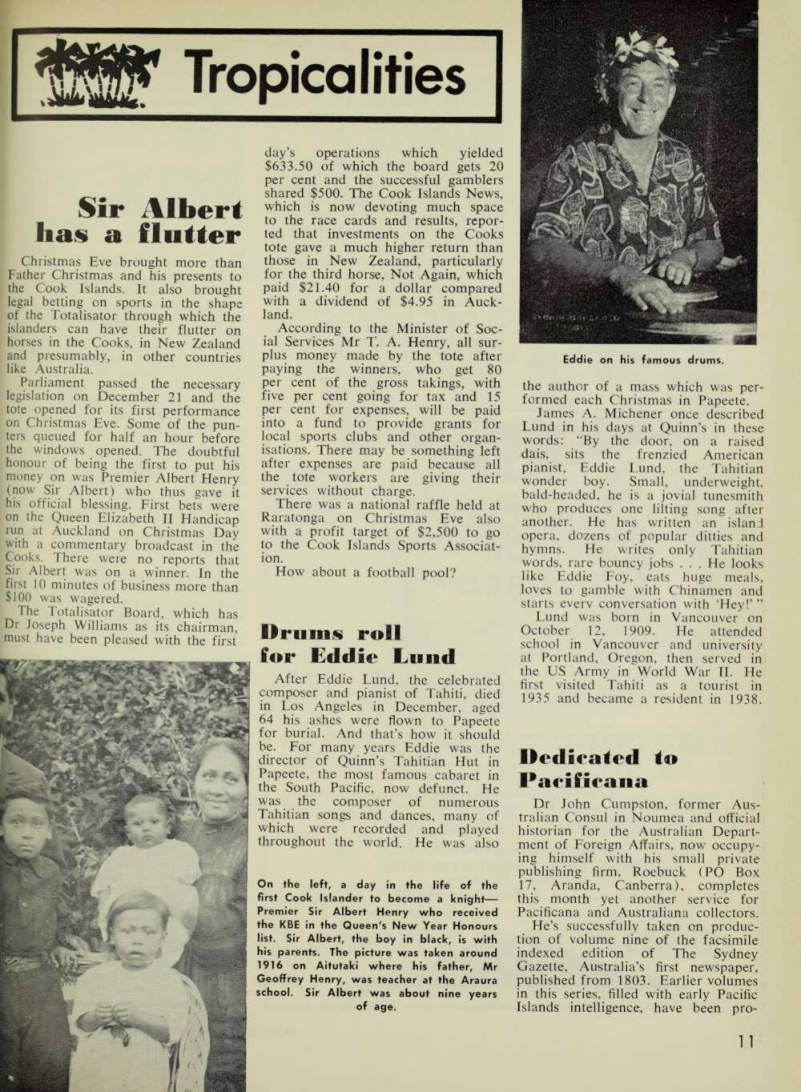
After Eddie Lund, the celebrated composer and pianist of Tahiti, died in Los Angeles in December, aged 64 his ashes were flown to Papeete for burial. And that’s how it should be. For many years Eddie was the director of Quinn’s Tahitian Hut in Papeete, the most famous cabaret in the South Pacific, now defunct. He was the composer of numerous Tahitian songs and dances, many of which were recorded and played throughout the world. He was also
the author of a mass which was per formed each Christmas in Papeete, James A. Michener once described Lund in his days at Quinn’s in these words: “By the door, on a raised dais, sits the frenzied American pianist, Eddie Lund, the Tahitian wonder boy. Small, underweight, bald-headed, he is a jovial tunesmith who produces one lilting song after another. He has written an island opera, dozens of popular ditties and hymns. He writes only Tahitian words, rare bouncy jobs ... He looks like Eddie Foy, eats huge meals, loves to gamble with Chinamen and starts everv conversation with ‘Hey!’”
Lund was born in Vancouver on October 12, 1909. He attended school in Vancouver and university at Portland, Oregon, then served in the US Army in World War 11. He first visited Tahiti as a tourist in 1935 and became a resident in 1938.
Ilc'dirated to
Paeifieana
Dr John Cumpston, former Aus tralian Consul in Noumea and official historian for the Australian Depart ment of Foreign Affairs, now occupy ing himself with his small private publishing firm, Roebuck (PO Box 17, Aranda, Canberra), completes this month yet another service for Paeifieana and Australiana collectors.
He’s successfully taken on produc tion of volume nine of the facsimile indexed edition of The Sydney Gazette, Australia’s first newspaper, published from 1803. Earlier volumes in this series, filled with early Pacific Islands intelligence, have been pro
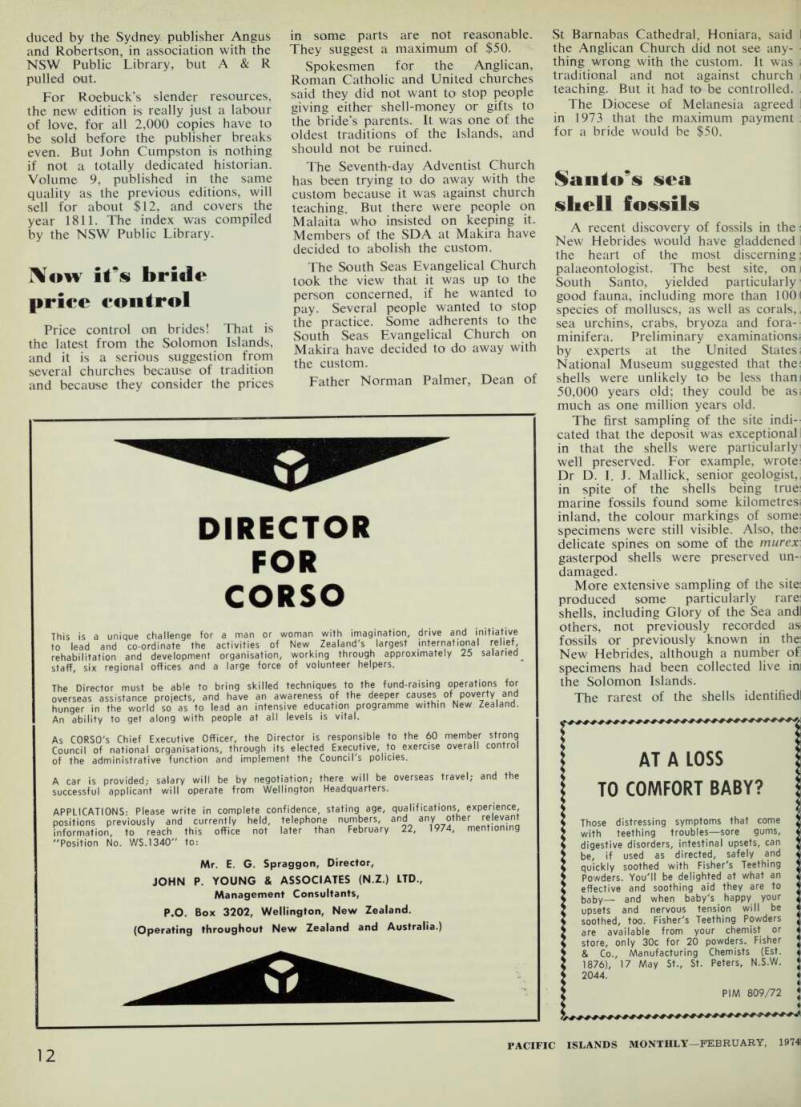
On the left, a day in the life of the first Cook Islander to become a knight— Premier Sir Albert Henry who received the KBE in the Queen's New Year Honours list. Sir Albert, the boy in black, is with his parents. The picture was taken around 1916 on Aitutaki where his father, Mr Geoffrey Henry, was teacher at the Araura school. Sir Albert was about nine years of age.
Eddie on his famous drums.
duced by the Sydney publisher Angus and Robertson, in association with the NSW Public Library, but A & R pulled out.
For Roebuck’s slender resources, the new edition is really just a labour of love, for all 2,000 copies have to be sold before the publisher breaks even. But John Cumpston is nothing if not a totally dedicated historian.
Volume 9, published in the same quality as the previous editions, will sell for about $l2, and covers the year 1811. The index was compiled by the NSW Public Library.
Now it’s bride
price control
Price control on brides! That is the latest from the Solomon Islands, and it is a serious suggestion from several churches because of tradition and because they consider the prices
in some parts are not reasonable.
They suggest a maximum of $5O.
Spokesmen for the Anglican, Roman Catholic and United churches said they did not want to stop people giving either shell-money or gifts to the bride’s parents. It was one of the oldest traditions of the Islands, and should not be ruined.
The Seventh-day Adventist Church has been trying to do away with the custom because it was against church teaching. But there were people on Malaita who insisted on keeping it.
Members of the SDA at Makira have decided to abolish the custom.
The South Seas Evangelical Church took the view that it was up to the person concerned, if he wanted to pay. Several people wanted to stop the practice. Some adherents to the South Seas Evangelical Church on Makira have decided to do away with the custom.
Father Norman Palmer, Dean of
St Barnabas Cathedral, Honiara, said I the Anglican Church did not see any- • thing wrong with the custom. It was < traditional and not against church i teaching. But it had to be controlled. .
The Diocese of Melanesia agreed 1 in 1973 that the maximum payment ; for a bride would be $5O.
Santo’s sea
shell fossils
A recent discovery of fossils in the; New Hebrides would have gladdened J the heart of the most discerning; palaeontologist. The best site, onj South Santo, yielded particularly 1 good fauna, including more than 100( species of molluscs, as well as corals,, sea urchins, crabs, bryoza and fora-minifera. Preliminary examinations* by experts at the United States j National Museum suggested that the; shells were unlikely to be less thani 50,000 years old; they could be as; much as one million years old.
The first sampling of the site indi cated that the deposit was exceptional] in that the shells were particularly 1 well preserved. For example, wrote; Dr D. I. J. Mallick, senior geologist,, in spite of the shells being true: marine fossils found some kilometres* inland, the colour markings of some: specimens were still visible. Also, the: delicate spines on some of the murex\ gasterpod shells were preserved un damaged.
More extensive sampling of the site: produced some particularly rare; shells, including Glory of the Sea andl others, not previously recorded as fossils or previously known in the; New Hebrides, although a number of: specimens had been collected live ini the Solomon Islands.
The rarest of the shells identified!
was the cypraea porteri, previously known only from one solitary speci men taken live in the Philippines.
Other rare species include conus sowerbii and conus kimioi, which were usually collected only by dredg ing. This suggested that the deposits containing the South Santo fossils probably accumulated in fairly deep water.
The fossils were discovered during a mapping operation by the Geo logical Survey Department of the British National Service.
Spreading the
Word by raeht
An Auckland couple, Mr and Mrs Ron Russell, returned in December to their home after completing an 18months’ cruise around the South Pacific Islands in their yacht Day spring. But, they weren’t the ordinary yachtee type. TTiey went as mission aries, believing, they told the Auck land Star, that God wants them to evangelise among the Islanders, In their more than 5,000-mile travels they visited islands in Fiji and the GEIC. They also acted as agents for the Bible Society and distributed Bibles wherever they went.
So far, they say, they have only skimmed the surface and expect to leave in April for three years’ work among the Islands.
Mr Russell’s comment about the Islanders’ faith should raise a few missionary eyebrows—“ The people in the islands we have visited have a good idea of Christianity”.
Election day
on Pitcairn
Presumably taking advantage of an abundance of peace and goodwill, the Pitcairn Islanders have traditionally held their elections on Christmas Day. This year there was total unanimity—and with it history was made, women for the first time taking their place on the Island Council.
In his regular radio chat with the Seventh-day Adventist centre in Cali fornia, Tom Christian reported that two women—Thelma Brown and Carol Christian—had been elected unopposed to Pitcairn’s chief adminis trative body. At the same time Ivan Christian was elected unopposed as chairman of the council.
The simplicity of election pro cedure in Pitcairn, just as simply summed up by Tom Christian, is worth noting: “Our laws say that if
a person is nominated and seconded by the public, and there are no opposing names for the post, then there is no need for balloting.”
While democratically - speaking it rules out the reasonable possibility of a single nominee being rejected by a majority, the system has much to commend it in terms of moneysaving: no balloting, no registrations, no scrutineers.
Christmas 1973 on Pitcairn seemed as good a time as any for a holiday.
With fuel supplies at a low ebb, many of the items of “modern living” on Pitcairn were not working. So, after celebrating Christmas Eve with carols by doodwi nut torches (good light but a bit smoky) and Christmas Day
with a “non-election election”, half the islanders set off for a week’s holiday on Oeno Island, 75 miles to the north-west. (The other islands in the Pitcairn group are Henderson and Dude—uninhabited like Oeno.) The trip was made in the 36-foot long boats.
On the fuel front, it was back to modern living early in January when supplies turned up. Arrangements have been made to secure supplies indefinitely. The Pitcairners had a kind of census last September and later the island’s Miscellany published the names of all the Pitcairners, ages and all, which wasn't difficult. There were only 71 of them plus seven
“foreigners” who weren’t named.
The 71 shared five family names— Christian, Brown, Clark, Warren and Young.
New Year
equality wish
One form of New Year wish ex pressed in Noumea was that expatriate public servants from France should share more “liberte, egalite et fra temite” with their Caledonian col leagues.
The metropolitan French public servants enjoy various privileges, in cluding an “away from home allow ance” for service in New Caledonia.
This allowance amounts to 14 months extra salary, about SAB,OOO for the lower ranks, which is repeated for each term of about four years’ service.
After a heated protest made in the Territorial Assembly, the majority urged that this allowance be reduced to a minimum of three months extra salary, payable only on the first term in the territory. Needless to say, the Caledonian Assembly could only “express a wish”, which like many a New Year resolution, has no power to see it carried out.
Hunger knows
no borders
When the Cook Islands Minister of Supportive Services, Mr I. Akar uru, visited Penrhyn Island recently he saw three Japanese and Korean fishing vessels outside the reef near Omoka village and a fourth one anchored outside the reef near Tautua village, eight miles away across the lagoon.
Foreign vessels are not supposed to call at the outer Cooks except in an emergency as there is a big risk of insect pests, plant diseases and human epidemics being introduced from the visiting ships. The intro duction of the rhinoceros beetle to the northern Cooks is especially dreaded as, apart from a little pearl shell, copra is their only export. The tuna boats are based at Pago Pago, American Samoa which has the beetle.
Mr Akaruru found that the Resi dent Agent at Penrhyn had tried to discourage the fishing boats from staying, but had received no support from the islanders because Penrhyn had run out of rice, flour, sugar and tobacco, and the Penrhyn people were visiting the fishing vessels to try to obtain supplies.
The islanders were in no danger
of starving as there are ample supplies of coconuts and lagoon fish, but even atoll dwellers have become accus tomed to a little more variety in their diet. Had they been approaching starvation level, the Resident Agent would have radioed the Premier’s De partment and the government would have chartered one of the two local traders to take food supplies there, a chore which would have cost the Cook Islands taxpayers $4OO a day for a seven or eight-day voyage, plus the cost of emergency food supplies.
Calls at the northern Cooks by the two local traders, Manuvai and Moana are infrequent due to the poor cargoes offering. Very little copra is made when world prices are low. However, due to recent improvements in copra prices, copra cargoes have been wait ing to be uplifted.
First French win
in Guam Games
The French won their point over the date of the 1975 Guam Games, arguing that the choice of July 5-17 was catastrophique because it was in the school term and most of their athletes were high school students who could hardly mix swotting with training. The dates have now been changed to August 9-22.