Independence aim is this year!
pp. 7-8 · Read in the full issue
Pacific Islands Monthly
From correspondents in Port Moresby and Canberra.
With self-government under their belt since December 1, Papua New Guinea leaders are now working to wards independence in September.
There has been no announcement, and there is not likely to be any for some months.
Chief Minister Michael Somare and his cabinet are anxious to avoid possible confrontation with the political Opposition through announc ing their target date. They plan to wait until the final report by the constitutional planning committee is introduced into the House of As sembly in late February or early March, and debated in special session in April.
By this time, it is reckoned, self government would have satisfied the Opposition that it is unnecessary for them to fear that more haste has created less speed, and they will then have seen the necessity for a clear declaration of independence.
The country is all but independent now. Only defence and foreign rela tions lie outside the government’s control, and legislation to administer the defence force is now being drawn up.
Some other areas have been “re served” for Australia until indepen dence, but these have been chosen by PNG itself for the sake of con venience. They are matters affecting civil aviation, the House of Assembly and electoral policy, the Public Solicitor, the Supreme Court and the administration of other courts.
PNG has already tightened up on its immigration rules, but will soon make PNG more accessible to tourists by requiring only a visa to be stamped in a passport instead of the present irksome system of issuing separate “entry permits”, practised by the Australian administration.
PNG’s own officers took over con trol of the present permit system in Australia from January 14, following the arrival in Canberra of Oala Oala- Rarua as PNG Commissioner in Aus tralia, and Robin Kumaina in Sydney as PNG representative there. With independence, Oala Rarua will be come High Commissioner and Kumaina probably consul-general.
Oala Rarua, a Papuan, formerly Lord Mayor of Port Moresby, is occupying a leased house in Brassey Street, Deakin, an attractive Canberra suburb, with his wife, Paruru, and their children Loa, 14, Ruth, 12, Ovia, 10, Konio, 8, and Oala Jr, 3.
The PNG office is close by in a house in fashionable Red Hill, at 24 Beagle Street, opposite that of the Spanish Embassy and close to those ed the British and Fiji High Commissio r ns - , , In the PNG Commissioners office, with its distinctive bird-of-paradise emblem outside, the Commissioner is assisted by first-secretary Anton Farapo, from Kerema, secondsecretary Dominic Duya, from the Southern Highlands, and administrative assistant Toro Aihi.
Also in Canberra, and available for help if needed, is a staff of about 40 Australian public servants formerly part of the staff of the Department of External Territories, which ceased to exist in December. These remnants, mostly technical people, now comprise the Papua New Guinea Office, which is a wing of the Australian Department of Foreign Affairs, and directed by the former Minister for Territories, Mr Bill Morrison (now Minister Assisting the Foreign Minister in PNG Matters), with a staff of permanent officers led
by John Greenwell, director, Alan Kerr, assistant-director (government), and Brian Leedham, assistant-director (economics). This office will also probably disappear on independence, but meanwhile is operating in the Derwent House quarters of the de funct Territories Department.
The PNG Office controls the Sydney office, where most of the former departmental staff are operat ing in the same building in Market Street, but PNG is negotiating to lease a 10-storey building in Clarence Street with an option to buy. The building will be called Papua New Guinea House.
Robin Kumaina, assisted in the office by Serege Saiada, is living in the Sydney suburb of Gordon with his wife and family, in a house bought by the PNG Government.
In PNG itself, 1974 opened with a mixed record.
When Self-government Day, Christ mas and the New Year all passed in PNG with hardly an incident— beyond a policeman killed while in vestigating a game of cards on Self government Day—the leaders of the new nation felt pleased. But that was before Friday, January 11.
There was a riot in Port Moresby
(over page)
the night before, not the usual tribal fighting but rioting between the guardians of law and order.
Outside Port Moresby’s Murray Barracks, members of the Defence Force—a figure of 200 was given— pelted police with rocks, bottles and traffic signs after police had arrested some peace disturbers. Soldiers in plain clothes stormed out of the barracks and the fight was on. The police replied with tear gas and eventually quelled the rioters by 3 am on the Friday.
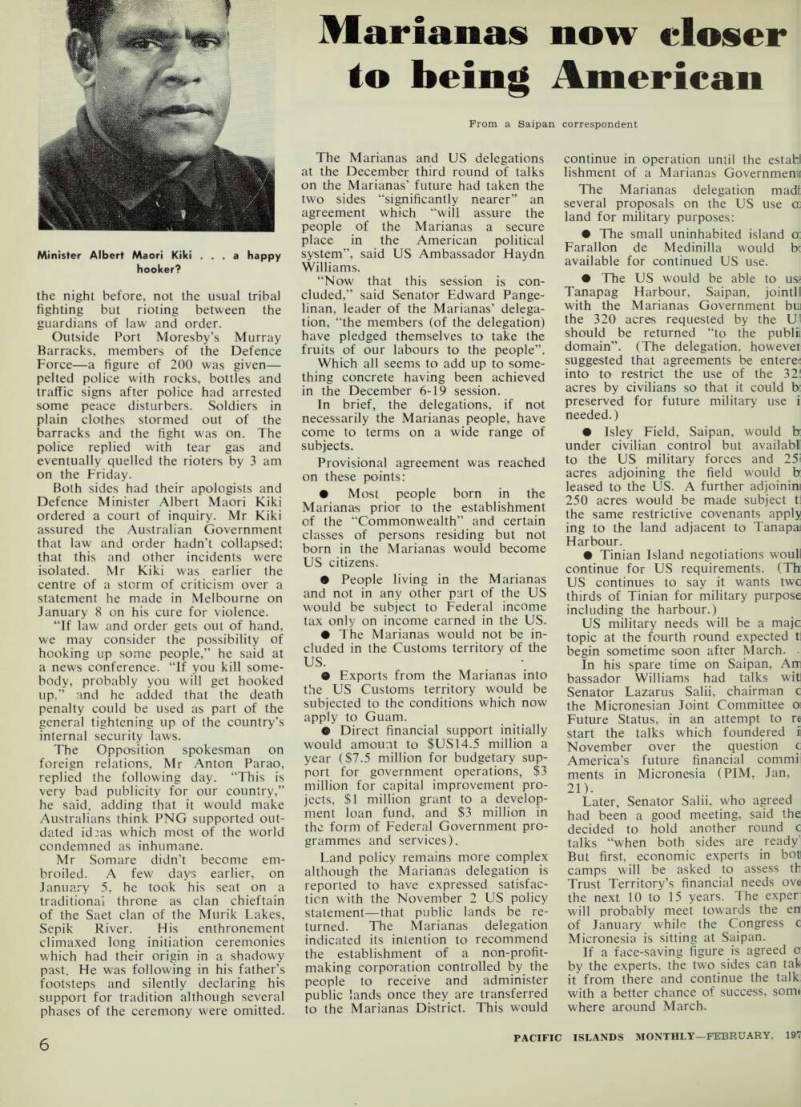
Both sides had their apologists and Defence Minister Albert Maori Kiki ordered a court of inquiry. Mr Kiki assured the Australian Government that law and order hadn’t collapsed; that this and other incidents were isolated. Mr Kiki was earlier the centre of a storm of criticism over a statement he made in Melbourne on January 8 on his cure for violence.
“If law and order gets out of hand, we may consider the possibility of hooking up some people,” he said at a news conference. “If you kill some body, probably you will get hooked up,” and he added that the death penalty could be used as part of the general tightening up of the country’s internal security laws.
The Opposition spokesman on foreign relations, Mr Anton Parao, replied the following day. “This is very bad publicity for our country,” he said, adding that it would make Australians think PNG supported out dated ideas which most of the world condemned as inhumane.
Mr Somare didn’t become em broiled. A few days earlier, on January 5, he took his seat on a traditional throne as clan chieftain of the Saet clan of the Murik Lakes, Sepik River. His enthronement climaxed long initiation ceremonies which had their origin in a shadowy past. He was following in his father’s footsteps and silently declaring his support for tradition although several phases of the ceremony were omitted.
Minister Albert Maori Kiki ... a happy hooker?