Deaths of Islands People
pp. 102-103 · Read in the full issue
Mr Paulus Arek Few public figures who have died have had such an honest and candid epitaph than that applied to Papua New Guinea’s Minister for Informa tion Mr Paulus Arek, who died in Port Moresby General Hospital on November 22 after a long illness.
His own department, in the person of Gail Boyd, wrote it for the PNG Post-Courier and there’s little doubt that Mr Arek would have passed it for publication had he been able.
“It would be hypocritical to de scribe Paulus Arek, who died yester day, in the euphemistic terms the dead usually suffer,” wrote Mrs Boyd.
“A pillar of rectitude he was not, and some of the more lofty virtues attributed to people in high places also eluded him at times. But he could be forgiven much of his indi viduality. The rest could be can celled out by his genuine belief in Papua New Guinea nationalism—
even before it became a populai catchcry—his efforts to get worken a better deal and his pride in hii family.
“Paulus had panache and a splendk sense of theatre. This wat fineb cultivated during the long weeks o< travelling and meetings during thu second House of Assembly’s Selec; Committee on Constitutional De; velopment.
“At times one wondered whethe: the performance wasn’t more impor tant than the fine sentiments ex; pressed. But ‘off-stage’ it was quih obvious that he meant what he said “And in spite of the carefully worded ‘terms of reference’ of th< committee, how he would harangu* the crowds at any suggestion of sepa ratism—often in his distinctive pidgin “The biography that he talket about may never be written, but a chairman of the Select Committe< that recommended the country’ course to self-government, and as th' minister responsible for the establish ment of a national broadcasting com mission, we won’t forget him.
“Twenty-four hours in the day wer not enough for the man—for workin; and living.”
Mr Arek, 44, was born at Wani gela, northern Papua; educated at tfr Anglican mission at Wanigela and a Sogeri Secondary School. He was ; teacher for 17 years, a trade unioi worker and MHA for Ijivitari Opel since 1968 becoming the Minister fo Information in the Somare govern ment in 1972. In the last House o Assembly he was chairman of th Select Committee for Constitutions Development. He leaves a widow ani eight children.
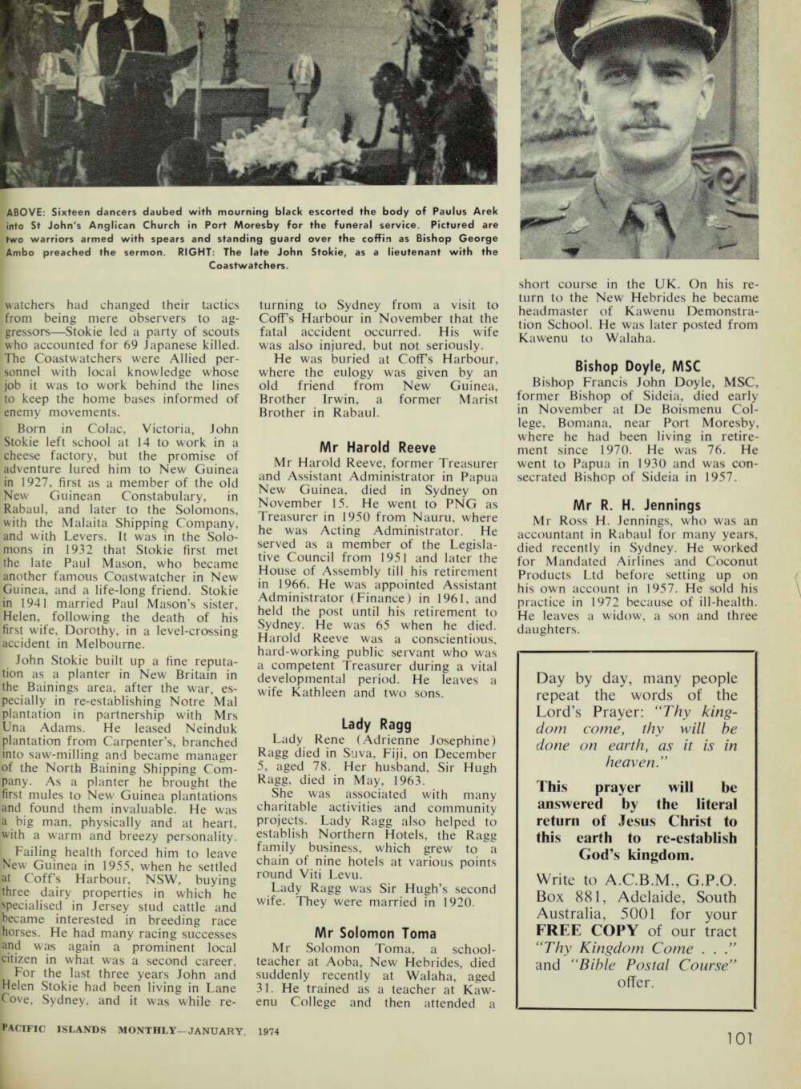
Mr John Stokie Leslie John Stokie, who died i NSW as a result of a motor accider in November, a month before hi 72nd birthday, won the Militar Cross for his wartime exploits wit the Coastwatchers in New Britair He had been in the Islands sine 1927, but when Rabaul fell to th Japanese in January, 1942, he too to the bush and lived undisturbed b the Japanese for the next 15 month; John Stokie, with the rank c lieutenant, officially served in Ne 1 Britain as a Coastwatcher from Sei tember, 1943, to June, 1944, and fc a second period between Septembei October, 1944. In one series c brushes at Open Bay, New Britain, i 1944—at a time when the Coas
watchers had changed their tactics from being mere observers to ag gressors—Stokie led a party of scouts who accounted for 69 Japanese killed.
The Coastwatchers were Allied per sonnel with local knowledge whose job it was to work behind the lines to keep the home bases informed of enemy movements.
Born in Colac, Victoria, John Stokie left school at 14 to work in a cheese factory, but the promise of adventure lured him to New Guinea in 1927, first as a member of the old New Guinean Constabulary, in Rabaul, and later to the Solomons, with the Malaita Shipping Company, and with Levers. It was in the Solo mons in 1932 that Stokie first met the late Paul Mason, who became another famous Coast watcher in New Guinea, and a life-long friend. Stokie in 1941 married Paul Mason’s sister, Helen, following the death of his first wife, Dorothy, in a level-crossing accident in Melbourne.
John Stokie built up a fine reputa tion as a planter in New Britain in the Bainings area, after the war, es pecially in re-establishing Notre Mai plantation in partnership with Mrs Una Adams. He leased Neinduk plantation from Carpenter’s, branched into saw-milling and became manager of the North Baining Shipping Com pany. As a planter he brought the first mules to New Guinea plantations and found them invaluable. He was a big man, physically and at heart, with a warm and breezy personality. ; Failing health forced him to leave New Guinea in 1955, when he settled at Coff’s Harbour, NSW, buying three dairy properties in which he specialised in Jersey stud cattle and became interested in breeding race horses. He had many racing successes and was again a prominent local citizen in what was a second career.
For the last three years John and Helen Stokie had been living in Lane Cove, Sydney, and it was while re
turning to Sydney from a visit to Coff’s Harbour in November that the fatal accident occurred. His wife was also injured, but not seriously.
He was buried at CofFs Harbour, where the eulogy was given by an old friend from New Guinea, Brother Irwin, a former Marist Brother in Rabaul.
Mr Harold Reeve Mr Harold Reeve, former Treasurer and Assistant Administrator in Papua New Guinea, died in Sydney on November 15. He went to PNG as Treasurer in 1950 from Nauru, where he was Acting Administrator. He served as a member of the Legisla tive Council from 1951 and later the House of Assembly till his retirement in 1966. He was appointed Assistant Administrator (Finance) in 1961, and held the post until his retirement to Sydney. He was 65 when he died.
Harold Reeve was a conscientious, hard-working public servant who was a competent Treasurer during a vital developmental period. He leaves a wife Kathleen and two sons.
Lady Ragg
Lady Rene (Adrienne Josephine) Ragg died in Suva, Fiji, on December 5, aged 78. Her husband, Sir Hugh Ragg, died in May, 1963.
She was associated with many charitable activities and community projects. Lady Ragg also helped to establish Northern Hotels, the Ragg family business, which grew to a chain of nine hotels at various points round Viti Levu.
Lady Ragg was Sir Hugh’s second wife. They were married in 1920.
Mr Solomon Toma Mr Solomon Toma, a school teacher at Aoba, New Hebrides, died suddenly recently at Walaha, aged 31. He trained as a teacher at Kaw enu College and then attended a
short course in the UK. On his re turn to the New Hebrides he became headmaster of Kawenu Demonstra tion School. He was later posted from Kawenu to Walaha.
Bishop Doyle, MSC
Bishop Francis John Doyle, MSC, former Bishop of Sideia, died early in November at De Boismenu Col lege, Bomana, near Port Moresby, where he had been living in retire ment since 1970. He was 76, He went to Papua in 1930 and was con secrated Bishop of Sideia in 1957, Mr R. H. Jennings Mr Ross H. Jennings, who was an accountant in Rabaul for many years, died recently in Sydney. He worked for Mandated Airlines and Coconut Products Ltd before setting up on his own account in 1957. He sold his practice in 1972 because of ill-health.
He leaves a widow, a son and three daughters.
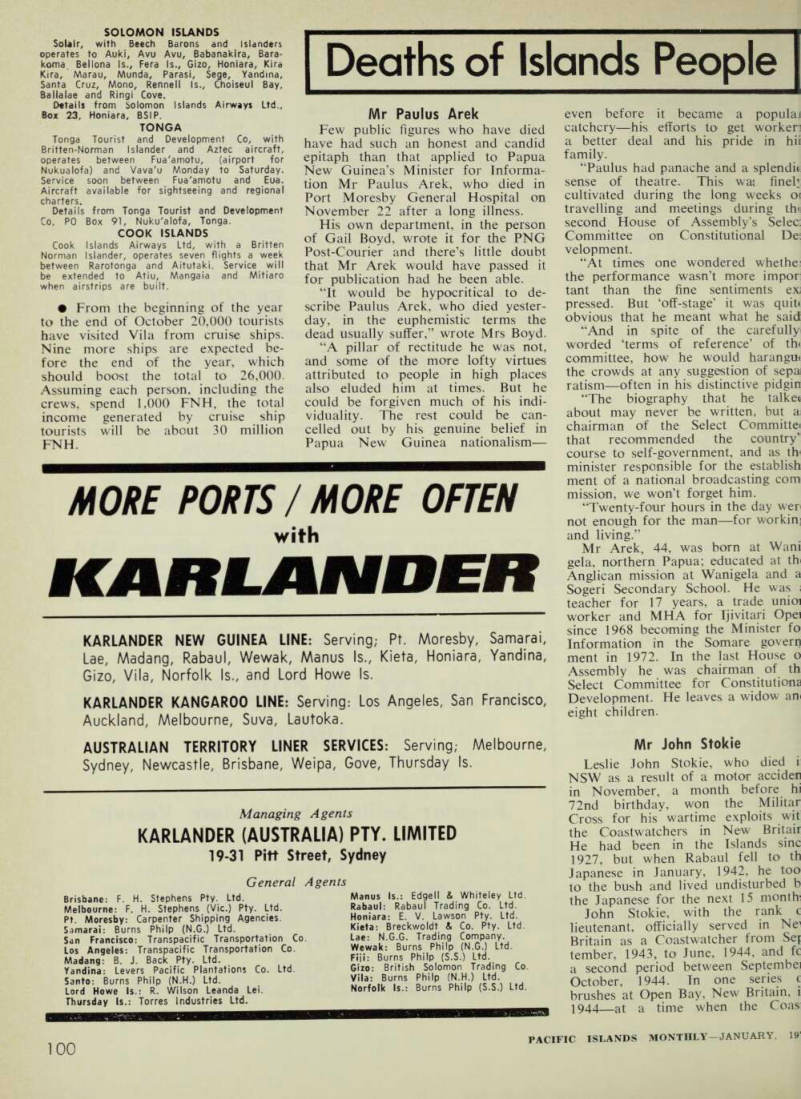
ABOVE: Sixteen dancers daubed with mourning black escorted the body of Paulus Arek into St John's Anglican Church in Port Moresby for the funeral service. Pictured are two warriors armed with spears and standing guard over the coffin as Bishop George Ambo preached the sermon. RIGHT: The late John Stokie, as a lieutenant with the Coastwatchers.