Pacific Transport
p. 77 · Read in the full issue
Mud Flies When Airline Heavies
Fight For Saipan-Japan Route
From a Saipan correspondent
The right to operate a direct air service between Saipan and Japan has developed into a battle, bitter at times, between two powerful heavy weights—Pan American World Air ways and Continental Air Micro nesia. A third applicant for the route, Northwest Orient Airlines is con sidered to have little chance.
In the final public hearing before the US Civil Aeronautics Board, PAA received some solid support from Trans World Airlines, the CAB Bur eau of Operating Rights, the CAB administrative law judge, Mr Milton H. Shapiro, and four congressmen.
But eight congressmen, representing the official position of Congress, spoke strongly in favour of Contin ental Air Micronesia.
There is obviously too much at stake for a clean fight. Continental alleged bribery by PAA, while PAA countered with allegations of pressure by Continental. Both airlines admit ted that “lobbying” had taken place, but they strongly denied anything improper was done.
Continental produced a letter sig ned by four members of the Tinian Municipal Council, saying that the men had supported a recent council resolution favouring PAA because a “representative” of PAA had prom ised them free trips to Singapore and Japan. Later, however, the PAA attorney produced a telegram, signed by the same four members, repu diating the earlier letter, and alleging that a Continental Air Micronesia employee had attempted to mislead them.
While it is unlikely that the charges and counter-charges will af fect the final decision, the chairman of the CAB, Mr Robert D. Timm, said that the board would have to look into them.
Northwest Orient stood on the sidelines during the mud-slinging.
Its mam argument to be allocated the route was similar to that advan ced by PAA in its own cause—it serves Japan at present and has ex perience in the Orient.
Trans World Airlines sent an attoniey to argue briefly in favour of PAA. TWA does not want the route itself, but opposes the entry into Japan of a third US carrier.
Continental attorney, Mr Lee M, Hydeman, argued that the CAB Bureau of Operating Rights and Judge Shapiro failed to give sufficient weight to the economic development of all six districts of Micronesia. Continental also needed the route to ensure
its profitability.
Without access to Japan Continental could not expand its (Trust Territory) service”, he said. “Indeed, it would probably have to reduce its services”.
PAA and Northwest Orient each immediately offered to buy out Continental.
A number of other parties also gave evidence. Air Pacific Inc (not the Fiji-based Air Pacific) asked for a licence restriction to prevent the entry of another carrier on the Saipan-Guam route. The Pacific Islands Development Commission executive
secretary, Mr Andrew Gerakas said the commission had passed a resolu tion asking that the CAB consider the development of all six districts of Micronesia, and the expressed wishes of the Micronesian people.
The commission also urged the CAB to act as quickly as possible.
Mr Kurt Moylan, Lieutenant-Gov ernor of Guam, said that from the point of view of Guam the only carrier to consider seriously was
Paa.
The last stage of the public hear ing was known as “oral argument”.
The CAB will now go over the de tails and come to a decision, or opin ion. This opinion will then be drafted into a proper form for release, a pro cedure which can take from six weeks to two months, according to Mr Timm. Additional time may have to be given to other departments and agencies for comment. Thus, it could be well into 1974 before the case finally goes to President Nixon, who will award the licence—that’s if he is still President!
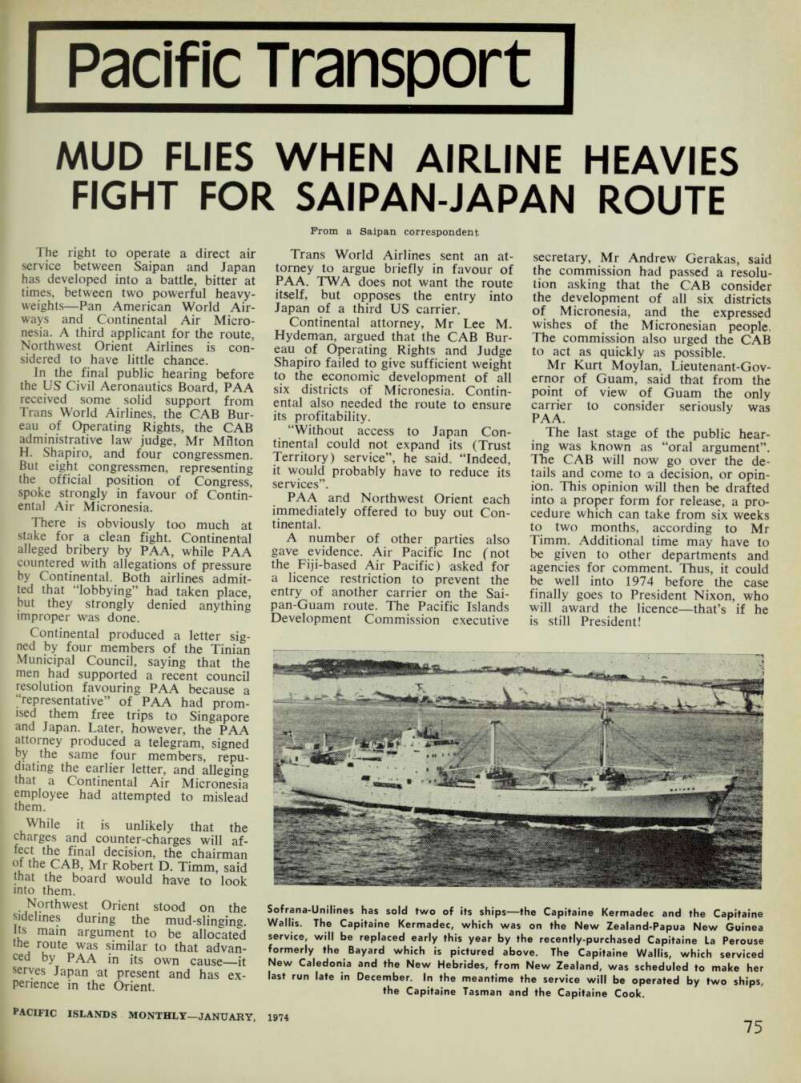
Sofrana-Unilines has sold two of its ships—the Capitaine Kermadec and the Capitaine Wallis. The Capitaine Kermadec, which was on the New Zealand-Papua New Guinea service, will be replaced early this year by the recently-purchased Capitaine La Perouse formerly the Bayard which is pictured above. The Capitaine Wallis, which serviced New Caledonia and the New Hebrides, from New Zealand, was scheduled to make her last run late in December. In the meantime the service will be operated by two ships, the Capitaine Tasman and the Capitaine Cook.