Domesday
pp. 39-41 · Read in the full issue
How PNG's Domesday Book was written
By Dr A. D. Ward
How the Land Commis sion went about its monu mental task, travelling all over Papua New Guinea, visiting all the major village centres of each district and interviewing thousands of people, is told here by Dr Ward, who was Permanent Consultant to the commis sion. He is senior lecturer in history at La Probe University, Melbourne.
Papua New Guinea’s Commission of Inquiry into Land Matters has completed its report and it is now in the hands of the House of Assembly, being tabled there on November 15.
The commission, with Mr Sinaka Goava as its chairman has compiled a report 183 pages long containing 132 recommendations on all major land problems. These include the question of registering customary land, the most appropriate forms of land tenure, the machinery for dispute settlement and problems about urban land and alienated land.
There are chapters on succession, resettlement, valuation, land admini stration, credit for land development, survey and forestry.
The commissioners have been thanked and congratulated for pro ducing their report, on such wide ranging and difficult questions, within five weeks of the date originally requested in the commission’s terms of reference, despite delays in getting the commission established. Depend ing upon the response of the govern ment and House of Assembly to its recommendations, the commission may prove to be a crucial influence on land policy in Papua New Guinea, and consequently upon the economy and society of the country. It is therefore important that thought fulness and thoroughness with which the commission worked should be understood.
The commissioners, chosen from all regions of Papua New Guinea, were Mr Sinaka Goava (chairman), Mr Cletus Harepa (deputy chair man), Mr Edric Eupu, Mr Horatius Igua, Mr Pokwari Kale, Mr Ignatius Kilage, Mr Posa Kilori, Mr John
Kup, Mr Boana Rossie, Mr Donigi Samiel and Mr Philip Tobongolua.
Mr. Bill Welbourne of the Depart ment of Lands was secretary. Support staff included Mr Nick O’Neill from the Law Reform section of Crown Law as legal counsel, and Dr Alan Ward, Senior Lecturer in Pacific History, La Trobe University, as permanent consultant. Professor Ron Crocombe, of the University of the South Pacific, Suva, was visiting consultant for nine weeks in Junc- July and September-October, Profes sor Rudv James, from the University of Dar-Es-Salaam, Tanzania, was visiting consultant for 2i weeks in May-June. Mr Jim Fingleton, from the Public Solicitors’ Office, Port Moresby, worked full-time with the commission as research officer from May.
After assembling in Port Moresby in mid-February the commission spent three weeks studying its terms
of reference and from mid-March to the end of August was almost con tinuously on tour of the country.
Meetings were held in major village centres of every district (indeed of every sub-district but three) as well as in the towns.
Publicity, by pamphlet and radio, in English, Pidgin and Motu, preceded the tour. This was assisted, where possible, by a prior visit from one of the commissioners. There was considerable variation in the effect of this pre-publicity. It was most effective where a local leader or government official had assisted the people of the area to study the com mission’s terms of reference and the discussion papers and questionnaires that had been distributed.
Without this extra step the pre paration and distribution of ex pensive publicity material was largely wasted. Officers of the Government Liaison Branch were to have held pre-discussions in the Highlands District, but in some cases proved to have done very little.
However, even when the com mission’s purposes were not under stood beforehand, villagers were generally quick to grasp the chair man’s explanations of its basic pur poses and to offer forthright opinions.
The thoughtfulness and constructive ness of the comments of many vil lage leaders, with little formal schooling or experience outside their district, was in fact a feature of the tour. Their submissions compared very favourably with the rhetoric and sloganising of some politicians or erstwhile politicians, and the downright superficiality of many submissions from the tertiary institu
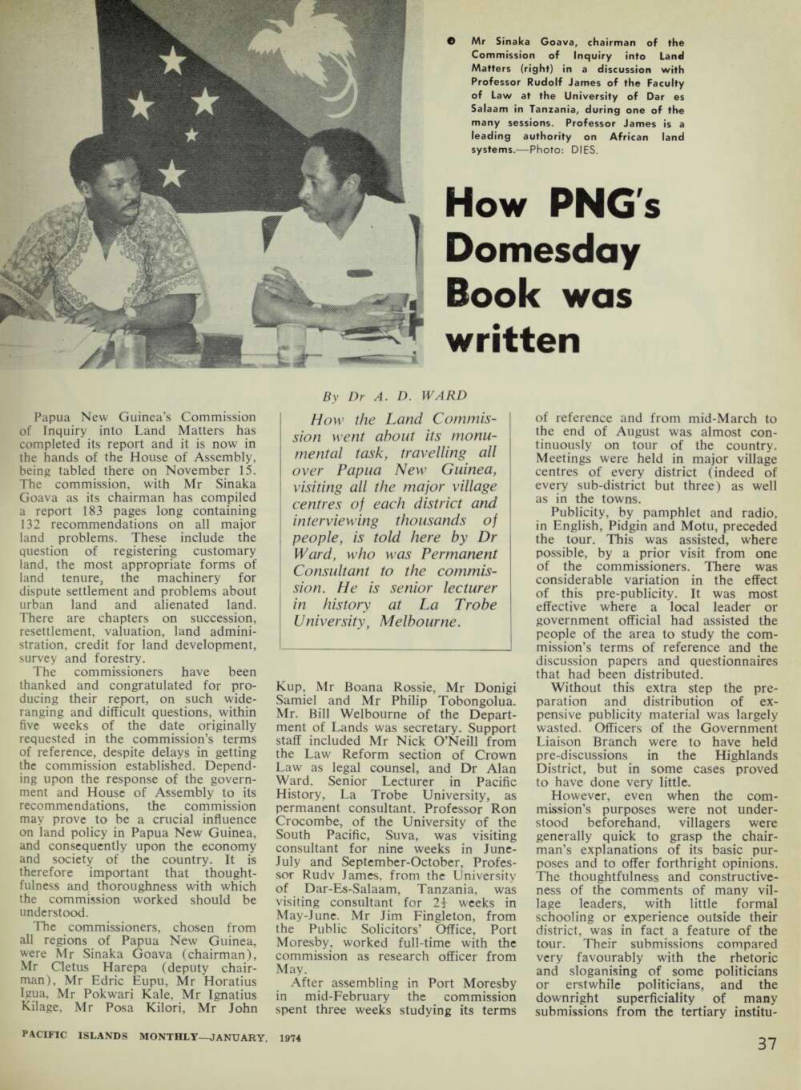
Mr Sinaka Goava, chairman of the Commission of Inquiry into Land Matters (right) in a discussion with Professor Rudolf James of the Faculty of Law at the University of Dar es Salaam in Tanzania, during one of the many sessions. Professor James is a leading authority on African land
systems.—Photo: DIES.
tions, where few staff and students seem to have given much serious thought to land problems and alter native ways of solving them.
The commission regarded the question of how to treat customary land, the vast bulk of the land in Papua New Guinea, as by far the greatest question confronting it.
However, it was aware of the heat and potential for conflict surrounding the question of alienated land and submitted an interim report on that subject in June. A method of pro ceeding was devised for that purpose which was largely followed when the various sections of the main report were drawn up later.
Out of days and weeks of dis cussion, both in the conference room in Port Moresby and in buses, ships and hotel rooms during the tour, the important issues emerged. The full time consultant. Dr Ward, or the legal counsel, Mr O’Neill, then drew up a detailed question paper on the subject at issue—such as alienated land, dispute settlement and registra tion of customary land.
The question paper was considered by a drafting committee of the com mission—usually the chairman and three others—meeting without support staff present. The drafting committee then drew up a short paper which became the first draft of that section of the report and tended to establish the main lines of the commission’s approach to the problem.
The full committee and support staff considered the first draft in detail, noting the pros and cons of alternative courses of action and the reasons why the commissioners opted for one line or another. With this material Dr Ward or Mr O’Neill wrote a second draft.
The second draft was considered by the full commission and visiting consultants when present, paragraph by paragraph. Words, sentences, whole paragraphs were changed, sug gestions from all involved being em bodied in the prose. A third draft was written and the process repeated.
At this point the draft was usually shown to officials or academics in volved in the particular problem and their comments considered by the commission. The fourth draft ap proached final shape but when the whole report was put together further changes had to be made to achieve consistency through the various sec tions, and editorial uniformity. The final product was a fifth draft. A revised version of the interim report on alienated land became the fourth chapter of the main report.
The compilation of the report was very much a team effort. It basically embodied a consensus of the com
mission’s views, and evaluated various alternatives, as was required by the terms of reference. The evaluation was based on the evidence put before the commission, and on the commis sions’ own very considerable ex perience.
The report was compiled in a 10week period from the end of August.
During that period commissioners and support staff worked long hours, including evenings and weekends with few breaks. Aware of the enormous weight of the task, and of the need to put proposals before the govern ment and House of Assembly for prompt consideration, they accepted an exacting timetable from the chair man, whose earnestness and dedica
tion to the work was a vital factor in the smooth working of the com mission.
Largely at the commission’s urging a Policy Planning and Research sec tion is to be established in the Lands Department to prepare the commis sion’s recommendations for imple mentation, insofar as they are accepted by the government and the House of Assembly. In this way it is hoped that the new direction and impetus in land policy given by the commission will not be lost. Much, however, will depend upon a revita lising of the Lands Department which lacks the numbers of staff and the kind of training likely to be required for the new tasks envisaged.