When Corned
pp. 26-27 · Read in the full issue
Beef Was King
From a special correspondent Look at a can or keg of corned beef and imagine drama, mystery, intrigue and romance! Difficult? Yet this humble product has been the cause of all criteria.
And as far as R. & W. Hellaby Limited is concerned, corned beef has the additional credit of founding an export business which today earns more than $5O million in overseas exchange each year. Hard to believe?
One hundred years ago, the brothers Richard and William Hel laby founded the business with the purchase of a small butcher shop in down-town Auckland.
Exporting had not been heard of and it certainly did not present the brothers with any flash of inspira tion. They were much more interested in surviving and recouping some of the finance and confidence which had been lost during their brief excursion in the realms of gold searching in Otago and Thames.
Fortunately, Richard and William were astute businessmen and estab lished the pattern of paying for the meat at the highest possible value to the producer and relying on the by products to produce the profit.
Just how successfully this philo sophy worked can be gauged from their business progress. Within three years of paying $l2O for Hammond’s butcher shop, they had moved further up Shortland Street into much larger premises and had added fertiliser and ice-making to their production.
They also began to keg and salt beef—a process that was well enough known to mariners but not parti cularly popular with local trade.
Some of the kegs of beef even tually found their way to the Pacific Islands and the reception was so dramatic that within a few years a regular export trade developed. It was the reputation of the Hellaby beef which gave rise to the first crop of rumours.
Tales drifted back to New Zealand that the sea rover Bully Hayes had discovered that kegged beef could purchase anything he needed in the Islands and more than one small trading vessel, transporting the kegs
between the small islands, myster iously disappeared en-route.
Although no charges were ever laid due to insufficient proof, Hayes appeared to have an inexhaustible supply of kegged beef! But even the most firmly established traditions have to make way for progress. The 40 lb keg of salted beef is no more —at least as far as Hellabys is con cerned.
Just a couple of months ago the last keg was filled and despatched.
The difficulty in finding skilled co opers to make the kegs had proved too much and the company decided, with reluctance and not a little sadness, to dispense with this form of export.
The corned beef saga was not left solely to the trading of kegs. In fact, the more reliable tales were promoted by the advent of canned products around the turn of the century.
Most popular was the 6 lb round tin and its reputation became so established that at least three songs were written and sung about the glories of the Hellaby meat, and its purchasing power had to be seen to be believed. Copra, shells, labour and girls were all fair game for the pos sessor of a can of Hellaby corned beef.
Traditional Island product was weighed by placing a 6 lb tin on one side of the balance and the sale able items on the other. Even the can was put to good use—the indecent publications tribunal would frown on some of the more colourful uses —and the jagged lids were nailed to
poles and turned into home-made, but effective scythes.
Of course, Hellabys has had its competitors and one French company even went to the trouble of pro ducing a can under the label “Hello boy” but the Islanders could not be fooled.
The canning machine at the Hellaby plant had a distinctive way of crimping the can edge while fitting the lid. Prospective purchasers could quickly sort out the genuine article by running their fingers around the lip.
Hellaby’s domination of this
market continued until the 1930 s when the availability of meat became a key factor and enabled other com petitors to gain a foothold.
World War II then broke the con tinuity of supply—a move which other canned meat producers seized upon with glee. Today Hellabys still commands a firm market in the Pacific but the purchasing power has fallen by the wayside.
Apart from canned products, Hellabys has won a substantial reputation in the Pacific for its frozen and chilled meat trade. Like other markets throughout the world, the frozen trade received its impetus from carcases which were cut to the customer’s requirements by the retail butcher.
Recently, the company has changed its emphasis to meeting the demands of tourists. Hotels and restaurants want a quality of product and cut which requires sophisticated proces sing. Portion control has come into its own with all the processing being carried out by Hellaby butchers in Auckland and the finished product being exported ready for cooking.
Times change. So do opportunities.
The keg is no more. No longer will a weights and measures inspector approve of the use of a tin of corned beef as a standard weight.
Corned beef has ceased to be the market price of a girl, but with the meteoric rise of South Pacific tourism the name Hellabys will still be seen—as a satisfied smile on the face of the well-fed tourist!
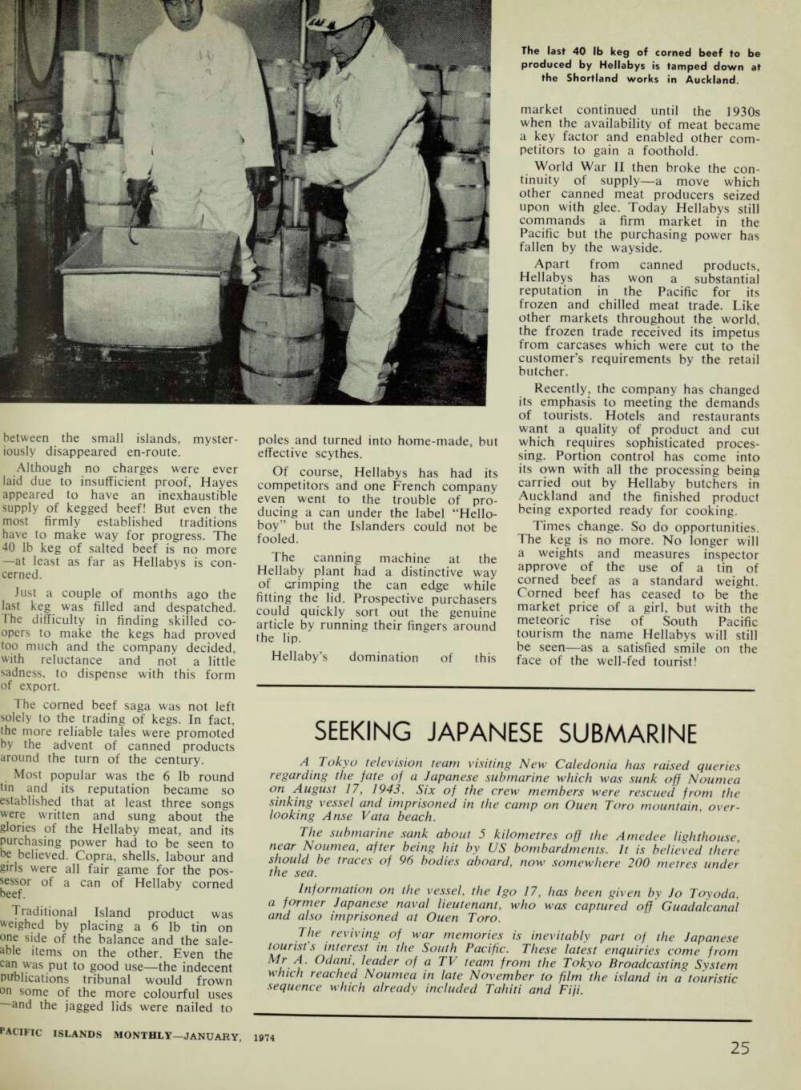
The last 40 Ib keg of corned beef to be produced by Hellabys is tamped down at the Shortland works in Auckland.