With Silence
p. 10 · Read in the full issue
Not With A
Bang ... But
From a Port Moresby correspondent Self-government came to Papua New Guinea on Saturday, December 1, not with a bang or a whimper, but almost in utter silence. There was less traffic here in the capital on the Friday night than at any time since World War 11, and from 6 pm on wards hardly anyone was about.
When I drove from Korobosea via the city area and Konedobu at 8 pm to make a check on the eve of the great day I met only two police cars.
Another drive just before midnight revealed only half a dozen cars on Three-Mile Hill—and nothing and nobody else. There were only police cars on the way to the airport, and 1 noticed another 20 police trucks with police standing by at central police station, Boroko.
On the day itself only the news agencies were open to sell special self-government issues of the Post- Courier and it was not until 5 pm that one saw people about. There was a crowd at a meeting at Kaugere on behalf of the Papua Besena Move ment of Miss Josephine Abaijah, but there was no fuss.
In the morning Mr Michael Somare made a prepared broadcast in which he stressed that although New Guineans had “waited im patiently for this day for years”, there was little change in practical terms, and New Guineans would do the same things that day as they had done the day before.
The only official ceremony was the short swearing in of former Adminis trator, Mr Les Johnson, as Aus tralian High Commissioner, who in turn swore in Mr Somare as Chief Minister, and five others as members
of the PNG Executive Council (formerly the Administrator’s Coun cil).
Sunday was another quiet day in the capital, and at the Koke United Church, Bishop Riley Samson (a Western District man) said in his sermon that all Papuans were appre hensive about the future, but that too much stupid talk had gone on during the last few months and the people should work for national unity.
All hotels had closed on Friday for the long weekend, and licensees were instructed not to serve liquor even to guests. The liquor ban un doubtedly assisted in keeping the occasion trouble-free. A further ban on liquor supply will operate between December 24-26 and December 31 and January 1. Liquor can’t be drunk at any public place on Christmas Day and New Year’s Day apart from hotel dining rooms.
Meanwhile, clues on the way things will shape under self-government can be seen in two important reports— one on land (see opposite) and an other by the Constitutional Planning Committee, introduced into the House of Assembly. The committee, representing all political parties, will give its final report in February, and the Assembly is expected to debate and approve it at a special session next April.
Main proposals in this, its second interim report, are that dual citizen ship be rejected, a system of pro vincial governments be established, regional electorates be abolished and the total number of open electorates be increased to a minimum of 100. and the voting system be “first past
the post” and not preferential as at present.
On citizenship the committee said measures would have to be taken to protect the rights of New Guineans from being disadvantaged by “new citizens”, such as Australians, who because of their education, economic status and mobility could otherwise be in a more advantageous position.
The government had to minimise in equality of opportunity, and citizen ship laws thus “may have to be rather restrictive”, if only temporarily. For details, we’ll have to wait.
On regional government, the pro posal is for the present districts to become provinces, with their own popularly-elected provincial assem blies, headed by Premiers with cabinets. There would be a single PNG public service, with national public servants working also in the provinces, for the provinces, along side local personnel employed directly by the provincial governments.
The aim is to give PNG provinces significant powers without splitting PNG into autonomous regions. The powers of the provinces will be deter mined by a task force now being set up in Port Moresby.
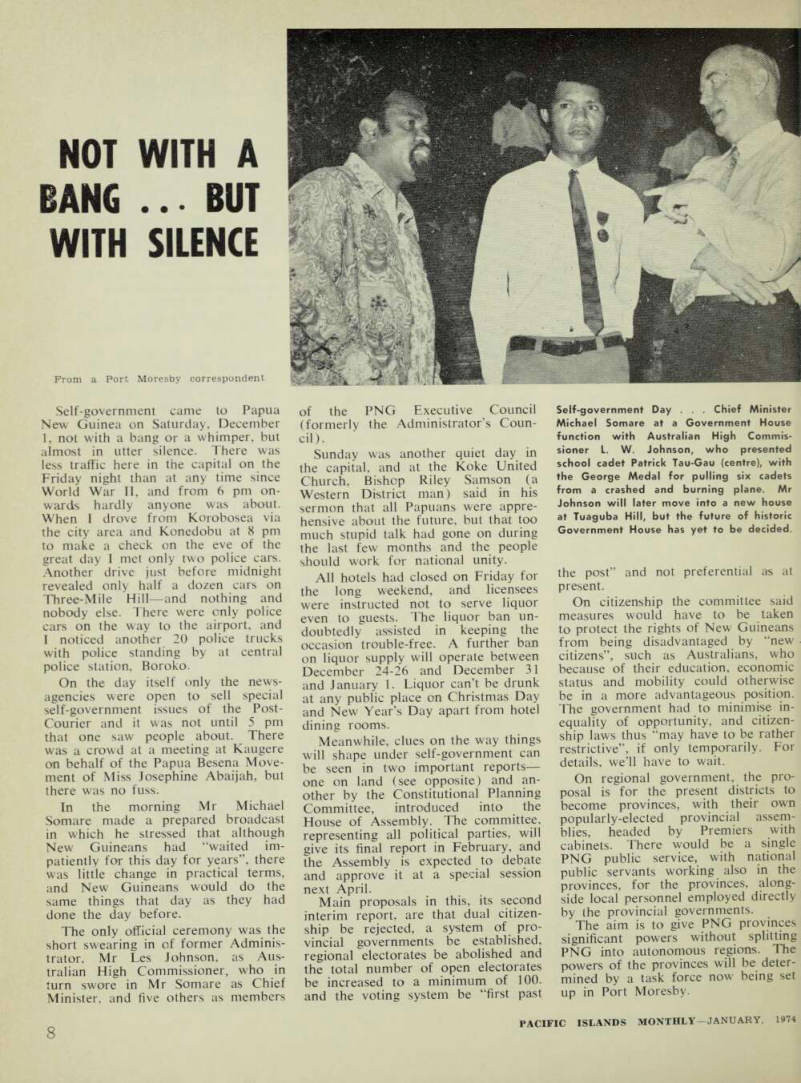
Self-government Day . . . Chief Minister Michael Somare at a Government House function with Australian High Commis sioner L. W. Johnson, who presented school cadet Patrick Tau-Gau (centre), with the George Medal for pulling six cadets from a crashed and burning plane. Mr Johnson will later move into a new house at Tuaguba Hill, but the future of historic Government House has yet to be decided.