Pacific Islands Monthly
pp. 6-7 · Read in the full issue
Ellice To Get Their Chance To
Separate From The Gilberts
By a staff reporter
The Ellice islanders, who, accord ing to their representatives on the GEIC Legislative Council, want to separate from the Gilberts and form a territory of their own under British rule, will have to decide for themselves.
The British Government, after consideration of a report from Sir Leslie Monson, British-appointed commissioner to inquire into the Ellice islanders’ request, who was in the colony early last year, has decided that they shall have their wish if a referendum reveals that the majority want separation. But, the conditions, if separation is decided on, will be tougher than the Ellice people bargained for.
When they put their case to Sir Leslie Monson and, previously, to Sir John Field, who retired as governor last year, they asked that in any carve-up of assets, they should be given the Phoenix Group of islands or some of the Line Islands.
But the British Government laid it down in the statement read by Governor Mr John Smith in the Legislative Council towards Nov ember’s end that “the territory of the new Ellice Colony should be confined to the Ellice Islands them selves”.
A prerequisite of separation is that it should also be the wish of the GEIC Government. If the Ellice people decide on separation, it’s un likely that the Gilbertese will oppose it. Mr Reuben Uatioa, Leader of Government Business, told PIM last year (Jan, p 39) that they would not oppose separation if the Ellice wanted it.
Among alternatives to separation suggested by Sir John Field was either a federal system, which “might have certain political advantages”, or a regional system with different parts of the country having limited rights to regulate certain local affairs with out creating separate states.
Mr Uatioa, however, has said that the Gilbertese will agree only to
separation or the existing type of unitary government.
Other conditions laid down by the British Government which may make the Ellice people think again are: a No assets (fixed, movable or in cash) belonging to the present colony outside the Ellice Islands should be transferred to the Ellice Islands on separation except for one ship from the colony’s fleet, and e The Ellice Islands would have no claim to phosphate royalties.
The referendum will be in August or September, 1974, and if it shows a majority of Ellice people in favour of separation, and the colony govern ment also wishes it, Britain will invite representatives of the Gilbertese and Ellice people to discuss the detailed constitutional, administrative, financial and economic arrangements, including the question of future British aid.
“In the light of these consultations,
a date for separation will be decided,” the Legislative Council was told.
“In the meantime, it is the inten tion of Her Majesty’s Government that the new constitution and ensuing general elections in the GEIC shall proceed as planned.”
As they are scheduled for 1974, new elections may displace some of the Ellice leaders and result in some re-thinking by the Ellice people, who, according to Ellice opponents of separation, know very little of what separation means.
As the Ellice people are out numbered by nearly six to one by the Gilbertese, fear of domination is the driving force behind the Ellice people’s wish for separation and even the conditions imposed by Britain may not deter them.
They expect, if separation is agreed on, to remain a British dependency, in which case, they say, Britain will look after them, and their lot would be better than if they remain as part of an independent Gilbert and Ellice Islands country.
As Mr Telavi Fati, Legislative Council Member for Nanumea in the Ellice Islands, reasoned before Sir Leslie Monson, separation was better than loss of identity and loss of culture and tradition which would follow in the next 10 to 20 years if the Ellice remains with the Gilberts.
“We do not mind if our people get lost in the civilised world,” he said, suggesting that Britain should arrange a migration of about 2,000 Ellice islanders within the next 20 years to other Ccpmmonwealth countries and the imposition of some sort of tax on the migrants to help those back home. .
He also asked for the retention of the Ellice labour force on Ocean Island for as long as phosphate mining lasts or, if the Gilbertese ob ject, a transfer of the work force to Christmas Island in the Indian Ocean.
The Gilbertese, however, could be expected to protest against the con
tinued presence of Ellice workers on Ocean Island if separation comes, as they argue that Ellice would be a separate country, and Ocean Island is nearer to the rest of the Gilberts.
Governor Mr John Smith is quoted in the colony newspaper, Atoll Pioneer, as saying that if separation came, the earliest practical date would be January, 1976.
He was asked if, in the event of separation, Ellice people living on Tarawa would have to pack their bags and leave. He replied: “We are discussing constitutional separation and not a declaration of hostilities.
There are a great many individual Ellice islanders for whom the govern ment, the Development Authority and others have contractual obliga tions. There may be others who, for one reason or another, have decided to make their home in the Gilbert Islands.
“At the point of separation, I am assuming that both the Gilbert Islands and the Ellice Islands will still be dependencies of Britain. There will, therefore, be no question at that stage of Gilbertese or Ellice citizenship.”
Budget
Mr Douglas Freegard, Financial Secretary of the GEIC, is budgeting for a surplus of $1.34 million in 1974, even though expenditure will be $479,630 higher than 1973. He ex pects the higher expenditure will be offset by a lift of $747,000 in revenue.
The Appropriation Bill provides for recurrent revenue of $5,877 million and recurrent expenditure of $4,577.
Britain will provide additional aid of 51.053 million in 1974 to assist in the rehabilitation of Funafuti, which was devastated by hurricane Bebe in October, 1972. The increase in world price of phosphates will add about $680,000 to the 1974 revenue in phosphate tax.
Customs duty is expected to yield $42,000, income tax (including GEI Development Authority profits) $91,000 and Posts and Telecommuni cations $60,000. Against that revenue is loss of fishing revenue, which was expected to start in 1973, but the fleet was wiped out by hurricane Bebe.
That revenue had been estimated at $150,000. There was also loss of revenue from fees and licences which now go to urban councils.
Mr Freegard said that in 1973, GEIDA contributed about $33,000 to the revenue from the profit earned in 1972, its first year of operation.
The subsidy required by GEIDA for shipping services declined in the first half of 1973. For the last quarter °f 1972, the authority required a
shipping subsidy of $95,000. For the first quarter of 1973 it was $67,000, and in the second quarter, April-June, there was a small profit of $7,000.
The better result was achieved partly because of an increase in fares and freight charges, and partly through the considerable increase in
copra production.
Actual revenue and expenditure in 1972 were $4,650,930 and $5,012,579 respectivelv after putting $995,389 to reserve. The surplus of revenue over expenditure was $25,800, which was transferred to reserve in 1973. Thus the total put to reserve on the 1972 account was $1,021,189, which was $223,833 less than originally esti mated. The revised estimate for 1973 indicated a final out-turn to reserve of $1,039 million, or $33,000 less than originally estimated.
Mr Freegard said that while the GEIC was able to put about $.26 million more to reserve in 1973, members should not consider that any real reason for self-satisfaction.
“It must be borne in mind that the greater part of the increase in revenue next year will come from exports of phosphate,” he said. “When we lose the phosphate revenue we shall have a larger gap to plug than ever.”
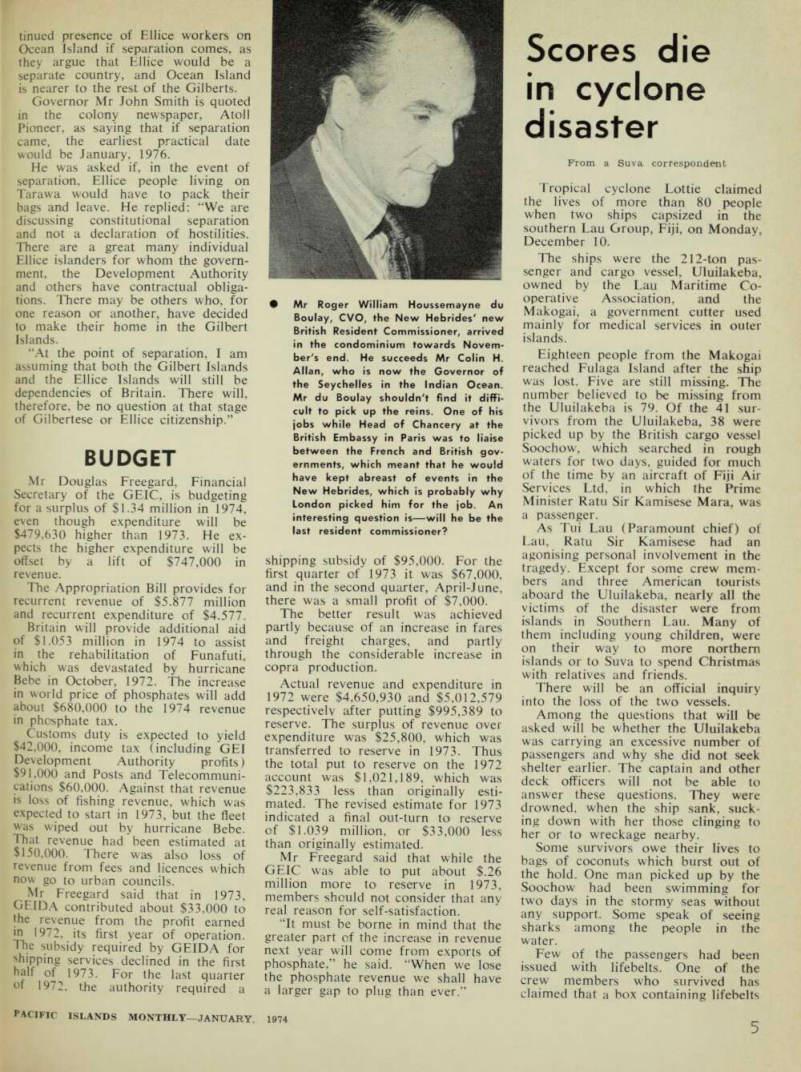
• Mr Roger William Houssemayne du Boulay, CVO, the New Hebrides' new British Resident Commissioner, arrived in the condominium towards Novem ber's end. He succeeds Mr Colin H.
Allan, who is now the Governor of the Seychelles in the Indian Ocean.
Mr du Boulay shouldn't find it diffi cult to pick up the reins. One of his jobs while Head of Chancery at the British Embassy in Paris was to liaise between the French and British gov ernments, which meant that he would have kept abreast of events in the New Hebrides, which is probably why London picked him for the job. An interesting question is—will he be the last resident commissioner?