Fruit Juice Is Not Enough
pp. 104-106 · Read in the full issue
The Cook Islands needs tourism to back up its citrus fruit industry. But will tourism adversely affect a virtually unspoiled island group? That is a poser worrying three young Cook Islanders, agricultural officers who are examining the citrus fruit industry in Australia under a United Nations FAO scholarship.
The men are Anau Manarangi (Rarotonga) Julian Dashwood (Mauke) and Ngaro Solomana (Aitutaki). They all attended Massey Agricultural Col lege, near Palmerston North, NZ„ in the mid-19605. All believe the citrus industry must be developed to its full potential. Each is optimistic that ef forts to build up the canning industry and the export of fruit will eventually be successful.
One of their aims when they re
turn to the Cook Islands about the end of December will be to increase the number of citrus trees to the
acre through improved farming
methods —spraying, the use of ferti lisers and building irrigation dams if possible.
“Irrigation is a must if we want to boost our production because the rainfall is not evenly distributed”, Mr Dashwood said to PIM.
The three men were most im pressed with the way some citrus farmers in Australia were able to build their own irrigation dams with bulldozers.
Mr Solomana said the government was doing a lot to help the Cooks economy. It was encouraging the people of Atiu to grow pineapples, supplying materials to help citrus
rowers and encouraging tourism irough which it was hoped to pro ide more employment.
Mr Manarangi had reservations bout tourism, although recognising s potential.
“I reckon the influence of tourism ill spoil the natural look of the ilands”, he said. “It (the Cook Is tnds) will be the next small Hawaii”.
However, from an economic point f view, the Cook Islands needed jurism.
Mr Dash wood was doubtful 'hether tourism would bring money ) everyone; he thought earnings 'ould get into the hands of just a ;w.
The three men agreed the Cook dands could grow most of the food jurists would need, but meat would ave to be imported.
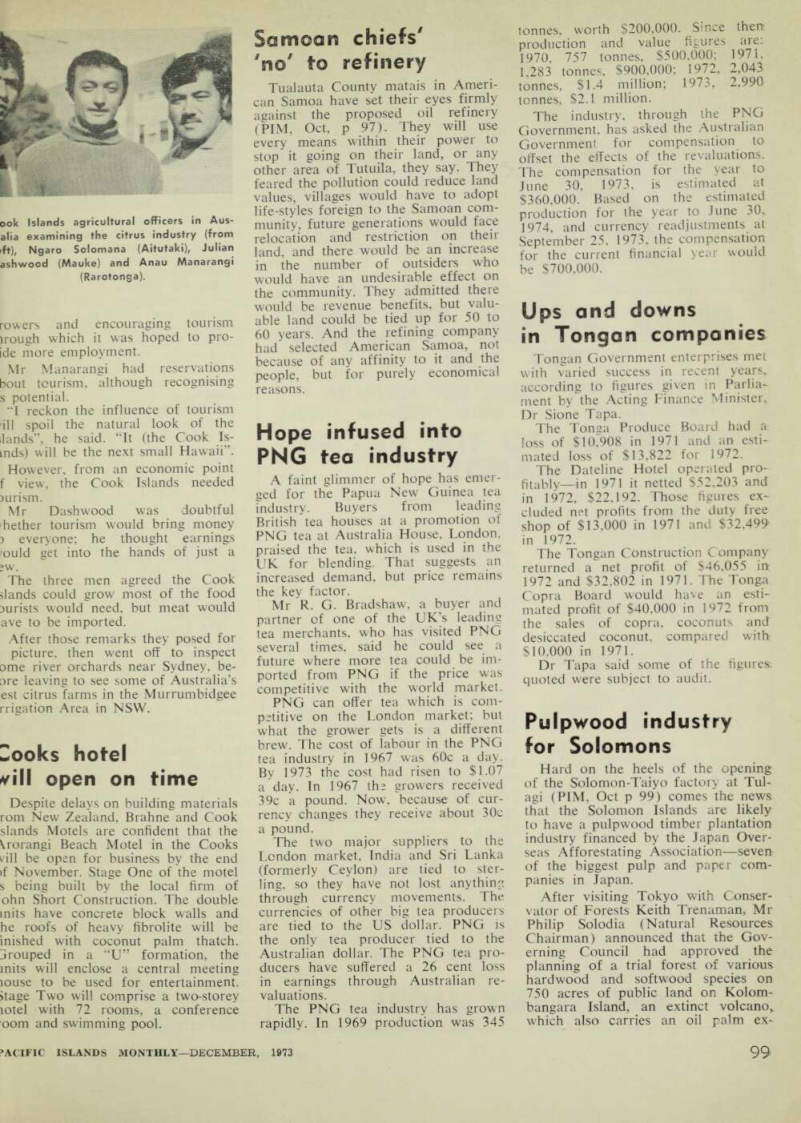
After those remarks they posed for picture, then went off to inspect ome river orchards near Sydney, be are leaving to see some of Australia’s est citrus farms in the Murrumbidgee rrigation Area in NSW.
Zooks hotel
vill open on time
Despite delays on building materials rom New Zealand, Brahne and Cook slands Motels are confident that the krorangi Beach Motel in the Cooks yill be open for business by the end if November. Stage One of the motel s being built by the local firm of ohn Short Construction. The double mits have concrete block walls and he roofs of heavy fibrolite will be inished with coconut palm thatch.
Grouped in a “U” formation, the mits will enclose a central meeting louse to be used for entertainment. >tage Two will comprise a two-storey lotel with 72 rooms, a conference oom and swimming pool.
Samoan chiefs'
'no' to refinery
Tualauta County matais in Ameri can Samoa have set their eyes firmly against the proposed oil refinery (PIM, Oct, p 97). They will use every means within their power to stop it going on their land, or any other area of Tutuila, they say. They feared the pollution could reduce land values, villages would have to adopt life-styles foreign to the Samoan com munity, future generations would face relocation and restriction on their land, and there would be an increase in the number of outsiders who would have an undesirable effect on the community. They admitted there would be revenue benefits, but valu able land could be tied up for 50 to 60 years. And the refining company had selected American Samoa, not because of any affinity to it and the people, but for purely economical reasons.
Hope infused into
PNG tea industry
A faint glimmer of hope has emer ged for the Papua New Guinea tea industry. Buyers from leading British tea houses at a promotion of PNG tea at Australia House, London, praised the tea, which is used in the UK for blending. That suggests an increased demand, but price remains the key factor.
Mr R. G. Bradshaw, a buyer and partner of one of the UK’s leading tea merchants, who has visited PNG several times, said he could see a future where more tea could be im ported from PNG if the price was competitive with the world market.
PNG can offer tea which is com petitive on the London market; but what the grower gets is a different brew. The cost of labour in the PNG tea industry in 1967 was 60c a day.
By 1973 the cost had risen to $1.07 a day. In 1967 the growers received 39c a pound. Now, because of cur rency changes they receive about 30c a pound.
The two major suppliers to the London market, India and Sri Lanka (formerly Ceylon) are tied to ster ling, so they have not lost anything through currency movements. The currencies of other big tea producers are tied to the US dollar. PNG is the only tea producer tied to the Australian dollar. The PNG tea pro ducers have suffered a 26 cent loss in earnings through Australian re valuations.
The PNG tea industry has grown rapidly. In 1969 production was 345
tonnes, worth $200,000. Since then production and value figures are: 1970, 757 tonnes, $500,000; 1971, 1,283 tonnes, $900,000; 1972, 2,043 tonnes, $1.4 million; 1973, 2,990 tonnes, $2.1 million.
The industry, through the PNG Government, has asked the Australian Government for compensation to offset the effects of the revaluations.
The compensation for the year to June 30. 1973, is estimated at $360,000. Based on the estimated production for the year to June 30, 1974, and currency readjustments at September 25. 1973, the compensation for the current financial year would be $700,000.
Ups and downs
in Tongan companies
Tongan Government enterprises met with varied success in recent years, according to figures given in Parlia ment by the Acting Finance Minister, Dr Sione Tapa.
The Tonga Produce Board had a loss of $10,908 in 1971 and an esti mated loss of $13,822 for 1972.
The Dateline Hotel operated pro fitably—in 1971 it netted $52,203 and in 1972, $22,192. Those figures ex cluded net profits from the duty free shop of $13,000 in 1971 and $32,499' in 1972.
The Tongan Construction Company returned a net profit of $46,055 in 1972 and $32,802 in 1971. The Tonga Copra Board would have an esti mated profit of $40,000 in 1972 from the sales of copra, coconuts and desiccated coconut, compared with
Sio,Ooo In 1971.
Dr Tapa said some of the figures; quoted were subject to audit.
Pulpwood industry
for Solomons
Hard on the heels of the opening of the Solomon-Taiyo factory at Tul agi (PIM, Oct p 99) comes the news that the Solomon Islands are likely to have a pulpwood timber plantation industry financed by the Japan Over seas Afforestating Association—seven of the biggest pulp and paper com panies in Japan.
After visiting Tokyo with Conser vator of Forests Keith Trenaman, Mr Philip Solodia (Natural Resources Chairman) announced that the Gov erning Council had approved the planning of a trial forest of various hardwood and softwood species on 750 acres of public land on Kolom bangara Island, an extinct volcano* which also carries an oil palm ex
ook Islands agricultural officers in Aus alia examining the citrus industry (from [?]ft), Ngaro Solomana (Aitutaki), Julian ashwood (Mauke) and Anau Manarangi (Rarotonga).
periment by the Agriculture Depart ment.
The JO A A sent a mission in Aug ust last year as part of a survey it has been making of tropical countries to find places suitable for quick growing trees to meet Japan’s paper
scarcity.
Mr Solodia went to Tokyo armed with a refusal by Govco to accept a proposal that the JO A A carry out the trial in the Solomons and then decide whether to go ahead.
With the backing of his fellow members, and a message to JO A A that Solomon Islanders would almost certainly be running the country under a new constitution next year, Mr Solodia re-formed the proposal.
He got the JO A A to agree to the Solomons Forestry Department carry ing out the trial because it was capa ble, because it would bring employ ment to Solomon Islanders, and be cause it would avoid any suspicions and opposition such as occurred with the sudden influx of Japanese dur ing the Taiyo Fishery Co’s survey in 1971-72.
He also came away with the agree ment in principle that the Solomons would receive a large share in a joint venture company, if the trial was successful and both parties agreed that the plantations should be plan ted. Many thousands of acres of Kolombangara, and possibly other areas would be involved.