News
pp. 93-94 · Read in the full issue
British Airways
Boac
Pacific Jet
News
"But, soft! methinks I scent the morning air"—Hamlet I iv
(BOAC Supplement—Advertisement)
By Humphrey Lyttelton
Bishop Gore, an eminent theologian in the early part of this century, was in America on a lecture tour at the time when a new, crunchy, brown coloured breakfast cereal, that is now very popular, came on the market.
Knowing that the English set great store by their breakfast, his hosts de cided to offer him the new delicacy, tipping some into a bowl and setting it before him with expressions of great expectancy. He didn’t wait to add milk and sample it, but gave the verdict on sight in his precise clergy man’s voice. “Gravel?” he said, put ting the emphasis on the second syll able, “I positively refuse to eat gravel.”
In fact, his hosts had got it wrong.
The English have always been timid and unadventurous when it comes to the first meal of the day. In his soc ial History of England, G. M. Trevel yan records that, in the mid-17th century, breakfast in most upper and middle class homes consisted of no more than a “morning draft” of ale with a little bread and butter. The proverb current at that time —“He that would eat a good dinner, let him eat a good breakfast”—sounds in the circumstances like the advertising slogan of some contemporary Break fast Marketing Board.
It was Dr Johnson, visiting Scot land some hundred years later, who stumbled grudgingly on the truth. He had no great opinion of the North Britons, asserting that “the noblest prospect which a Scotsman ever sees is the high road that leads him to England.” Before his tour of Scot land, he dismissed the Scots’ diet con temptuously with a reference to oats as “a grain which in England is gen erally given to horses but in Scotland supports the people”. He is not the only Englishman to this day to be lieve that the Scots subsist solely on oatcakes and porridge, with haggis thrown in on special occasions. But when he actually went there, he had to concede that “in the breakfast, the
Scots, whether of the Lowlands or Highlands, must be confessed to ex cel us ... if an epicure could remove by a wish in quest of sensual gratifi cation, wherever he had supped, he would breakfast in Scotland”.
It’s interesting to note that Dr Johnson’s rapture of “tea and coffee accompanied by honey, conserves and marmalade” was not shared by all Scots. In his novel “Old Mortality”, Sir Walter Scott described a feudal breakfast in terms which seem to mirror the 20th century Englishman’s view of the “Continental breakfast”.
No tea, no coffee, no variety of rolls, but solid and substantial viands—the priestly ham, the knightly sirloin, the noble baron of beef, the princely venison pastry; while silver flagons . . . mantled some with ale, some with mead and some with generous wine of various qualities and descriptions”.
The truth is then, that we owe most of what we now call the “English breakfast” to the Scots. It is some years—two hundred, perhaps—since we have tucked without thought for
liver or waistline into the “solid and substantial viands” of our ancestors.
Tea and coffee have long been the norm, though some bon viveurs, the late Sir Winston Churchill reputedly among them, have perpetuated with champagne the tradition of the “mor ning draft”. But even I, from the standpoint of no great age, can recall in childhood staying at stately homes in which an Edwardian style of breakfast prevailed. Innumerable sil ver dishes were lined up on a hot plate, offering a staggering choice as one moved along them raising lids.
Eggs boiled, scrambled or fried, bacon, ham, kidney, huge flapping field mushrooms, sausages, kippers, haddock, sometimes even a cheese souffle and kedgeree.
A certain amount of misinforma tion was taken in with the food. I was brought up on the theory that mar malade was invented in France as a sort of tonic food (for Marie-Antoin ette, perhaps) and that the name de rived from Marie malade”. It was typical of the Edwardians to devise
British A irways staff worldwide wish our travel agent friends, our passengers, and all readers of Pacific Jet News, a very happy Christmas.
such a romantic and culturally high falutin’ derivation. The true history is more down-to-earth. Marmalade was devised, as an expedient, by —you’ve guessed it—a Scott. Janet Keiller and her husband ran a small business in Dundee. One morning a ship from Spain brought a large con signment of oranges into harbour and deposited them there to be sold off cheap. James Keiller bought them, but found that he couldn't sell them.
Rather than lose them all, his thrifty wife sliced them up, peel and all, and made them into jam. Whether it was she or one of her customers who took the first spoonful and ran into the street crying “Eureka”, history doesn’t record. Nor do we know ex actly when the name marmalade — from the Portugese marmelda, a pre serve made from the marmelo, or quince—first came to be applied to the new concoction. We do know that connoisseurs of the British breakfast are as particular about their marmal ade, be it Dundee or Oxford or any other of the famous varieties—as a wine-drinker about his vintages.
One favourite breakfast dish, which I long attributed, quite wrongly, to the Scots, is kedgeree. The name is In dian, and the native kedgeree belonged seemingly to the pilaf family of rice and leftovers, not very appetising to the British palate. Our variations, pre sumably imported during the early years of the British Raj, are at best a delicious concoction of rice, hard boiled egg and fish, ranging in luxury from haddock at one extreme to fresh pink salmon at the other. Like many dishes that owe their birth to impro visation. kedgeree is best eaten in a private home. It is a rare hotel menu that will offer it, and then there is little hope that it will be exactly as Mum used to make it!
Indeed despite the proud claims of most British hotels to provide a traditional English breakfast, it is to Scotland that one must still go for the apotheosis of the morning meal. South of the border kippers and Finnan Haddock too often turn out to he unnaturally-coloured objects from t e deep-freeze hastily delivered from a plastic natal sack (although I quite recently found delicious fresh kippers in the Southampton Post House, and
you can hardly get further south than that).
All other evidence shows that the tradition for really scrumptious break fasts left Scotland in fine fettle, was still strong as it travelled through the North of England (the Liverpool custom of putting jam on kippers may not be to every one’s taste, but it shows true gastronomic enterprise) and petered out somewhat as it moved south. Two breakfasts stand out in my memory, both in Scotland. At the Houstoun House Hotel in Uphall, just outside Edinburgh, a massive and obese basset-hound, one of two that roam round the hotel like errant book-ends watched with great sad, suppliant eyes as I tucked into por ridge, oatcakes and honey, kippers and fine, craggy toast. Similar fare at the Newton Hotel in Nairn, over looking the Moray Firth, enabled the breakfast to outshine the more am bitious and spectacular dinner menu with effortless ease. Jet travel now enables Dr Johnson’s epicure to dine elsewhere and breakfast in Scotland.
Expensive, but, to experience a real British breakfast, almost worth it.
Bo Ac + Bea = 216
British Airways has the world’s largest international fleet of aircraft.
With the bringing together of BO AC and BEA (British European Airways) under the one banner of British Air ways, the new big airline had—the last time we counted them — 216.
Here’s what they all are: — 13 Boeing 747 s 27 VC 10s 29 Boeing 707 s
65 Tridents 22 BAC 1-lls 5 Vanguards 9 Merchantmen (Vanguards con verted for freight carrying) 35 Viscounts 2 Skyliners 7 Sikorsky S-6IN helicopters 2 Bell helicopters And here's what there is on the way :— 5 Concordes 2 more Boeing 747 s 6 TriStars
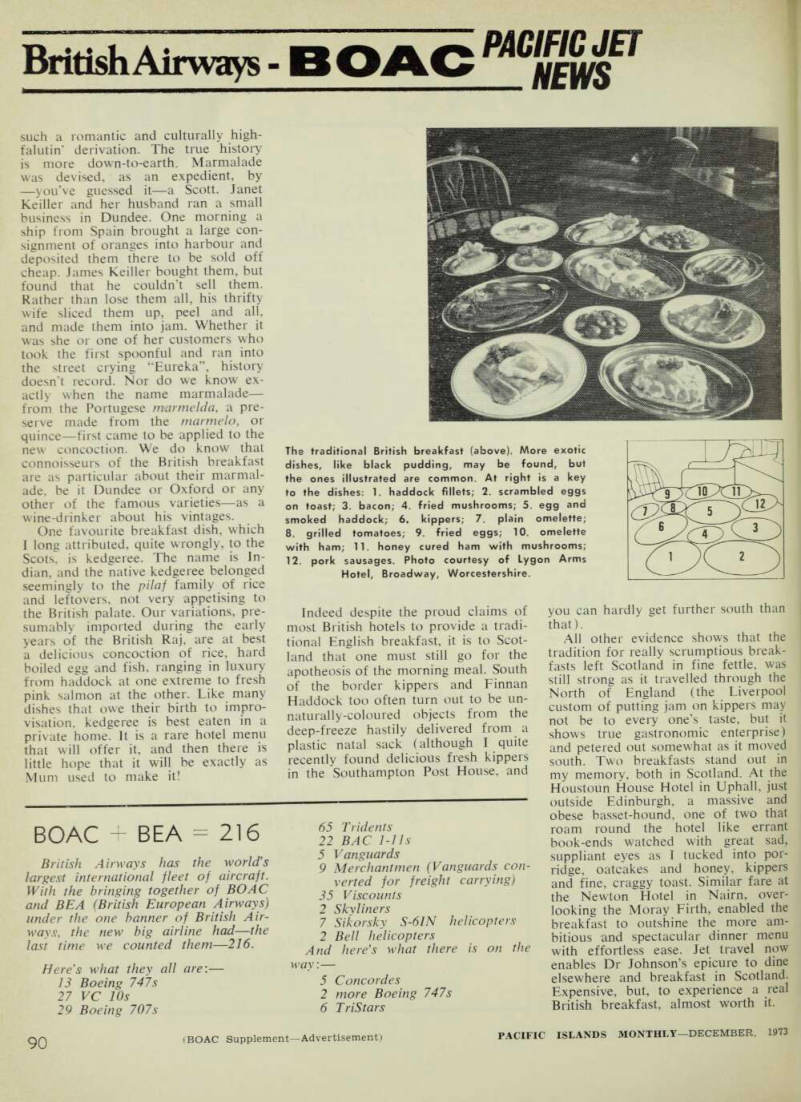
The traditional British breakfast (above). More exotic dishes, like black pudding, may be found, but the ones illustrated are common. At right is a key to the dishes: 1. haddock fillets; 2. scrambled eggs on toast; 3. bacon; 4. fried mushrooms; 5. egg and smoked haddock; 6. kippers; 7. plain omelette; 8. grilled tomatoes; 9. fried eggs; 10. omelette with ham; 11. honey cured ham with mushrooms; 12. pork sausages. Photo courtesy of Lygon Arms Hotel, Broadway, Worcestershire.