Pacific Transport
pp. 81-89 · Read in the full issue
Islanders Press Their Rights
TO A 'FAIR GO' ON THE HIGH SEAS
By staff reporters
Waitangi, the town in the north of Mew Zealand’s North Island, already listoric as the scene of the signing )f the peace treaty between the Maoris md Colonial Britain, may figure in the history of the South Pacific islands as the birthplace of a regional shipping line and a square deal for he Islands from NZ trade unions.
In late October, delegates from the Cook Islands, Fiji, Nauru, Niue, Ponga, Western Samoa, the NZ Federation of Labour, NZ maritime anions, shipping lines and the NZ government met to discuss adequate shipping services, expansion of •egional trade and development, employment opportunities for sea going personnel, conditions of service n the industry, training programmes md possible economic assistance for regional shipping projects.
What was first conceived by the SZ Government as a cover-up for its inaction over the NZ Seamen’s
Union’s persecution of the Enna G, which was “blacked” by the unions, supposedly over wages and working conditions of the Fijian crew, was a success—with some qualifications from Island observers.
The conference accepted the vital principle that Islands ships have the right to trade in the South Pacific area with their own crews, on their own conditions. It agreed to in vestigate feasibility of a regional shipping line.
But the status quo is to be main tained until (a) the NZ Government establishes a Shipping Corporation of NZ, which will be a national line giving more work for NZ seamen, and (b) minimum wages and con ditions for Islands’ seamen on Islands’ ships are established.
The Islands’ own Bureau for Economic Co-operation, established by the South Pacific Forum, will have the job of advising on the minimum conditions, which means that the results will be practical, and not based on the selfish self-interest displayed until now by the NZ unions.
One delegate told PIM he wasn’t entirely happy with the NZ union involvement with the establishment of minimum Islands wages and con ditions, or in establishing the regional shipping line, because it was only a small step to have NZ unions inter fering in other industrial areas rightly the concern only of Islanders.
But in the main Island delegates were pleased.
“The main breakthrough,” said President Deßoburt, of Nauru, “is that at long last the unions have agreed to recognise the right of small Islands to employ Islands’ seamen on rates of pay geared to local economies.”
Fiji team’s leader, Mr Jonati Mavoa, the Minister of Labour, said: “We got the trade union people, particularly the maritime unions, to
understand the problems we have in the Islands. For the first time they’ve promised to stop opposing Island shipping trading with New Zealand, provided we come to some arrange ment over wage standards and basic conditions.
“There was a lot of plain talking, but no rows. The Island territories made no bones about the problems they had. We’ve also created machinery to deal with any future problems which arise, and that’s something we haven’t had up to now.”
Australia and the GEIC were absent from the conference. They should have been there. Any agree ment on shipping conditions in the South Pacific will affect Australian interests.
The Australian maritime unions and the International Transport Workers’ Federation intervened more than 12 months ago over the em ployment of GEIC seamen in
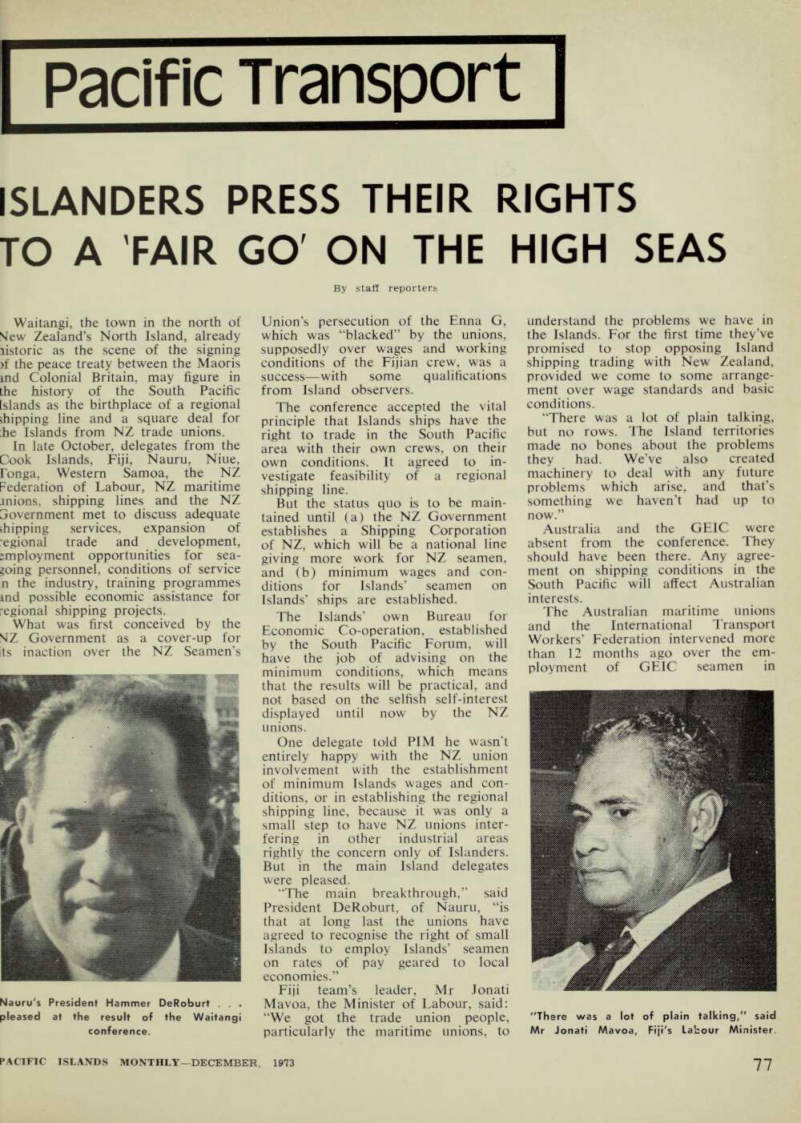
Nauru's President Hammer DeRoburt . . . pleased at the result of the Waitangi conference.
"There was a lot of plain talking," said Mr Jonati Mavoa, Fiji's Labour Minister.
German ships. Talks at Tarawa last December ended in an agreement over wages and conditions.
Will that agreement and the wage standards established there differ from any agreement which SPEC is able to work out? GEIC’s Member for Communications, Works and Utilities, Mr Naboua Ratieta and Commissioner of Labour Mr A. T.
Martin, agreed with PIM that they could be affected by decisions made as a result of the Waitangi con ference. The colony government will watch the position closely.
Some of the other benefits to come out of the Waitangi conference will be provision of technical and capital assistance to the Islands, including help and study to develop port and wharf facilities and training in shipbuilding.
Back in Nukualofa, Secretary to the Government, Mr Dan Tufui, who attended the conference with Captain Chris Hill-Willis in his capacity as a director of the government-owned Pacific Navigation Co, expressed satisfaction that the Islands had won their point.
But Captain Hill-Willis paid high tribute to Mr Tufui. He said the opening speech by Mr Tufui on the rights of Islanders had made a tremendous impact at the conference, and “paved the way for its success ful outcome”. The speech is reported in full on p 25.
Pacific airlines in a state of flux!
Air Nauru To
Be More Active
Air Nauru, the Republic of Nauru’s international airline, is planning a more active role in the Pacific, with an increase in promotion and routes.
To put the airline in a better posi tion it may acquire a back-up aircraft in support of its existing F2B jet. This may be either another F2B or a 737, but probably the latter.
Air Nauru currently operates a major service between Melbourne- Tontouta (New Caledonia)-Honiara- Nauru, but it also flies between Nauru-Tarawa and Nauru-Majuro- Okinawa-Kagoshima (Japan). It is interested in rights into Fiji and also into Apia.
If it could establish a link between Nauru and Apia via Funafuti it would have a worthwhile service connecting Polynesia with the North Pacific, which at present Continental has the theoretical rights to operate (that is, it has been approved by the US but by nobody else).
Air Nauru also has an eye on New Guinea developments now that Air
Niugini has been established, and can see another possibility for a direct Honiara-Port Moresby service.
It seems unlikely that Nauru will get Fiji rights because of its current uneasy relationship with the Air Pacific consortium, from which it has withdrawn —preferring to make its own way. Western Samoa is in the consortium and any discussions with Air Nauru about a Samoan leg could possibly prove embarrassing—but there is greater possibility of an arrangement there than with Fiji.
Air Nauru’s situation vis-a-vis the Air Pacific consortium, including the disposal of Air Nauru’s shareholding in Air Pacific, is to be discussed at a meeting of consortium delegates in December. The various independent moves which could be regarded as a threat to the consortium, such as the Nauruan, Samoan and Tongan de velopments (see separate story of King Taufa’ahau’s hopes) will pro bably also be raised at the meeting.
Because of these developments the internal South Pacific airline situa tion is currently in a state of flux, almost of turmoil.
Nauru’s 5,600 ft airport has a hot mix seal and is currently being instal led with DME (distance measuring equipment, a navigational aid) and night lighting. Service on the Air Nauru Fokker is noted as being super first class, with passengers spoiled by an abundance of food and drink.
Other airline development are:
Air Niugini
Takes The Air
Air Niugini got off the ground on schedule on November 1, owner of a fleet of four Fokker Friendships, 12 DC3 passenger and cargo aircraft and another four Fokker Friendships leased from Ansett.
The four Friendships Air Niugini owns were bought from TAA for SI million. The DC3s cost $15,000 each and included a large stock of spare parts.
The members of the board of Air Niugini are Messrs Paul Pora, Mekere Morauta, Simon Kenehe. Dr K. N. E.
Bradfield (representing the PNG Government). Captain Frank Ball (TAA). Dr Harold Poulton (Ansett) and Captain R. J. Ritchie (Qantas).
Mr Pora is chairman and Captain Ritchie vice-chairman.
The first flight of the new airline was from Port Moresby to Lae on November 1. The aircraft arrived late at Lae because of bad weather.
The airline’s manager in Lae, Mr W.
Johnston, described the first day of operations as “right up to expecta tions. Things have gone really well.”
The ribbon “holding” the aircraft to take off on the first flight was cut
by the Chief Minister, Mr Michael Somare. Later, at a reception mark ing the occasion, he said Air Niugini would prosper towards a profit making airline in spite of “prophets of doom”.
The “prophet of doom” to whom he referred was Professor Keith Cleland, head of the Accountancy and Business Studies Department at the University of Technology, Lae.
Professor Cleland said that setting up Air Niugini was a “classic case” of the lack of government advisers in implementing ideas.
“It is madness to think that within three months of appointing a general manager, you can successfully merge two airlines and go on in a normal way,” he said. “1 predict there will be chaos in the next few months with Air Niugini. Not enough work has been done. They are on a snowball and don’t know how to get off.”
One fly in the ointment on the first day’s flying was when engineers walked out at 10.30 am and stayed off their jobs for nearly five hours.
Tongas King Is
Thinking Big
King Taufa’ahau Tupou IV of Tonga is thinking big about the future of the country’s aviation industry. In his speech from the throne at the closing of parliament in October he spoke of making Fua’amotu a full jet airport by extending the runway from 6,000 feet to 10,000 feet or more.
Admitting that such a project, along with other plans for aviation would cost a lot, he said financial assistance was “procurable” and he hoped to have talks about it during a visit to Japan. It is from Japan that Tonga, has been offered, free, a Boeing 8737 twin engined 100-seater jet aircraft.
On the Japan visit King Taufa’ahau also expected to talk about the equip ment necessary for the jet aircraft, and to negotiate ways and means of getting pilots and ground crews to maintain it, and train staff to run the new Tongan airlines.
Negotiations are under way with Fiji and Western Samoa which fly to Tonga, with France which administers New Caledonia and Tahiti, with New Zealand, about Rarotonga airport and Niue, and with the US about Pago Pago. When arrangements with these countries were completed, it would be possible to set up a Tongan airline.
The king did not spell out details about these negotiations, but presum ably they related to landing rights.
He said that Tonga could have connections with the “busy airports” of New Caledonia, Nadi, Pago Pago, Tahiti, the Cook Islands, and any
other destination which might be •developed later.
Turning to shipping the king said it was important that Tonga should have its own slipway because of the number of ships it operated. Tonga was an important country in its part of the Pacific in cargo handling and providing transport. It would be of tremendous advantage if Tonga could build its own ships to suit its par ticular requirements. But it had to aim first at docking and repairing its own ships before embarking on ship-building.
The Cooks Take
To The Air
White, green and blue will soon become familiar colours to Cook Islanders as they look up at a Britten Norman Islander aircraft winging its way between Rarotonga and Aitutaki, 160 miles apart. The trim little nine seater will be white (top) and blue, separated by a green band. On the tailfin will be a green and white stylised tropical flower.
The service, the first domestic ser vice in the Cooks, was scheduled to start in November, a month before Air New Zealand opens its DCS ser vice to Rarotonga. It will be oper ated by Cook Islands Airways, in which Air NZ and the Cook Islands government are partners. The man ager of the new airline will be Mr N. A, Nisbet, who will continue in his present post as Cook Islands manager for Air NZ.
Fiji To Take Over
Nadi Airport
Fiji has set July 1, 1975, as the take-over date for running Nadi International Airport. This decision follows a recommendation by the South Pacific Air Transport Council.
The NZ Government at present ad ministers the airport on behalf of
Spatc.
Although control of the airport is still more than 18 months away, this has not deterred Fiji from enter ing into agreements for landing rights.
Nadi is in a strategic position, which puts the Fiji Government in a posi tion of bargaining from strength when seeking landing rights for Air Pacific, in which she is a partner.
In the last few months Fiji has signed aircraft landing rights agree ments with Chile and New Zealand.
Agreements with Australia, India and Canada, have been negotiated, and are waiting for government ap proval before signature. Fiji hopes to negotiate an agreement with the United Kingdom before the end of
1973, and also plans to meet France and the US over landing rights.
The agreement with New Zealand gives Air New Zealand terminating flights to Nadi and flights through Nadi to North America, Asia and other Pacific Islands. New Zealand, in return, has given Air Pacific land ing rights at Auckland, via Tonga, and on to New Caledonia, the New Hebrides. Air Pacific may also land at Niue and Rarotonga on flights to Tahiti and Chile.
Some of these rights, of course, may not be taken up for years; but they are now there for the benefit of Air Pacific if and when it becomes an international airline.
Zooming Oil Prices
Worry Shipowners
Substantially higher prices for mar ine and diesel oil fuel could rub off in higher Pacific freight rates. So far there has been little talk of a further hike, but shipping companies are con cerned about oil prices.
If freight rates do go up because of higher fuel costs, it is more likely to be a surcharge, which can be re moved if prices drop, rather than an across-the-board increase, such as that applied between Australia and Papua New Guinea from April 1.
On December 23, 1972, marine
fuel oil cost shipowners 1U526.35 a tonne. At April 1 it had risen to 5U528.60 a tonne, and it is now 5U540.35 a tonne. It has increased by 46 per cent between April 1 and now.
Diesel fuel oil has risen more sharp ly from $U539.20 a tonne on De cember I, 1972. At April 1 it was 5U5'44.45 a tonne and now it is 5U570.70 a tonne. The rise since April 1 is 71 per cent.
Cargo Rates Up
For Norfolk
Qantas will apply higher air cargo rates between Australia and Norfolk Island from December 3. It is the first hike in these rates since 1951.
The average increase is 8c a kilo gram.
For shipments less than 45 kg, the new rate will be 53c (previously 44c). For shipments more than 45 kg. the rate will rise from 33c to 40c.
A 52.20 minimum charge will apply for small articles.
Previously there had been no min imum charge on the route, although such charges applied on domestic and international flights throughout the world. The minimum rate between Norfolk Island and New Zealand is $5.
Another new measure will be prior ity cargo rate of $1 a kg. The mini mum charge will be S 3. Qantas will not guarantee this cargo will travel on the next flight to Norfolk after receipt, but it will take precedence over ordinary cargo as space becomes available.
Airlines Compete
For Japan Route
Pan American World Airways is early favourite to be the American flag carrier on the lucrative Saipan- Japan route. But there is still a long way to go before the end of the race. Other contenders for the route are Northwest Orient Airlines and Continental/Air Micronesia.
Continental/Air Micronesia has had its hopes boosted through letters from the US Departments of State and Interior reminding CAB that, under the Trusteeship Agreement, America must promote the political, economic, social and educational advancement of the Micronesians and the Congress of Micronesia favoured Continental/Air Micronesia for the route. ® Trans Tours Ltd, of New Zeal and, has chartered the Italian liner, Marco Polo, for a year. The ship will operate exclusively in the South Pacific.
No Tt Flag, Yet
The time for the Trust Territory to become a country of registry for ships is not yet. The Deputy High Commissioner, Mr Peter T. Coleman, in the absence of the High Commis sioner, Mr Edward E. Johnston, vetoed the enabling act after it had been passed by the Congress of Micronesia. The act also had a pro vision to establish a body of law re lating to admiralty and maritime matters.
Mr Coleman wrote to congress saying the basic objectives of the legislation were not opposed; the veto was applied because of rapid develop ment in international shipping law.
Several recent conventions required careful study to see where the re sponsibilities for the US and the Trust Territory lay in the Pacific.
Uss May Sail Into
The Cruise Business
The Union Steam Ship Co of NZ Ltd will not put a passenger/cargo ship on the New Zealand-Fiji-Samoa- Tonga service to replace the Tofua, which was withdrawn in May. But it is “examining the possibility” of using a passenger ship for cruising, accord ing to a company spokesman in Sydney.
The spokesman said the company was finding it difficult to get what it considered was a suitable ship—one with first-class facilities and capable of carrying about 400 passengers.
Facilities had to be good to attract tourists.
Meanwhile the company has not exercised its option to end its char ter on the Tarros class container ship, the Union South Pacific, which is servicing Suva, Pago Pago, Apia and Nukualofa from Auckland every 14 days. The company took a three year charter of the ship, with the option to end it after five months.
The five months have elapsed.
The spokesman for the USS Co said the service had been “quite successful”. The ship could not carry as much cargo as hoped, and the economics were not as good as was anticipated.
“But from a shipper’s point of view we can say it was quite successful”, he said. “If the ship was a little bigger it would be more suitable, but there is no bigger ship available that does not need better facilities in the
Islands ports”.
Between 15 and 20 containers were being put ashore in Suva each visit, because that was all the port could handle. A further container ship
would not be added till the required unit-load handling facilities were available.
End Of A
Mission Ship
The Manutai, a former New Heb rides inter-island trading ship has been bought by Rabi Holdings Ltd, Fiji, the Banabans' company and will be broken up. The hull will be used as a copra store and the rest of the ship will be used for spare parts.
Ihe Manutai, built in 1946, was well known in the South Pacific. She was then the Empire Sloane, but in 1948 the London Missionary Society bought her and renamed her John Williams VI. As a missionary ship she spent most of the time in the GEIC, sailing between the GEIC and Fiji.
In 1963, Burns Philp bought the ship, and sent her to the New Heb rides where she was renamed Manu tai and became an inter-island trader.
Some Pacific Islands will be visited by the former NZ inter-island ferry, Maori, 7,600 tonnes (7,480 tons), which has been converted into a floating school of evangelism to train young people for missionary work. The new owners, Youth with a Mission based in Switzerland, bought the ship from the Union Steam Ship Co of NZ Ltd. The ship, renamed Agape, has accommodation for 920 passengers and crew and a 1,000-seat auditorium for conferences.
Mr John Rippin who has been appointed secretary of the Papua New Guinea Harbours Board. Mr Rippin, who has been living in Melbourne, has had wide ex perience as an economic and financial consultant in the Pacific region.
Ex-War Transports
For Transpac Hire
The Trust Territory Government is expected soon to take delivery of two World War II transport ships, the Herkimer and Muskigum from the Federal Maritime Administration.
These ships are at present being re paired at Yokohama.
No date has been fixed for the arrival of the ships in the Trust Ter ritory as the government is negotiating with Transpac to charter them.
Mr Robert Laird, chief of the ship technical branch under Mr Beadles, recently inspected the ships in Yoko hama and reported they were in “ex cellent condition”.
The TT Government operates 11 ships. A new one is being built in Korea and two more have been bud geted for in 1975.
Transport briefs
• The Fiji Government will extend the Levuka wharf and build pas senger terminals there and at Natovi during Development Plan Seven. The wharf at Levuka, badly damaged a year ago by Hurricane Bebe, is now too small for the traffic which uses it. • A Soviet liner, the Taras Sheven ko, 19,862 tonnes (19,549 tons) will arrive in New Zealand in December for several summer voyages and cruises. She is a sister ship to the Shota Rustaveli, the first Russian liner to make regular cruises to the Pacific. • Gurney aerodrome in Papua New Guinea will be upgraded to take Fokker Friendship aircraft. The work will cost $lBO,OOO and when work is finished there will be a sealed runway, 5,600 ft long and 100 ft wide. • The Reef Shipping Company, of New Zealand, has bought a re placement for the MV Jean Philippe, the MV Fijian Swift, which sailed on its maiden voyage from Auckland in November to Suva and Lautoka in Fiji. • A 11,256-ton cargo ship, the Illyric, from London, was slightly damaged in Suva Harbour late in October in an accident with the Cap itaine Tasman while berthing at Walu Bay. The Illyric glanced off the Cap itaine Tasman and then off the wharf front. The ship was “patched up” in Suva before sailing to New Zealand for major repairs to starboard plates.