Yesterday
p. 56 · Read in the full issue
The news was almost all about Royalty in the South Pacific in December, 1953, when Queen Elizabeth and the Duke of Edinburgh, paid the first of a number of visits to the area. But almost missed press coverage. Thirty overseas journalists and Mr L. G. Usher, then Fiji Govern ment Public Relations Officer, flew from Fiji to Tonga before the visit to make a one-day check of arrange ments. Their aircraft broke down in Tonga and they were stranded till a special plane arrived from NZ to take them back to Fiji. They arrived in Suva the evening before the Royal party arrived. In other Islands arrangements were progressing smoothly to take dignitaries to New Zealand and Australia for the tour. Pitcairn, Western Samoa, the Cook Islands, Niue, and the Tokelaus were represented in New Zealand.
Brigadier D. M. Cleland, then Admini strator of Papua New Guinea was appointed to lead the PNG party to Australia for the Canberra section of the tour. Two residents of Norfolk Island were expected to go to Australia for part of the tour.
Korolevu Beach Hotel, 64 miles west of Suva, which really "kicked off" the Fiji tourist trade, was opened with a lavish display of hospitality. The hotel, 20 years ago, included 20 well-built Fijian-style cottages close to the beach, shaded by coconut palms. Korolevu almost completed a chain of hotels round Viti Levu for Northern Hotels Ltd, founded by Sir Hugh Ragg. To be added later were the Beachcomber at Deuba and the Club Hotel, Suva. Last month PIM reported the sale of Northern Hotels for $5 million to the Tourist Corporation of Fiji Ltd.
Plans for the South Seas Hotel in Suva, to replace the old Club Hotel, which was a victim of the 1952 hurricane, were modified after the 1953 earthquake, as the original plans did not include precautions against earthquakes. The owners, Morris Hedstrom Ltd, settled for two or three storeys; they had thought earlier of a taller building.
The new hotel, called the Club Hotel, opened on December 2, 1958, just after another hurricane hit Fiji, as a two-storey building. A third storey, mainly for functions, was added in early 19605.
A number of territories which sold their copra to the British Ministry of Food under a nine-year contract (made in 1949) made representations to London asking that the 1954 price be 10 per cent higher than 1953. A clause in the con tract allowed a 10 per cent rise or fall in any one year. In 1953 the world price was consistently above the Ministry of Food price. Territories seeking the rise were Fiji, Papua New Guinea, BSIP, Tonga, Western Samoa, the Cook Islands and the GEIC.
Mr Richard B. Lowe, fifth post-war Governor of American Samoa, said after he was sworn in that the purpose of the American Samoa Government was to help the Samoans to help themselves.
The first way to that was by increasing agricultural production. He also said ar rangements had been made with the Van Camp organisation of the US to open a fish cannery at Pago Pago, and that recruiting for the US armed forces would be resumed in American Samoa.
The cannery is now an important fact of life in Pago, and only recently Governor John M. Haydon gave strong support to a resolution from the 13th Legislature requesting that an Armed Forces recruiting officer should be assigned to American Samoa. The same piece of news added that 19 American Samoans died in the war in Vietnam and 51 were wounded.
Cook Islanders arriving in New Zealand 20 years ago were bitterly critical of NZ policy in the Cooks.
They said Rarotonga was NZ's "cushiest reservation for public servants". As an illustration, and chief target for their abuse, they mentioned the Public Works Department. The depot was built miles round the coast from the main settle ment, which was out of all proportion at that stage of economic develop ment. While money was poured into that great installation, the roads of the island were allowed to deteriorate into their worst condition for many years.
Mr Don Barrett, elected member for the NG Islands in the PNG Legi slative Council, won praise for a sug gestion that the Administration set up a publicity and liaison bureau in Sydney to tell the Australian people about the territory. PIM was all in favour of the proposal and, commented: "There is a tremendous amount of Australian in terest in New Guinea at present; but most of it is ill-informed and, short of press censorship, the problem is how to persuade Australian newspapers to pre sent the facts about New Guinea with out twisting them to produce 'reader interest' —in other words, sensationalism"
No such bureau was ever set up in Sydney! Which explains a lot.
The future of the British consular post in Tahiti was in doubt after the departure on leave of the consul, Mr Fred Devenish.
There were semi-official rumours that the post would be reviewed. Britain and the US set up minor consular posts in Tahiti many years earlier, but as much of the non-French traffic was taken over by the growing and independent British nations of Australia and New Zealand, the need for direct London and Washing ton representation declined. The US Consulate was closed some years ago.
The American Consul in Noumea pays regular visits to Tahiti.
The British Government allotted £500,000 to the BSIP from Japanese reparations funds. Plantation owners, who suffered a "wipe-out" in the war, received no rehabilitation help, and had to pay heavy income tax.
They asked that, at least, part of the money be allocated to them. The BSIP Government announced bluntly that no war damage compensation would be paid, and the £500,000 would be retained for special purposes. Where did it all go?
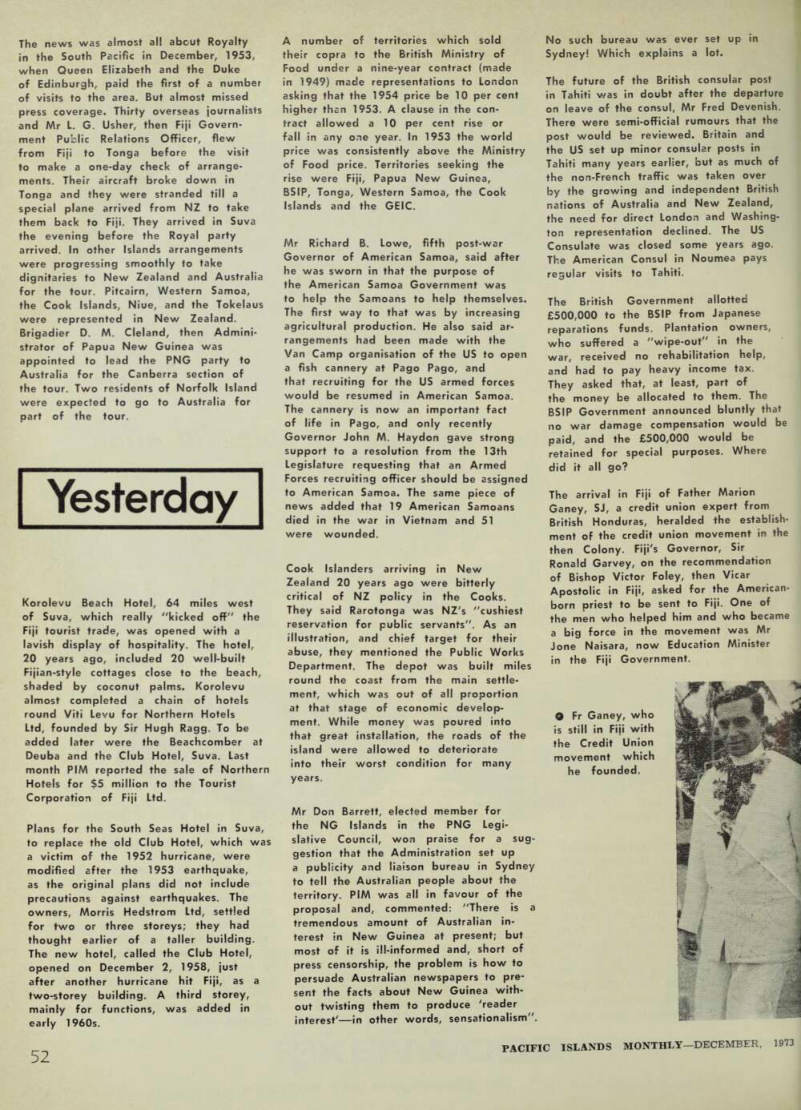
The arrival in Fiji of Father Marion Ganey, SJ, a credit union expert from British Honduras, heralded the establish ment of the credit union movement in the then Colony. Fiji's Governor, Sir Ronald Garvey, on the recommendation of Bishop Victor Foley, then Vicar Apostolic in Fiji, asked for the American born priest to be sent to Fiji. One of the men who helped him and who became a big force in the movement was Mr Jone Naisara, now Education Minister in the Fiji Government.
Fr Ganey, who is still in Fiji with the Credit Union movement which he founded.