Magazine Section
pp. 51-55 · Read in the full issue
Rise And Decline Of The
Thursday Island Press
This is the first of an occasional series of articles on newspapers in the Islands in the early days. Dr Coppell is a lecturer in education at Macquarie University, Sydney, and formerly Deputy Director of Education in the Cook Islands.
By W. G. Coppell
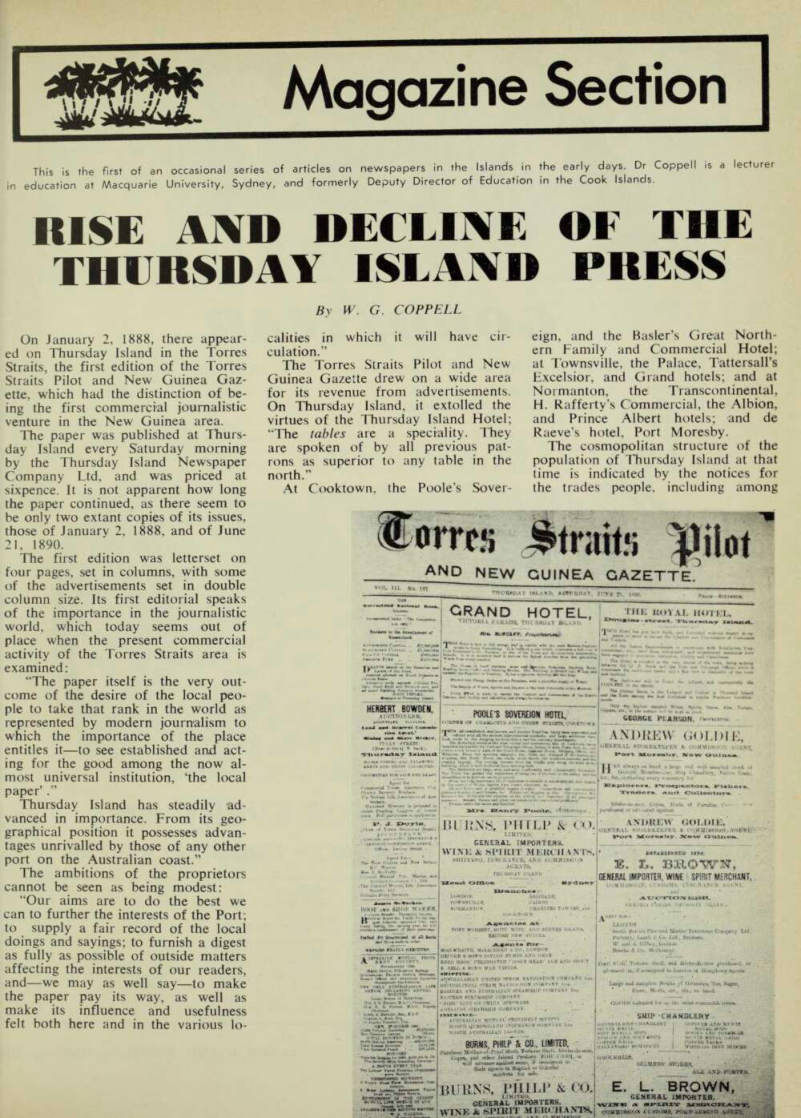
On January 2, 1888, there appear ed on Thursday Island in the Torres Straits, the first edition of the Torres Straits Pilot and New Guinea Gaz ette, which had the distinction of be ing the first commercial journalistic venture in the New Guinea area.
The paper was published at Thurs day Island every Saturday morning by the Thursday Island Newspaper Company Ltd, and was priced at sixpence. It is not apparent how long the paper continued, as there seem to be only two extant copies of its issues, those of January 2, 1888, and of June 21, 1890.
The first edition was letterset on four pages, set in columns, with some of the advertisements set in double column size. Its first editorial speaks of the importance in the journalistic world, which today seems out of place when the present commercial activity of the Torres Straits area is examined: “The paper itself is the very out come of the desire of the local peo ple to take that rank in the world as represented by modern journalism to which the importance of the place entitles it—to see established and act ing for the good among the now al most universal institution, ‘the local paper’.”
Thursday Island has steadily ad vanced in importance. From its geo graphical position it possesses advan tages unrivalled by those of any other port on the Australian coast.”
The ambitions of the proprietors cannot be seen as being modest: “Our aims are to do the best we can to further the interests of the Port; to supply a fair record of the local doings and sayings; to furnish a digest as fully as possible of outside matters affecting the interests of our readers, and—we may as well say—to make the paper pay its way, as well as make its influence and usefulness felt both here and in the various lo
calities in which it will have cir culation.”
The Torres Straits Pilot and New Guinea Gazette drew on a wide area for its revenue from advertisements.
On Thursday Island, it extolled the virtues of the Thursday Island Hotel; “The tables are a speciality. They are spoken of by all previous pat rons as superior to any table in the north.”
At Cooktown, the Poole's Sover
eign, and the Basler’s Great North ern Family and Commercial Hotel; at Townsville, the Palace, Tattersall’s Excelsior, and Grand hotels; and at Normanton, the Transcontinental, H. Rafferty’s Commercial, the Albion, and Prince Albert hotels; and de Raeve’s hotel. Port Moresby.
The cosmopolitan structure of the population of Thursday Island at that time is indicated by the notices for the trades people, including among
others —Ernst Sturzebecher, store keeper; Miss Buschel, pianoforte tui tion; D. Mills, boatbuilder; Viggo Jacobsen, accountant; Ono Showgers, Japanese laundryman; Tommy Japan, shooting gallery; Antonia Spain, tail or and hairdresser; and Tong Sing Wah, Sun Ti Lee, Kwong Hang Hing, Wong Fat, Lee Foo and On Lee, Chinese storekeepers.
The paper carried a wide range of overseas reports—Lord Randolph Churchill was on his way to St Peters burg; Queen Victoria was to visit Florence in the spring months; and students were dissenting at St Peters burg.
The first edition Pilot and Gazette was obviously intent on meeting its objective of recording the local doings and sayings; “John Moreman is a man no more, No matter whether grave or mel low; Whate'er he may have been before, He’s now a jolly good fellow— at least his boarders at the Euro pean said so on Christmas night, and they clinched the bold assertion with a ‘nip, nip—hurrah’ and a flourish of Udopho Wolfe.’ (A reference obviously to the Schnapps which Burns Philp adver tised).
Thursday Island was quite patently a lively place. The local police force was congratulated “upon the excellent Drder which prevailed on the Island throughout the late Christmas holi days”; the Collector of Customs was reported to have seized 200 brilliants, 1,200 rubies, 650 sapphires, and some rings and pins smuggled on to the Island by Mr Joseph Levy, of Paris; and, four men during the previous week had tempted the unsophisticated inhabitants to adorn their persons with gorgeous jewellery and precious stones.”
Mr Levy—one of four, was repor ted to have been constrained in his activities by seizure of his stock.
“Solomon, when arrayed in the very zenith of his glory, would have tur ned green and yellow with envy ;ould he have seen the people of this little island decked out with the full :ontents of the show cases of this quartette. But we didn’t ‘deck’ to an nverwhelming extent, so Solomon need not feel jealous of us. We are a modest people here and are satis fied with the unassuming pearl—and iven that we do not use as wearing apparel, but transmute into a trifle nf gold, which in turn we convert
into the food we eat—and the drop we drink.”
The June 21, 1890 issue of the Pilot indicates that the paper’s pro prietors were not enamoured of Sir William McGregor, the Governor of British New Guinea.
“Sir William had proven an ex plorer among the very foremost ranks, but as an administrator he has not been a success. However much he may desire that his name shall be written on the pages of history as a great explorer, it is unquestionable that the colonies will not long toler ate the expenditure of the greater part of their money in making his name famous.”
This later edition of the Pilot shows considerable departures from the for mat of the first edition. One page is given almost entirely to advertise ments of Melbourne business houses —J. Taylor, Saddler of Hargreaves
Street; Clausen and Co, the complete home furnishers of Bourke Street and the Golden Specific Co of Collins Street with positive cure of drunken ness— “lt can be given in a cup of coffee or tea without the knowledge of the person taking it; it is absolutely harm less and will effect a speedy and permanent cure, whether the patient is a moderate drinker or an alcoholic
Wreck. It Never Fails.”
At this time the paper was printed and published for the Torres Straits Newspaper Coy Ltd and it had clear intentions of future expansion. This edition contained several items reprin ted from English and American newspapers—‘Four Monarchs in Prison’ from the New York Times, the Arizona Kicker from the Detroit Free Press as well as a lengthy ex
(Continued on p 51)
tract from My Mrs Fitzallen by Marie Virginia Harding.
These contributions were seen to enhance the value of the Pilot. “The Manager of this paper has completed arrangements by which he trusts to be able to supply his subscribers with a supplement each week. The first number appears with this issue. It will be found to contain a very large amount of acceptable reading matter; and we earnestly hope the venture will meet with sufficient reward to warrant a continuance of the supp lements.”
The successor to the Pilot and Gaz ette was The Torres Straits Daily Pilot, a few copies of which are also held in Australian libraries, the earl iest edition being August 1, 1918, and the most recent, August 29, 1940. All issues inform the reader that the Daily Pilot is published for the pro prietress by A. Corran, Thursday Island, and that the subscription is one shilling payable in advance, one
copy for each subscriber, or sixpence each for single copies.
All copies are printed on one side only of a single sheet, and are set out in either two or three columns.
The editions from 1933 onwards state that the paper is registered at the GPO Brisbane for transmission as a newspaper. The Daily Pilot carried shipping notes, some local advertise ments, and a few short items of Aus tralian or general world news.
The August 29, 1940 edition car ried this notice: “£5O reward for in formation leading to the conviction of any of my employees found guilty of selling or handing over trochus shell, Beche de Mer, or any other marine produce to any other person or other than my authorised agents —T. J. Farquhar.”
In 1957 the Torres News was es tablished on Thursday Island as a weekly news-sheet, published each Tuesday by G. and J. Maloney.
The Maloneys still print and pub lish a cyclostyled paper, which carries the masthead of Torres News Bulle tin of Thursday Island and Torres Straits News. The issue of September 18, 1973 which was priced at 10c is completely concerned with the local scene, including weather notes, the results of the Lions Club raffle, Bowls Club notes, an item on Thurs day Island’s new wharf, an appeal for blood donors and a report contributed by the Principal of Thursday Island High School.
The decline in the commercial im portance of Thursday Island since the days of the Torres Straits Pilot and New Guinea Gazette is seen in the four advertisements for accommo dation houses, The Rainbow Motel, The Grand Hotel, the Royal Hotel and the Torres Straits Hotel.
No longer are “tables a speciality”, in fact only the Rainbow Motel allu des to any culinary virtues, in its case a snack bar and restaurant.