Fiji's homeless
p. 11 · Read in the full issue
Anxious days for Fiji's homeless and . . .
... A $60 Million
Tourist Town
From SEONA MARTIN in Suva
This time last year many Fiji eople were assessing and repairing ic damage done to their houses by urricane Bebe.
In some ways, they were the lucky nes. They had houses to repair or sbuild. There are many in Fiji who ave no house at all. The hovels and ;mporary shelters they live in could ot be graced by the term “house”.
Most of them are squatters. They uild makeshift shacks on land hich does not belong to them and xist uneasily until someone orders lem off. Some of them even pay a ttle rent, but have no proper lease n the land.
Their problems are exposed every 3 often when developers move into squatter area and enforce a mass viction.
Many developers, including Fiji’s lousing Authority, which builds low ost housing estates for workers, do leir best to find them alternative ites.
If one is found, the situation is sually not much better for the imily involved. Sometimes they can ot be helped at all.
Suruj Kuar and her family, for sample.
She, her husband and their seven tiildren live in a mean, little grass nd rusting iron shack, so small they an hardly all fit lying down on the oor to sleep.
Sacks and mats form their bedding, hey don’t have any luxuries like roper beds, and very little of the >sentials, like food.
Suruj’s husband, Ramiji (45), is ckly and cannot often work. When e does he earns about $l5 a week ith a construction company. When b doesn’t work, the family exists n about $lO a month government imily assistance payments.
Now, even the security of their lack is threatened by a Housing uthority development. Each day the ulldozers loom closer, bringing sarer the day when the family will s homeless.
They have nowhere else to go, and mnot afford to move into a Housing uthority flat. They could not pos hly keep up the rent payments.
Hart (Housing Assistance and elief Trust) hopes they will be able
to do something about this family’s plight, and the plight of many others in similar situations.
Hart was formed about three years ago to build low-cost houses for destitutes.
The organisation is pledged to help those who simply cannot help them selves. Most of the families living in Hart houses receive less than $2O a month income and cannot afford to pay rent.
Hart is essential to their survival.
The houses Hart provides are in no way luxurious. They are bare shells of concrete block, wood or fibro, with one large, partially partitioned room and a lavatory and shower stuck on the back or front of the structure.
Nothing elaborate, but dry and comfortable. Better than a collapsing hovel of grass, beaten biscuit tins and plastic bags—a secure type of home for hundreds.
Building costs have risen enormously in the past couple of years in Fiji, and houses which used to cost Hart $5OO to build now cost $l,OOO or more.
This month the organisation is appealing for funds to keep its work going.
Contributions can be sent to Hart, PO Box 1106, Suva.
Work on a 200-room hotel at Wail oaloa Beach, near Nadi in Fiji will start in December. This will be the first step in a $6O million project which was recently approved by the Fiji Government under the zoning and town planning laws. The project, covering 120 acres, includes 14 major hotels, two commercial areas (with a 3-acre shopping centre) 35 home lots and a marina with a 170 ft boat wharf.
New Metal Mines Ltd, an Aust ralian company diversifying into tourism, is negotiating for a 90 per cent share of the Sunlover Hotel, at Nadi. The company secretary, Mr Hilton Robinson, said it was only waiting for the hotel’s balance sheet before completing the deal. The price was reported at $1 million.
A $22 million housing and tourist resort will be built at Saweni Beach, near Lautoka. Saweni Beach De velopment Ltd has leased 240 acres of beach frontage land. The project, to be completed over five years, in cludes two international hotels, 400 housing allotments, shopping facili ties and public amenities. A. V. Jen nings Industries (Aust) Ltd, has 40 per cent of the shares; Australian Finance and Investment Co Ltd and Mr Ben Kirk, a Californian develop er 25 per cent each and the Native Land Trust Board 10 per cent.
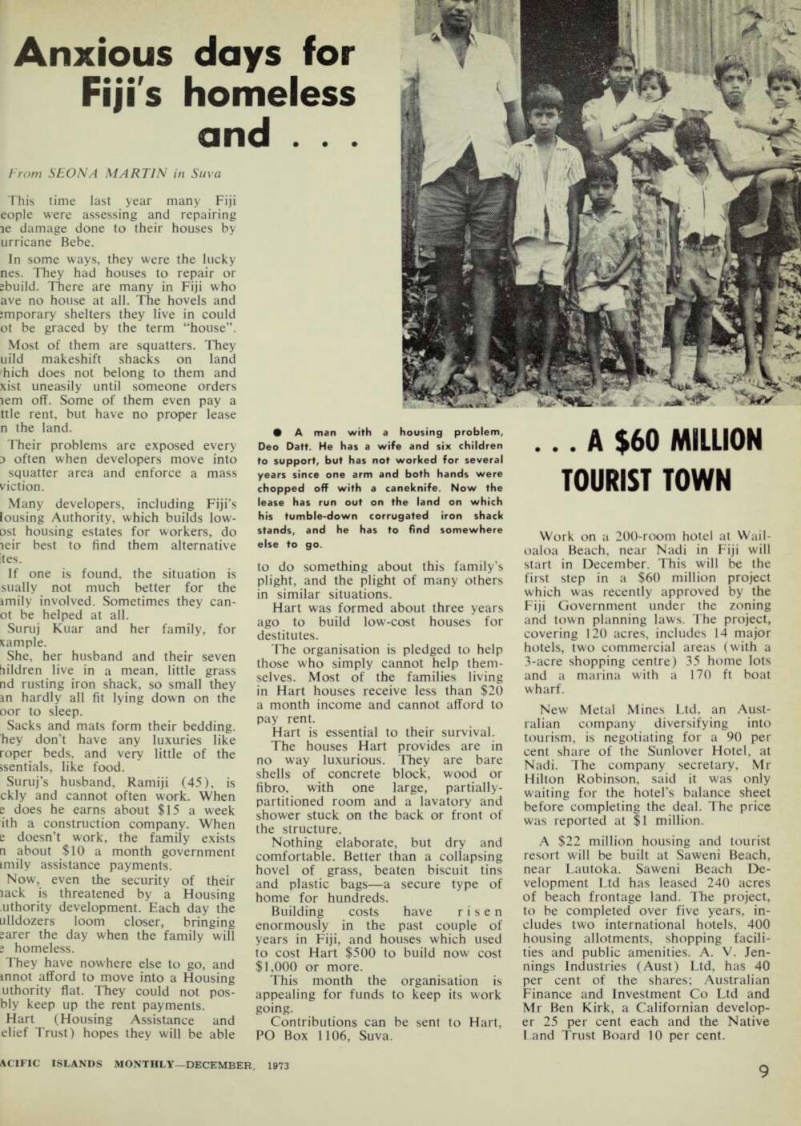
• A man with a housing problem, Deo Datt. He has a wife and six children to support, but has not worked for several years since one arm and both hands were chopped off with a caneknife. Now the lease has run out on the land on which his tumble-down corrugated iron shack stands, and he has to find somewhere else to go.