Localisation
pp. 9-10 · Read in the full issue
Creates New
Elite - And
A Headache
7 rom AAP correspondent PETER BROWN in Port Moresby For young, educated New Guineans he government’s policy of local sation has led to meteoric promotions md the creation of a new black elite.
Senior expatriate public servants yho have administered the Australian erritory are rapidly being replaced •y local officers while the govern nent has introduced strict employ dent regulations into the private sec or. About 200 occupations from bar nan to boilermaker are restricted to 4ew Guineans only.
In two years the country’s white •opulation has fallen by about 20 per ent from 55,400 to 44,600. And his rate is expected to accelerate be ween now and the end of 1976 when he government’s localisation pro gramme should have reduced the lumber of expatriate public servants rom 7,500 to 3,000.
The New Guineans filling the va ancies are becoming the privileged lass in a previously classless society.
Vith salaries ranging up to about '8,500 a year they are becoming im neasurably more affluent than the ast majority of the country’s ,500,000 people.
The entire indigenous workforce is stimated at just over 200,000 so aost New Guineans do not take part n the cash economy at all.
The new elite are the university rained ministerial advisers, depart nent heads, district commissioners nd senior public service officers.
The new chairman of the Public ervice Board, Mr Sere Pitoi, said hat seven of the 18 government de triment heads have been localised nd the remainder will be replaced •y New Guineans by 1976.
The bulk of lower levels of public ervants are now New Guineans.
The demand for skilled manpower 5 so great that new graduates are doving straight into senior positions nd fears are now being expressed hat the entire process is getting out •f hand.
Dr Reuben Taureka, the Minister or Health, recently sparked a public lebate about localisation when he yarned that his department and the
medical service in general was suffer ing because of it.
He told a district health officers’ conference that his department was meeting the government’s requirement of 15 per cent localisation this year.
“But I am not sure this is alto gether something to be proud of,”
Dr Taureka said. “The fact is that there are not just the numbers of qualified New Guineans to meet the requirements of the public service and the private sector.”
The next day, the Minister for Trade and Industry, Mr John Baptist Poe, said he agreed “most strongly” with Dr Taureka.
“To attempt to replace experienced officers with the untrained ones just to achieve a nominal 15 per cent localisation in the present year will cause chaos and disruption,” Mr Poe said.
During a recent tour of the country, several senior local officers told him they were worried because they them selves were being promoted far more quickly than they thought they could handle.
Mr Poe said that if his department had to continue its present rate of localisation the government would lose revenue from customs and excise duty.
“My department is training as many trainees as its funds allow, and in fact has difficulty in finding suffi cient recruits to fill all the positions available,” he pointed out.
He said that without the expatriates in the department his staff would not have the experience or know-how to collect all the revenue due.
At the same time, the Leader of the Opposition United Party, Mr Tei Abal, said that only a slowdown in the localisation programme could save the public service from collapse.
“The United Party has long stated that it is unfair to expect local officers to assume responsibilities for which they were being inadequately trained, and with little prospect of gaining any worthwhile experience due to the rapid departure of the expatriates who could have helped them,*’ Mr Abal said.
“As early as October last year the opposition had called for a realistic attitude in the wanton dismissal of expatriate public servants without considering the availability of local resources.’’
He was referring to his unsuccess ful motion in the House of Assembly which stated: “That this House recog nises and fully supports the principle of localisation throughout the public service, but deplores that the accel erated termination of senior overseas officers is leading to a position where local officers are unfairly being forced to accept heavy responsibility while being denied sufficient opportunity to benefit from the long experience of these officers.”
Earlier this year Chief Minister Michael Somare indicated his ack nowledgement of the need for foreign expertise.
He circulated letters to selected expatriates offering continued em ployment till December 1976, which he said was the minimum time their services would be required.
In the letters Mr Somare said the government realised that experienced overseas officers would be needed
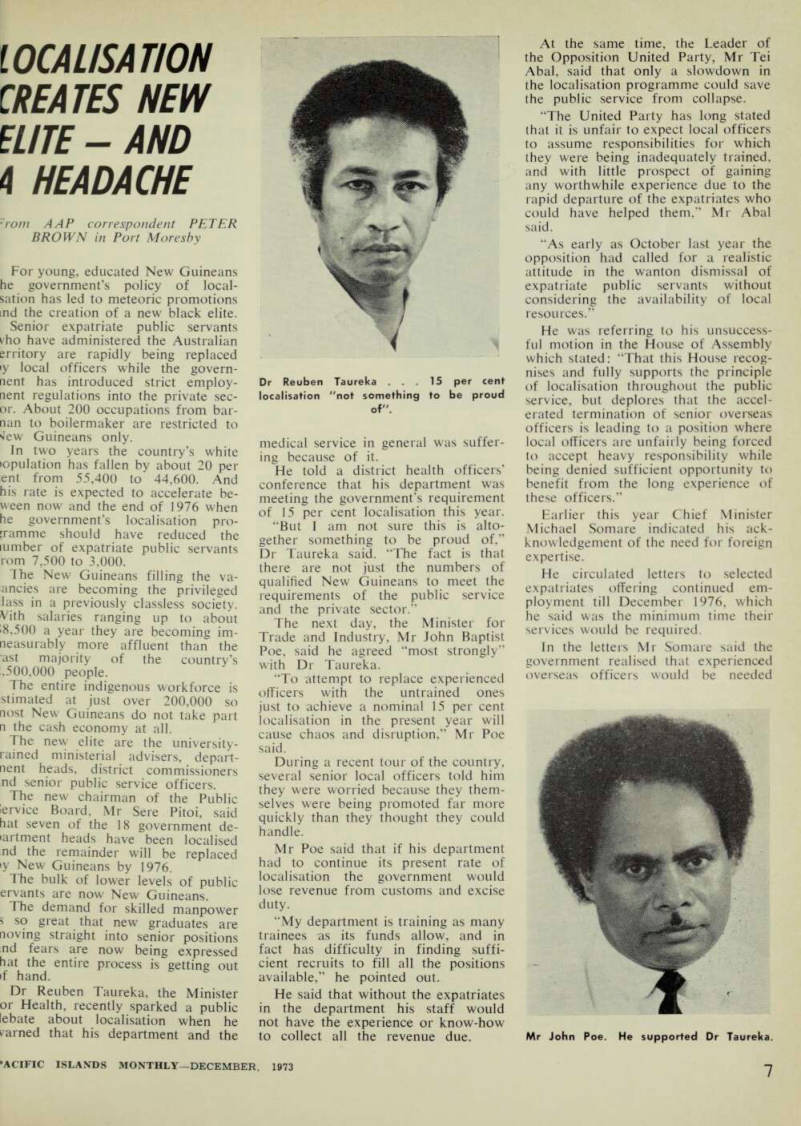
Dr Reuben Taureka ... 15 per cent localisation "not something to be proud of".
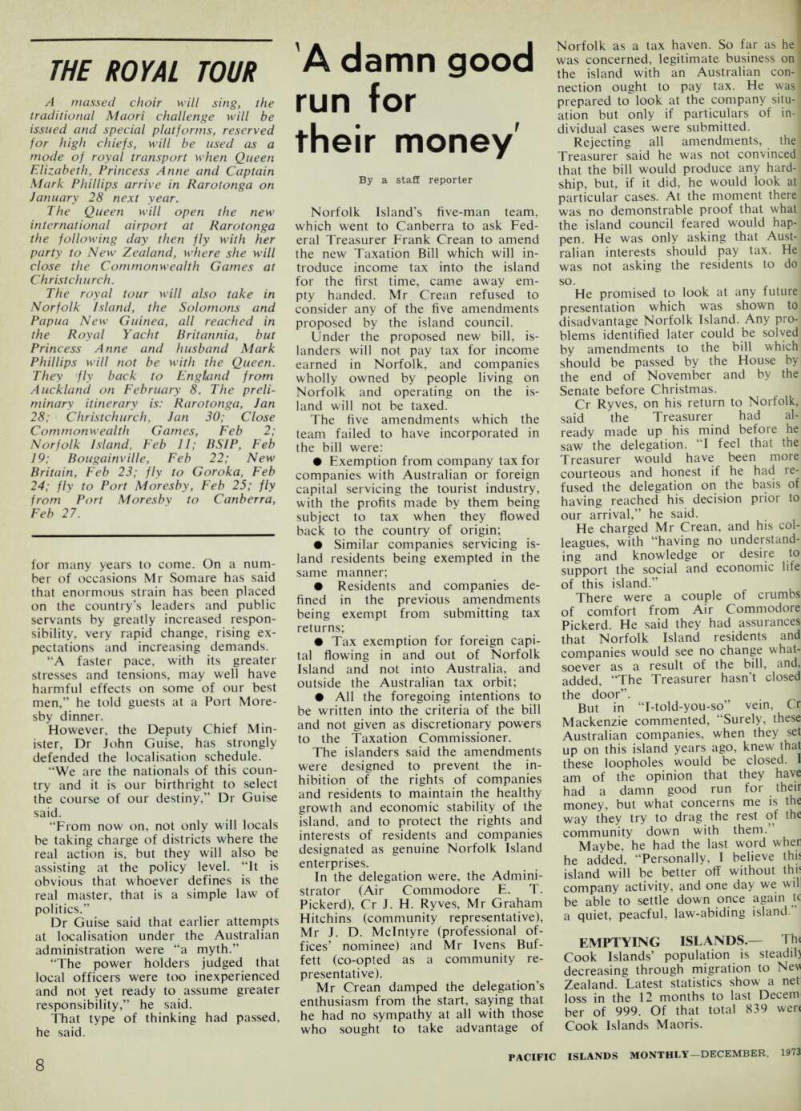
Mr John Poe. He supported Dr Taureka.
for many years to come. On a num ber of occasions Mr Somare has said that enormous strain has been placed on the country’s leaders and public servants by greatly increased respon sibility, very rapid change, rising ex pectations and increasing demands.
“A faster pace, with its greater stresses and tensions, may well have harmful effects on some of our best men,” he told guests at a Port More sby dinner.
However, the Deputy Chief Min ister, Dr John Guise, has strongly defended the localisation schedule.
“We are the nationals of this coun try and it is our birthright to select the course of our destiny,” Dr Guise said.
“From now on, not only will locals be taking charge of districts where the real action is, but they will also be assisting at the policy level. “It is obvious that whoever defines is the real master, that is a simple law of politics.”
Dr Guise said that earlier attempts at localisation under the Australian administration were “a myth.”
“The power holders judged that local officers were too inexperienced and not yet ready to assume greater responsibility,” he said.
That type of thinking had passed, he said.