BritisKAirways PACIFIC JET
p. 97 · Read in the full issue
Boac News
Spike Milligan
Off The
Beaten Track
BOAC Supplement—Advertisement)
By Spike Milligan
Try and see Britain from her secondary roads. These ire away from those high speed highways which don’t ;ive you much chance to drive slowly or stop to look iround. These secondary and country roads will take r ou through the countryside and into villages, and there 'ou find the real character of these islands. You’ll find r ourself passing through rural settings that clearly show heir origins in Anglo-Saxon times, and villages that lave changed little since the time of say, Oliver Cromwell. Each village has its church, usually the >ldest building around. Don’t be embarrassed about ipproaching the vicar. He can fill you in with a few mportant dates and facts, and also probably tell you i bit about the village’s history. And a visit to a rural mb of an evening will let you deeper into the personality if the farming community, whether you’re in the com iany of ploughmen or farmers or both. Many of the ilder villages, like Winchelsea, in Sussex, have their >wn local museums, which are more intimate and ociable in comparison with the monoliths like the British Museum, and in many cases, more interesting.
If you want to go the whole hog, take a book on he flowers and wildlife of the British Isles. You’ll find i book on geology, minerals and fossils useful. There ire many sites that you can potter around and most certainly, as I did at Kettering, in Northamptonshire, ind fossils in local excavations. If you are a glutton, md want up to date information on archaeological ex cavations, contact the Council for British Archaeology.
I St Andrew’s Place, London, N.W.I. They will tell everything you need to know, and if you wish you can even work on a site in the humble task of digging and get paid!
All there is to do next is get in the car and enjoy it.
But a point further. What season? Well, for me, it vould be spring running into summer, or summer unning into autumn. These two overlapping seasons
Probably more than anything, the world-famous Goon Show radio series of the 1950’s has contributed to Terence Alan Milligans reputation as one of the most quixotic, and cer tainly one of the funniest men alive.
The world knows him better as Spike of course —author of nonsense books, actor of crazy comedy and hilarious man with a few very serious causes.
He has been as much in the public eye off-stage, by putting his name to the conservation cause. He takes the preservation of architecture and natural beauty seriously, and is fond of wildlife, but his campaigns have inevitable tints of Milligan humour and madness. As when he fought to preserve the quaint gas lamps on Constitution Hill, next to Buckingham Palace, when they were threat ened with removal in favour of concrete electric ones.
Spike suggested to the authorities that they might like to plant plastic daffodils in the roadside flowerbeds as well, to put them in keeping with the modern look. And, once, at the Hayward Gallery in London he took a hammer and smashed a large tank containing tropical fish which were being electrocuted as part of an exhibition. offer snowdrops, lambs, chicks, bird’s nest hatchings, and at the other end, tired summer green commuting into burning embers of autumn. Both spring and autumn offer that brisk morning cold, with the first warmth of March to the dying warmth of September.
Along your way you will come upon places of humble origin that spawned illustrious sons and daughters. 1 had an occasion to be passing through Ecclefechan, in Scotland, and discovered the birthplace of Thomas Carlyle. Among other things there was the cot he was born in and the wooden foot-rocker cradle his mother lulled him to sleep in. On the subject of Scotland try, once in your life, to be there when the first heather is turning the hills into purple in July, August and September.
If you are a romantic, as I am, you’ll always take a volume of poetry with you. Wordsworth’s daffodils still grow in the Lake District (alas, no longer in hosts!) and to read the verse on the spot is a special pleasure.
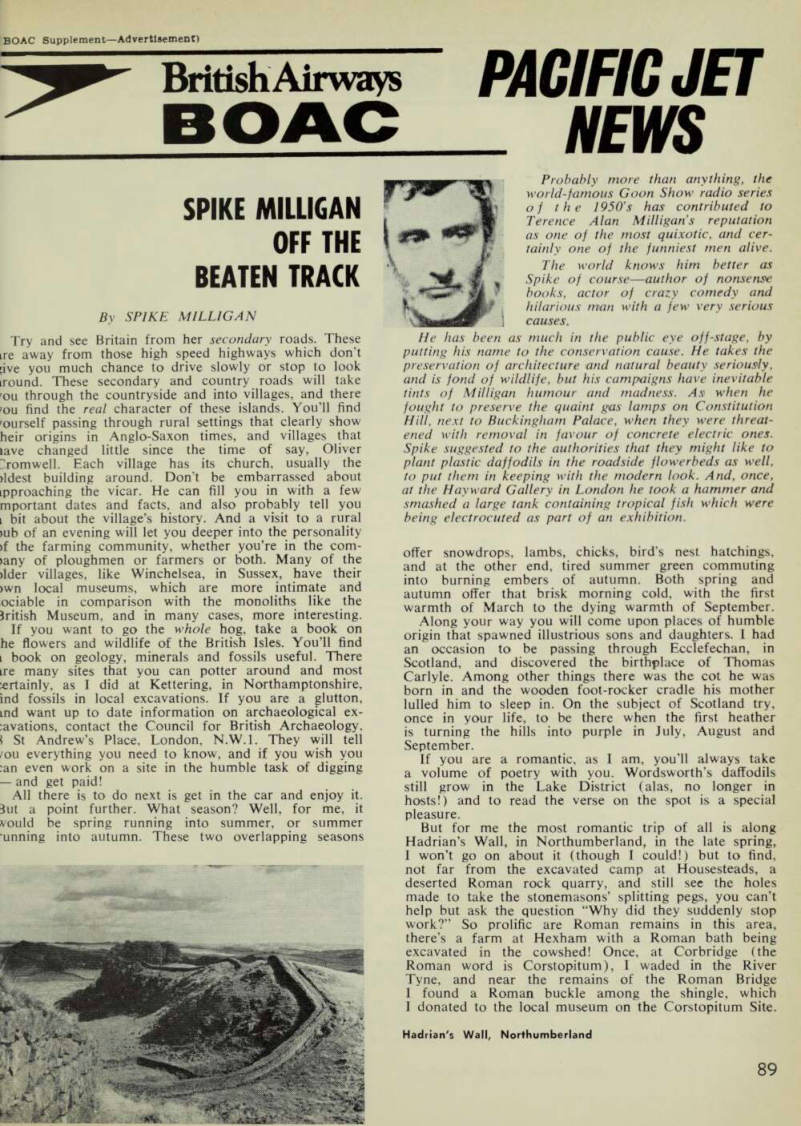
But for me the most romantic trip of all is along Hadrian’s Wall, in Northumberland, in the late spring, I won’t go on about it (though I could!) but to find, not far from the excavated camp at Housesteads, a deserted Roman rock quarry, and still sec the holes made to take the stonemasons’ splitting pegs, you can’t help but ask the question “Why did they suddenly stop work?” So prolific are Roman remains in this area, there’s a farm at Hexham with a Roman bath being excavated in the cowshed! Once, at Corbridge (the Roman word is Corstopitum), I waded in the River Tyne, and near the remains of the Roman Bridge I found a Roman buckle among the shingle, which I donated to the local museum on the Corstopitum Site.
Hadrian's Wall, Northumberland