'Rapture'
pp. 81-83 · Read in the full issue
Continues
In Png
Here in Port Moresby we had be gun to fear that the “first fine care less rapture” of Papua New Guinean theatre had dwindled into silence.
But two recent successful productions have allayed our fears. And the prospects for the rest of 1973 look hopeful, with the Third Niugini Festival of Arts in Port Moresby get ting under way as I write.
Sogeri High School’s production of Russell Soaba’s Scattered by the Wind brought out strongly the theme of the blending of old and new, village and city, in modern Papua New Guinea.
The lyrics, set to haunting Anuki tunes, were sung by a very with-it looking group of young men and women dressed in slick flares and singlets, who, between-whiles, did cool, jazzy, mod dances, rather sub dued in tone.
At the end of the play, their cool, urban dance alternated with the grass skirted bobbing and jogging of a Milne Bay traditional dance group, until, in a final scene, the lights went up on the whole stage, and on the two groups, and grass skirts and flares danced together in a symbolic blend ing of old and new, village and town.
I thought Eleanor Boyd’s interesting production over-emphasised this old new theme at the expense of the other principal theme of the play (which was better served by the UPNG perform ance of the same play at the First Niugini Festival of Arts in 1971): namely, the theme of humanistic pro test against the narrow rigidity of village Christianity. James, the protest ing son of a Papuan pastor has his counterparts all round the world. He rejects all labels, including the label Christian, and calls himself simply “a true dedicated human being” using language that sets up Existentialist echoes in western ears: “I am neither good nor bad, neither right nor wrong—l just simply am”.
If anyone thinks that in so Chris tianised a society as Papua New Guinea there is no place for modem, radical doubt, then he should read this play in Kovave (Nov 1972).
The second theatrical success of the year was Death of Muruk by Ber nard Narokobi. This is not a play about conflict of cultures or ideas: it is play which reasserts traditional Melanesian values. It is based on a Dagua myth which Margaret Mead
has referred to as “the Arapesh ver sion of “The Swan Maiden’’.
“Arapesh” is the word coined.
In it, a young man falls in love with a cassowary-women, marries fier in human form, but then, tempted ay the fleshpots, neglects her and their children. The wife abandons her liuman form and becomes again a cassowary, and turns the four young est children into swallows. In this itory is expressed the Melanesian sense af the oneness of man with nature, and also the more specifically Dagua attitude to men-women relations, and atherly and husbandly responsibilities.
The villagers, who were students from various parts of Papua New Guinea, danced genuine Dagua mour ning and wedding dances taught to them by the playwright’s parents, who came to Port Moresby from the Sepik District specially for the purpose.
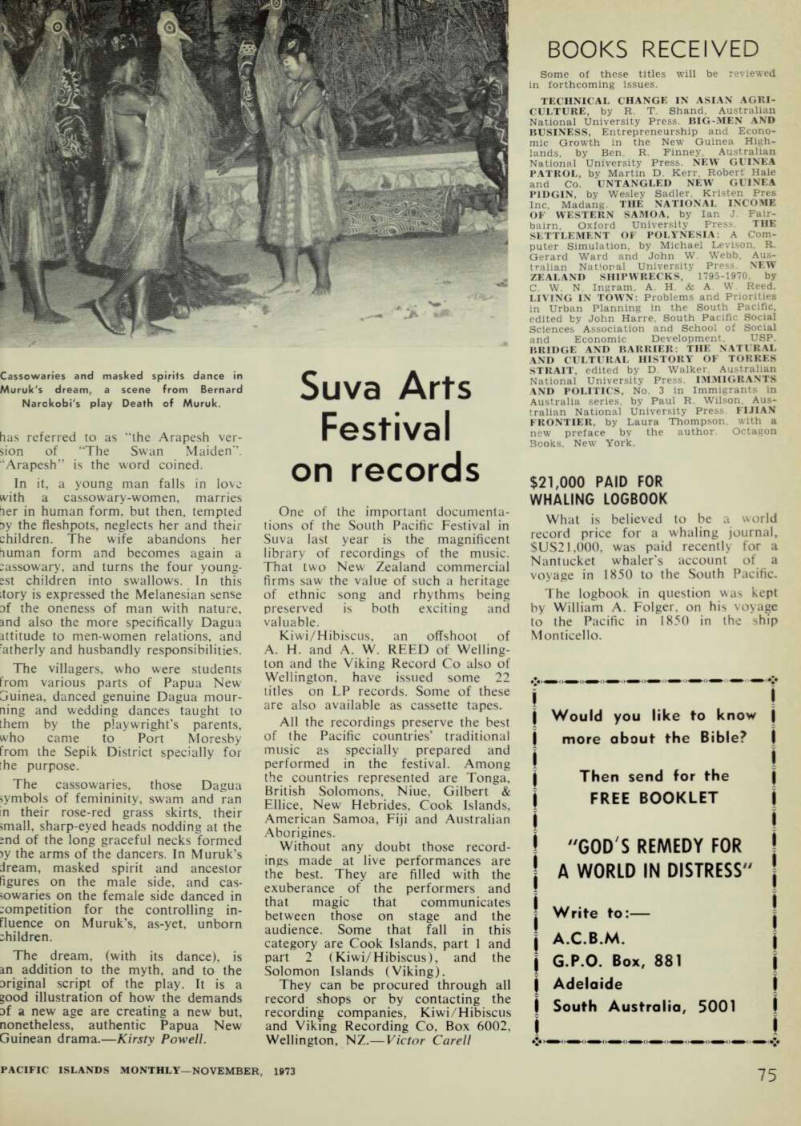
The cassowaries, those Dagua symbols of femininity, swam and ran in their rose-red grass skirts, their small, sharp-eyed heads nodding at the end of the long graceful necks formed >y the arms of the dancers. In Muruk’s dream, masked spirit and ancestor figures on the male side, and cas sowaries on the female side danced in competition for the controlling in fluence on Muruk’s, as-yet, unborn children.
The dream, (with its dance), is an addition to the myth, and to the ariginal script of the play. It is a good illustration of how the demands af a new age are creating a new but, nonetheless, authentic Papua New Guinean drama. —Kirsty Powell.
Cassowaries and masked spirits dance in Muruk's dream, a scene from Bernard Narokobi's play Death of Muruk.