A Legend Of Love And Death
pp. 71-72 · Read in the full issue
By Mele Nasalivata
IN the olden days the inhabitants of various islands in the Fiji group visited each other. The people of Lakeba, in the Lau group, followed the same custom. They often visited Tonga which is outside Fiji. Another island group which they were fond of was Bau.
Among the islands of the Lau group, Lakeba is known to be a chiefly island. At that time in each island of Fiji there was usually a person, a man, who was the strongest and handsomest and he was the chief.
Strength and beauty were the main characteristics of the island chiefs.
There dwelt, in the island of Lakeba, a chief called Niumataiwalu who was reputed to be the strongest man in Lau.
One fine day the people of Lakeba decided to visit the island of Bau.
Usually these visits were with a pur pose. The purpose of this one was to see and to meet the strongest chief in Bau to test Niumataiwalu’s strength. The people of Lakeba were looking forward to this trip to Bau with excitement. Soon the great day arrived to leave.
When they reached Bau they im mediately performed their traditional ceremony of sevusevu and qaloqalovi.
These Fijian ceremonies are usually done when people visit others in other parts or when a big chief returns to his original abode.
After all these ceremonies were performed the Lakebans were allowed to stay on the island for a few days.
All went ashore except Niumataiwalu who stayed on board. Unfortunately they didn’t find any strong man who could challenge Niumataiwalu.
People of Bau who went on board to see this great man began to talk about him, admiring his handsome features and prowess. This was the gossip mostly among the ladies. Be fore long the daughter of one of the chiefs heard about this. She wanted to see it for herself. She decided to visit him on the boat.
Early every morning she would cook food and sneak out of the house.
She did all this secretly for fear of being caught. She would take a small raft and row furtively via the back of the island, so that nobody could see her. She would then approach the boat from the starboard side. This went on for quite a while and, as
days passed, more frequently. Their daily relationship grew and they were lovers without anybody in Bau realising it.
The day came when the Lakebans had to return and the lovers had to part. Niumataiwalu left.
Before long, it was discovered that the chiefs daughter was pregnant.
The great Niumataiwalu was respon sible.
In those days it was very serious to have an affair outside or before marriage and worse still if the girl becomes pregnant. As a punishment for this crime the man responsible was usually killed with a wait (club) while the expectant mother was ostra cised by the members of the com munity.
The people of Bau gathered to gether when they heard about this to plot to put Niumataiwalu to death.
Now the main problem they faced was: Who would be brave enough to kill the accused? Not even the strongest man in Bau had guts to
kill him. The Bauans then went through the whole of Fiji to ask the people whether anybody could solve their problem. They went from island to island, village to village and they took with them tabua (whales' teeth) for this was a custom. A whale’s tooth is usually presented to show re spect and thanks for a particular favour or task. Also this is presented when you are in great need and would like some help.
It so happened that Niumataiwalu heard about the terrible plan. He started to escape to other villages and islands within Lau. The Bauans heard of his escape from Lakeba and were not sure of his whereabouts. They sent whales’ teeth to the villages he was likely to visit. Together with the tabua were what we call Matanivanua (spokesmen) who would explain to the people the purpose of the whale’s tooth. Niumataiwalu knew nothing about this.
At last the people from Bau came to the island Ono which is at the very
southern tip of the Lau group. There they found a man who was willing to kill Niumataiwalu. A whale’s tooth was presented to him to show respect and express thanks.
A meeting was held in the village of Matokana in Ono immediately.
The main purpose was to make ar rangements for the killing. It was de cided that Niumataiwalu would be clubbed in the next meeting which would be just among the chiefs of Lau, excluding the Bauans although they were on the island.
Before the great meeting Sauni kalou, the strongest man in Ono, who was to do the killing, had arranged with his only grandson all the things they would do.
It was decided that when the grog meeting was in progress the little boy was to enter the meeting house, bure, and present the club which was to be hidden smartly in rewly-bored banana leaves as if it was just a bunch of banana leaves. The boy was told that as soon as he entered he was to go straight to his grandfather Saunikalou without any fear and hesi tation and hand the bunch of leaves to him. If his grandfather was to chase him or growl for his interruption he was told not to listen but just hand the club and say the leaves were for
smoking.
The meeting was called and the chiefs of Lau were present including Niumataiwalu who was blissfully un aware of the conspiracy. The grog party was in swing when the grandson walked in from the second door »f the meeting house holding a bunch of banana leaves, all coiled up neatly.
He walked straight to Saunikalou and presented the disguised club. Sauni kalou had already started to growl and chased him but he knew that these would happen for he was told beforehand.
Now it was time to serve another round of grog and it was Niumatai walu’s turn to be served. The qarava
na dave (grog server) filled his bowl and gave it to the culprit.
While Niumataiwalu was busy help ing himself to his big bowl of yaqona, Saunikalou stood up. walked up to him and clubbed him brutally. Those who were in the house were shocked.
The great Niumataiwalu staggered out of the meeting house and col
lapsed. Within seconds he lay dead.
Saunikalou was thanked and praised for the great deed he had done. A big feast followed. Both the Lauans and the Bauans celebrated before the latter returned to their island.
As a reward the people of Ono-i- Lau are welcome to visit Ban any time. Today it is said that some trees in Matokana, the village in which Niumataiwalu was killed, bear whitish-yellow leaves. These trees grow on the places where Niumatai walu’s blood fell.
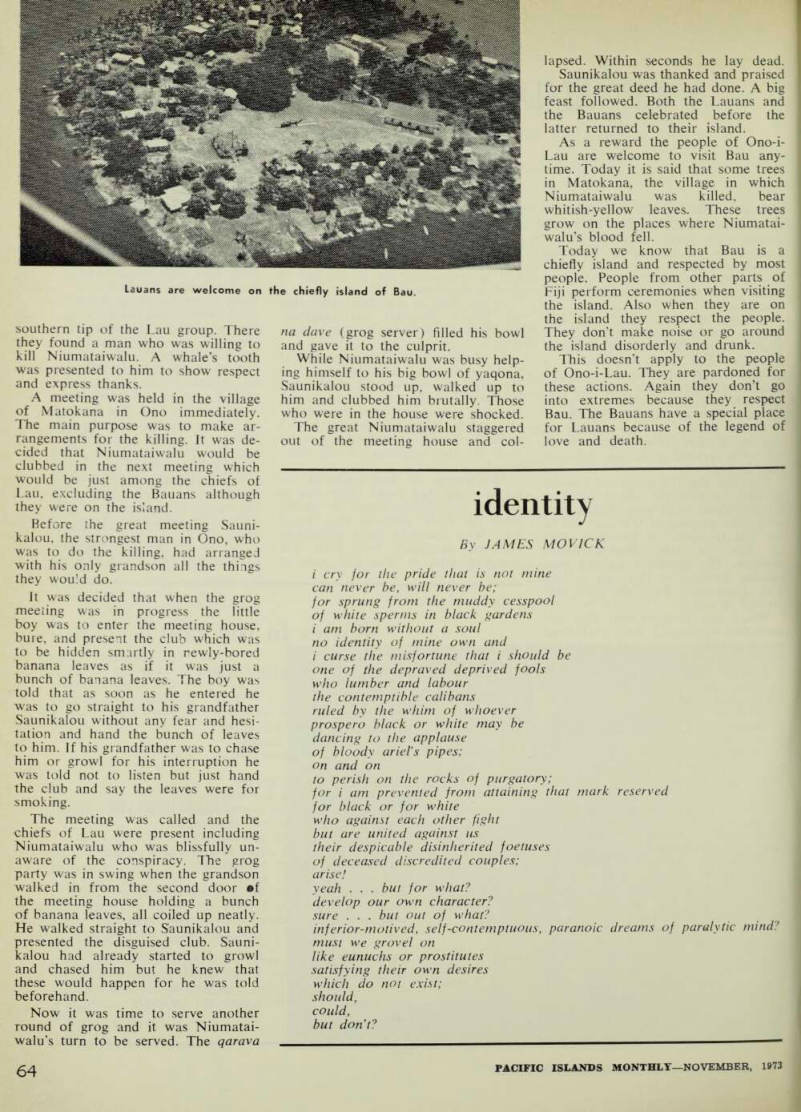
Today we know that Bau is a chiefly island and respected by most people. People from other parts of Fiji perform ceremonies when visiting the island. Also when they are on the island they respect the people.
They don’t make noise or go around the island disorderly and drunk.
This doesn’t apply to the people of Ono-i-Lau. They are pardoned for these actions. Again they don’t go into extremes because they respect Bau. The Bauans have a special place for Lauans because of the legend of love and death.
Lauans are welcome on the chiefly island of Bau.