Saving the New Guinean
p. 20 · Read in the full issue
from the demon Drink
From a special correspondent in Port Moresby
The less-than-gentle Australian art of “boozing” seems likely to be re stricted in a self-governing Papua New Guinea.
Kisim wanpela greenie and other bar noises will not be heard after 8 pm if liquor bills tabled in the House of Assembly last month are approved. The proposed restrictive legislation is seen as a bid by the government to prevent alcoholism and its associated problems.
Such problems were spelt out by the Commission of Inquiry into Alcoholic Drink in a report to the House of Assembly last year. The commission toured the country to see what effect alcohol was having on the lives of Papua New Guineans. It came up with evidence to support the view that the great Australian social habit had become a pernicious Papua New Guinea pastime. The commission blamed drink for all manner of evils —from racial violence and other crimes, to family neglect.
The substance of the bills to be debated in the November sitting of the house is drawn from the com mission’s report.
The bills were introduced by the Minister for the Interior, Dr Guise, who described them as “a big matter” and nothing to do with party politics.
They did, however, have a lot to do with Papua New Guineans, their wives and families. They added up to the simple fact that the govern ment is determined to protect Papua New Guineans from alcohol, and if necessary from themselves.
Such a concept may be strongly criticised, and even rejected by Aust ralians and people of so-called ad vanced Western countries. However, the reception it gets from many thinking Papua New Guineans may be interesting. For if an alcohol pro blem is emerging in Papua New Guinea, and ample evidence shows that there is, many Papua New Guin eans may see it as the government’s duty to do something about it.
Whatever the reaction, no one can say the legislation is being imposed on the people. The commission’s re port, showing the concern of many people, cited examples of wives having little with which to feed their families because their husbands had drunk their meagre wages.
The bills will give people a say in liquor licensing in their areas through local advisory committees set up to represent the local people in such matters as the licensing of hotels, taverns and tradestores. The govern ment also agrees with the commission that people have too great an oppor tunity to drink alcohol in public. It proposes to cut drinking hours from twelve to seven hours a day. Bars would close at 8 pm instead of 10 pm.
Licensed stores would not be per mitted to sell liquor after 6 pm, ma king it impossible for a drinker to leave a bar at closing time and go to a tradestore for a carton of beer on which to continue a drinking session elsewhere.
Sunday drinking would be cut from five hours to four. The government believes that if people are going to drink alcohol it is better for them to drink beer than wine or spirits, so it is proposed to make it illegal for fortified wines and spirits to be bought at public bars.
Believing that too many stores, par ticularly in rural areas, have licences to sell liquor, it is argued that many Papua New Guineans enter trade stores to buy food, but change their minds when they see alcohol for sale.
The bills also make it difficult for people to get drunk in public and
make it illegal for licencees to sens drunks. Licencees would also be re sponsible for removing drunks froq the premises, rather than leaving 1 to the police.
The government’s attitude was re cently summed up by the Chief Minis ter, Mr Michael Somare, when hi said alcohol restrictions were in thi best interests of Papua New Guinei because Papua New Guineans ha< not yet learned to use alcohol.
Acceptance of the government’ proposals by the House of Assembly at the November sitting seems likely Dr Guise has no doubt that the bill will have an easy passage.
To many Euroneans living in Papui New Guinea, the proposals appear t( be unduly restrictive. A comment b] the European member for Southerj Highlands, Mr Neville, when D Guise outlined the proposed drinkinj hours, may be indicative of wha many Europeans think. Mr Neville! interjection was a mere “Gee 1 Dr Guise’s answer “ it is goo< ” may, however, indicate wha many Papua New Guineans think; How “good” it will be for Papu| New Guinea’s much sought-afte tourists looking for another place ti go for a drink after 8 pm has yet ti be assessed.
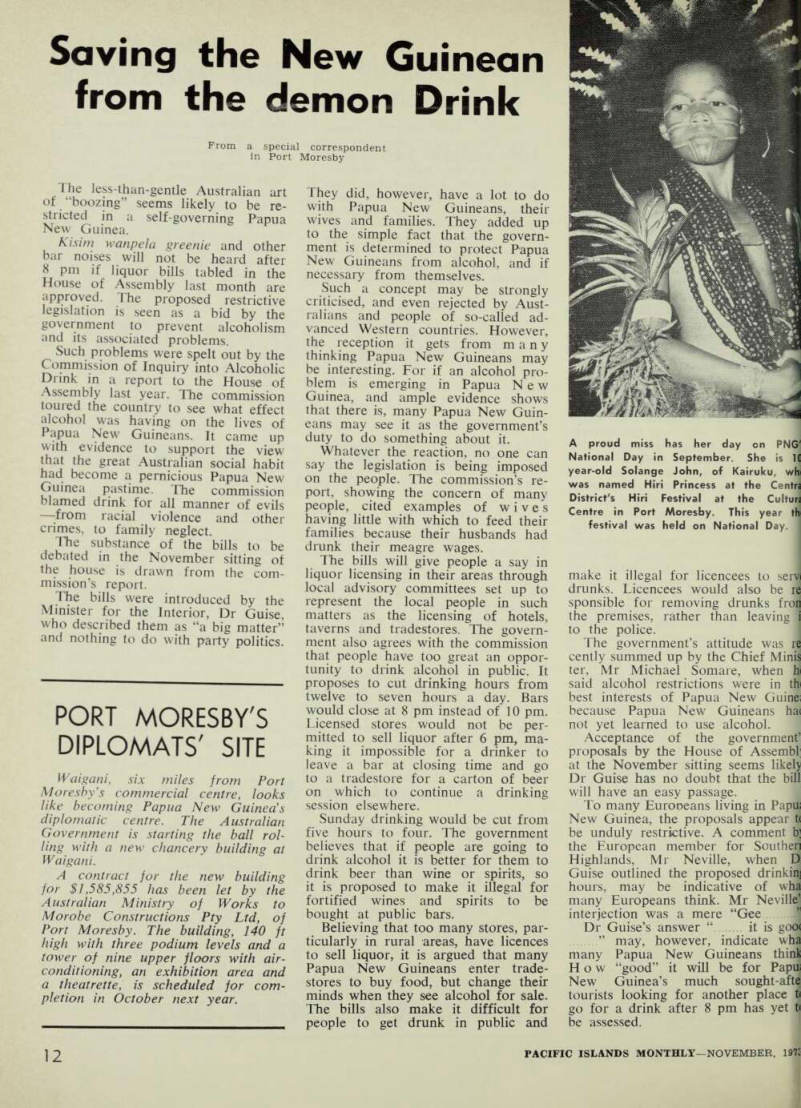
A proud miss has her day on PNG[?] National Day in September. She is 1[?]
year-old Solange John, of Kairuku, wh[?]
was named Hiri Princess at the Centra[?] District's Hiri Festival at the Cultur[?] Centre in Port Moresby. This year th[?] festival was held on National Day.