How Fiji Fights Price Rises
pp. 17-18 · Read in the full issue
PIB has become a dirty set of initials in Fiji. It stands for Prices and Incomes Board, the activities of lich are under fire from the parliamentary Opposition and the trade unions. The board is the Fiji Govern 3nt's attempt to stem inflation. Is it succeeding? Below are some of the answers.
From a Suva correspondent
Fiji’s prices and incomes policy to mbat inflation has followed a pat rn that seems to have become mdard.
First, there was a sudden, dramatic claration that all prices, charges, iges and house rents were to be >zen for 90 days from April 1. iring the freeze period a permanent ces and Incomes Board would be up and a representative National onomic Council established.
The declaration was generally well :eived. A common reaction was, flank God somebody is doing mething about the cost of living at ,t”.
Three months later, an expert ving been recruited from the lited Kingdom to head the Prices d Incomes Board and to formulate d administer a permanent anti lationary policy, details or Stage yo were announced.
They defined guidelines within lich changes in prices and incomes re to be restricted.
The next stage, to begin in Novem r, will be an attempt to resolve the esses and reconcile the pressures it have developed during Stage /o, and still try to flatten the in tionary spiral.
Hanging over all efforts to keep : cost of living down in Fiji is the m fact that a major element in it cost is outside Fiji’s control. So my goods are imported that prices ; basically determined by cost >vements in overseas countries, irrency exchange fluctuations edu cate things still further.
The gap between Fiji’s currency d those of Australia and New aland, countries which supply many Fiji’s imports, has widened imatically this year. When New aland revalued by 10 per cent and istralia by 5 per cent in September i followed with a 5 per cent re flation.
But the Fiji dollar has since floated wnwards with the pound sterling, th which it remains linked, and it now worth about 14 per cent less in the New Zealand dollar and out 15 per cent less than the Aus lian.
Add these percentages to the in ice cost of imported goods, plus ;ight and Customs charges based the landed cost, and add a further
percentage profit mark-up and you have a pretty formidable built-in price inflation.
The Fiji Prices and Incomes Board, consisting of two imported experts and a local civil servant, bases some of its price controls on percentage mark-ups, but in most cases fixes specific selling prices.
A commonly-heard complaint from merchants is that the margins per mitted are unrealistically low, and show that the board members know nothing about, or will not acknow ledge, the hard facts of commercial life, including the cost of financing purchases and of shipping delays and of storage and selling on credit.
Even the Consumer Council, a body set up by the government to act as a watchdog on prices and selling practices, concedes that it is difficult to police price controls in small stores, or where itemised dockets are not issued.
Cases have occurred where traders, faced with loss or what they regard as an inadequate return on imported goods, have just stopped importing them. Resulting shortages, especially in foodstuffs in popular demand, have led to a hasty upward revision of the permitted selling price.
But if the Prices and Incomes Board is not exactly the most loved body in the commercial world of Fiji, its
most vehement opponents have come from the trade union world.
The Stage Two guidelines fixed a limit of 8 per cent in the overall annual increase in the wages and salaries bill of a given business or industry.
Union leaders, beset by rivalries within the trade union movement generally and under pressure from their own members, have refused to acknowledge that such a discipline is necessary in the national interest.
They declare that all it does is to interfere with the collective bargain ing process and so stop them from getting wage increases which they would otherwise be able to get from employers.
A strike at the Fiji Industries Ltd cement works at Lami in September arose, not from any dispute between employers and employees, but be cause a 15 per cent wage increase, negotiated before the “freeze”, was disallowed by the Prices and Incomes Board as it exceeded the 8 per cent guideline.
The Board explained that a 15 per cent rise in wages would inevit ably lead to an application by Fiji Industries for an increase in the con trolled price of cement. This would in turn raise building costs and so contribute to the general inflationary movement.
But this lesson in the economics of control of inflation was brushed aside by the president of the Fiji Trades Union Congress, Mr James Raman, who said that the PIB was enabling employers to benefit by keep ing money which they would other wise have passed on to employees in increased wages.
Mr Raman later resigned from the National Economic Council, and then led a walk-out from a widely repre sentative conference called by the NEC to discuss the principles to be adopted in Phase Three of the prices and incomes policy.
“A political gesture”, commented the chairman of the Prices and In comes Board, Dr Norman Ross, adding, with obvious justification, that it seemed that union representatives did not consider it worthwhile to discuss problems which concerned the interests, welfare and well-being of Fiji’s workers. (Over)
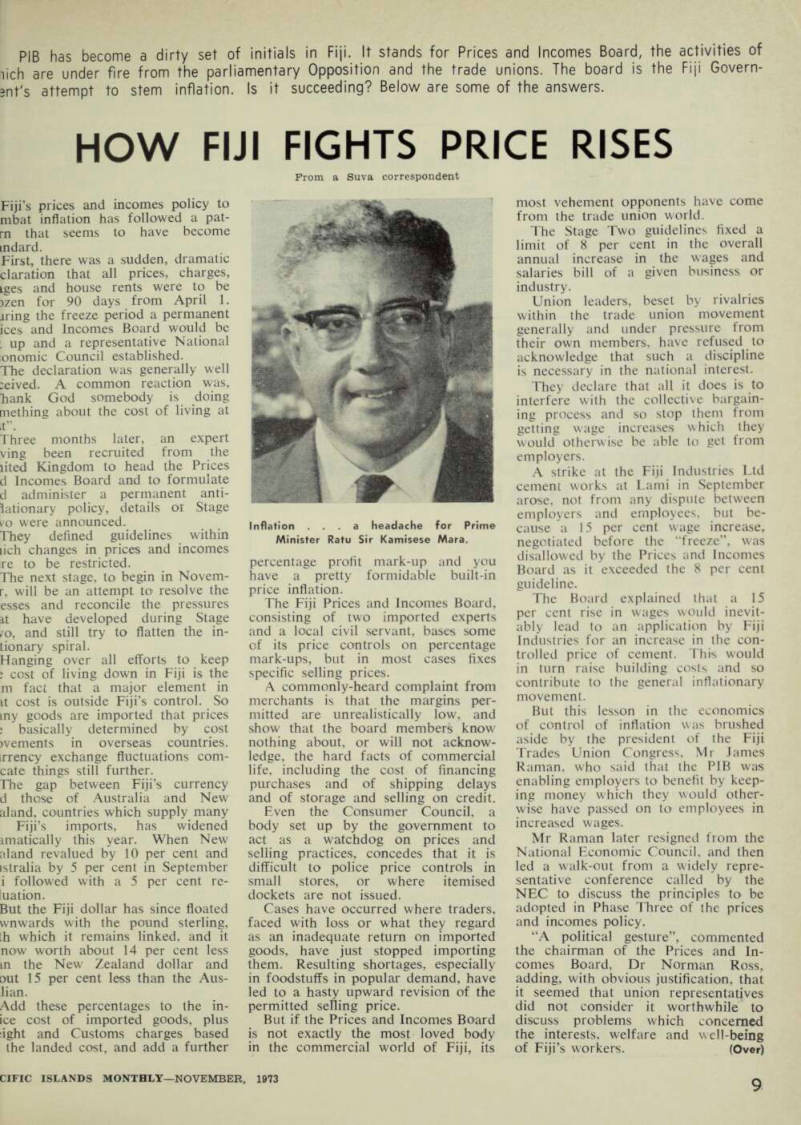
Inflation ... a headache for Prime Minister Ratu Sir Kamisese Mara.
The board can rightly claim some success. The cost of living, as measured by an official index, is still rising but the rate of increase has gone down.
The 8 per cent limit on wage lifts is being pretty generally applied, in spite of the loud noises being made by trade union leaders and by poli ticians for whom any stick is good enough with which to beat the gov ernment.
Price and rent controls are having an effect, in spite of protests by traders about heavy-handed and often inept interference by officialdom with commercial processes.
In the famous Punch cartoon the curate told his host, the bishop, that his breakfast egg was good in parts.
Fiji’s Prices and Incomes Board can at least make a similar claim.