American Samoa hatches
p. 16 · Read in the full issue
its own mini-Watergate
From a Pago Pago correspondent
In probably the first case of its kind, the Governor of American Samoa, John M. Haydon, recently appeared before an administrative tribunal of the United States Civil Service Commission to answer char ges involving malpractices in his ad ministration.
Governor Haydon was charged with putting pressure on the district governors to tell the voters to vote “no” on the proposal to replace the appointed governor with an elected one. (This national referendum re sulted in an overwhelming “no” vote against the proposal.) He was also charged that he had stated in a radio broadcast, just be fore the last general elections, that in his belief no palagi (Caucasian) should be elected to the Samoan legislature. At that election, a palagi, Wilbur Reinie, ran for one of the Manu’a constituencies, and lost.
There was also a number of other minor charges but these were the chief ones.
No one can deny that the main charges were serious ones dealing as they did with alleged interference with public elections, a matter speci fically forbidden in the US Hatch Act. According to this act, no civil servant can take part in or try to in fluence the course of a public elec tion.
Is Haydon guilty or not? This is a matter which only the tribunal can decide and its decision is expected before the end of the year. If Hay don is guilty, he may have to go.
But what strikes an observer of American Samoan affairs is the fact that the trial has come as a climax to many crises that have affected the Haydon administration—a sure sign of the political turmoil in which American Samoa is enmeshed as the result of the conflicts experienced in the political and social spheres.
There is, firstly, the conflict be tween the traditional Samoan social system and the foreign American social system and this is evident throughout all levels of Samoan society.
The Samoans, by and large, want to maintain the Samoan social system but find that, in reality, the faaSamoa system is no use against the white man’s law, administrative procedures and general standards of behaviour.
Hence, the average Samoan tends to be uncertain of himself.
In the political sphere, the question arises how much political power should be given to the Samoans, who are a ward of the United States Con gress? Samoans want political power but not to the extent of pushing out the Americans or of stopping US grants to the territory. This again creates an ambivalent attitude to wards the American.
In such an uncertain situation, op portunists have their way in Ameri can Samoa.
It would not be fair to label Gover nor Haydon as an opportunist for it could be argued on his side (as was done in the trial) that he was try ing to guide a generally-uninformed population as to the best decision to make in the two elections.
Perhaps he had reason to suppose that the Samoans were not yet ready to elect their own governor and that competition from palagis in the legis lature would not be a good thing for the majority of Samoans.
On the other hand, Haydon’s super iors at the Interior Department or the White House could say it was not Haydon’s discretion that was wanted in this case, but the will of the Samoan people regardless of their stage of intellectual development.
This is where Haydon will either stand or fall.
As to the minor charges, Haydon was contradicted by subordinates on the matter of the amount of the de-
ficit when he came into power i 1969 and of the number of feden grants then in operation. But even : Haydon was wrong, and his subordii ates right, this would merely prov that Haydon had been inconsisten that he had not been efficient in gel ting the facts first. The conclusio that he lied doesn’t necessarily follov Though it is quite conceivable th£ Haydon had overstepped himself i an important issue, it should be n membered on the other hand that h has had to operate in a murky ai mosphere ever since he became govet nor. His duel with Jake King, editc of the Samoan News, had bee splashed on the pages of the York Times, the Washington Po: and other national newspapers.
His image had been cruelly vil lied by the Samoa News and politic* aspirants and this in a manner ind eating a lack of understanding.
Haydon is probably a nice Amer can who tries his best but is clums at times. Call him an Ugly America / if you like but he is not the crimim he is often painted.
A sequel to the hearing involvin Governor Haydon was the dismiss* of the man who filed another charg< Assistant Attorney-General Jim Kinj zett. He charged the governor wit interfering with the civil rights c two individuals at the hearing.
Kingzett’s alleged offence accordin to Attorney-General Donald Williarr was that he had seen fit to privatel investigate certain charges involvin Governor Haydon and file them i Williams’s name with absolutely n discussion with Williams or othe attorneys in the department.
Kingzett replied that he was mere! doing his job. He had been r< sponsible for criminal prosecutior for the last two years and as a matte of practice did not consult Williarr before filing charges. Anyway, would not have been proper for hii to consult Williams as Williams wa already defending Haydon in th Hatch Act hearings, he said.
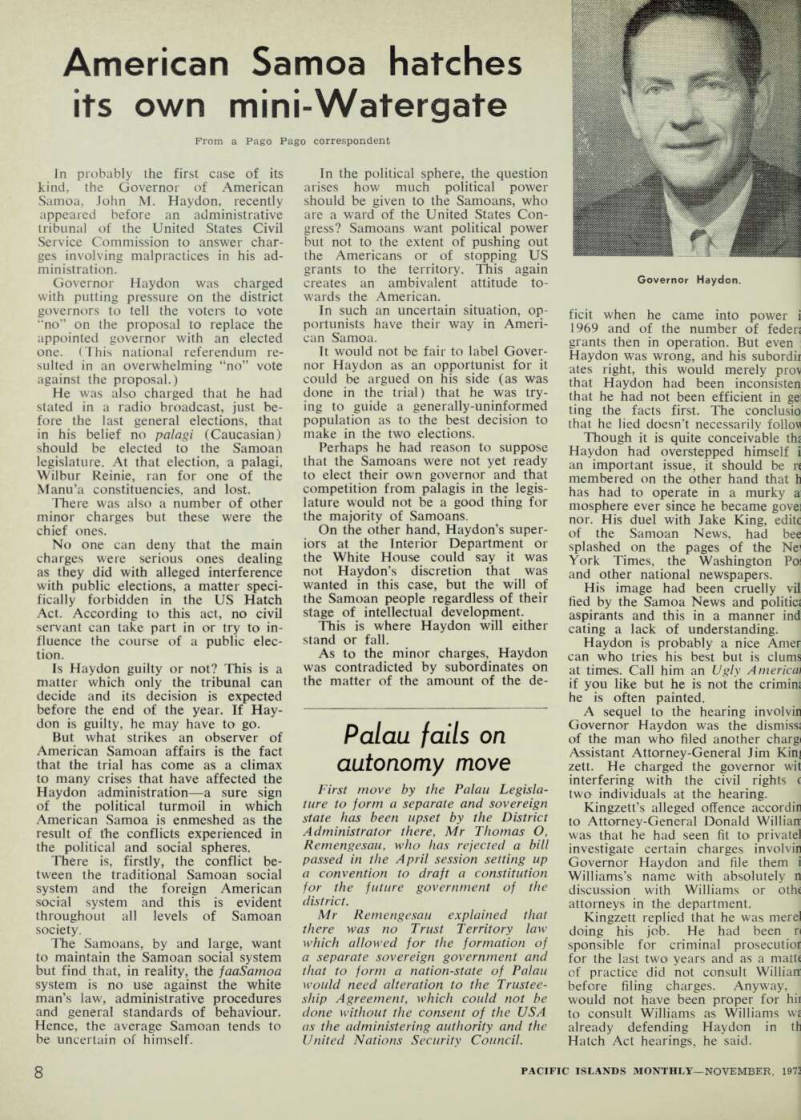
Governor Haydon.