Pacific Islands Monthly
pp. 13-14 · Read in the full issue
Oyal Treasure Hunt Gives
Ongans New Awareness Of Past
From Patricia Matheson,
in Vavau.
f they find the bottle and Vavau ngs to the King of Spain, will we )e slaves?” asked a tearful Tongan 1.
Is it legal?” inquired a Neiafu ness man. hose are only a few of the ques s Vavau residents are asking these i. They were all sparked off by current search for Malaspina’s le which was begun on Septem -17 by King Taufa’ahau Tupou who was in Vavau for the annual cultural show. ctually the affair of the bottle in on May 30, 1793, when a lish expedition headed by Don andro Malaspina which had been ting the islands of the group and ing studies of its people for 10 ;, was preparing to leave.
On an islet off the present village of Longamapu, the Spaniards had erected an observatory and a forge and it was there, in the place in which the observatory had been, that they chose to bury the bottle. In it was a paper which, with the easy and usual arrogance of the day, pro claimed that Vavau belonged to the King of Spain.
Lt Colson, who wrote the Journal of Malaspina’s expedition, claimed that Vuna, the leading Vavau chief, was perfectly willing to cede his lands to the Spanish monarch, Charles IV, but, in view of the fact that the Spanish had learned all the Tongan they knew in the 10 days since their arrival and Vuna knew no Spanish, it is doubtful if their political dis cussions were very profound.
However, then as now, Tongans were obliging people. Vuna with his followers attended the bottle burying ceremony, watched the flag of Spain raised on the tiny Tongan island and shouted, along with the Spaniards, “Viva el rey” seven times.
The next day the Spaniards sailed away and although they had assured Vuna many of their countrymen would follow, they were the last official party from Spain to come to the islands.
For some reason Malaspina fell into disfavour shortly after his re turn and his journals were not pub lished until some 50 years after his death, and in Spanish naturally.
Thus Malaspina has had no place at all in most Pacific histories.
However, it was not until June of
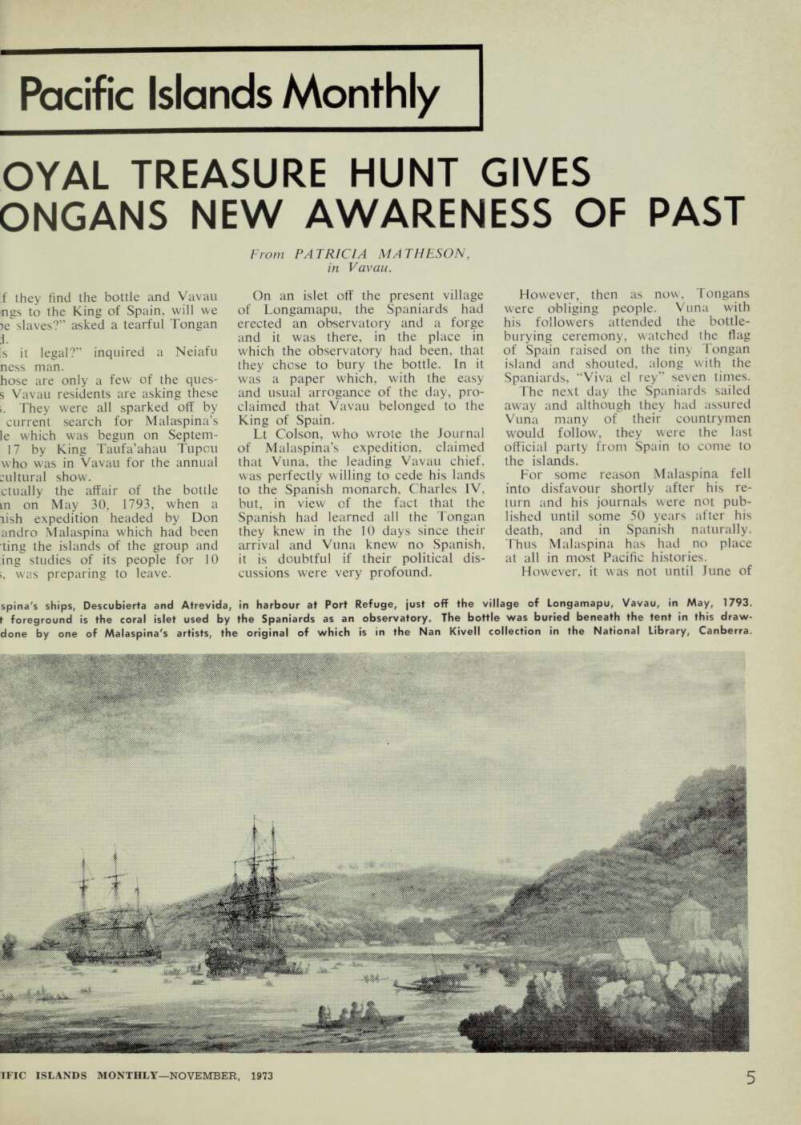
[?]spina's ships, Descubierta and Atrevida, in harbour at Port Refuge, just off the village of Longamapu, Vavau, in May, 1793. [?]t foreground is the coral islet used by the Spaniards as an observatory. The bottle was buried beneath the tent in this draw [?]done by one of Malaspina's artists, the original of which is in the Nan Kivell collection in the National Library, Canberra.
this year that PIM editor Stuart Inder and myself, with significant documentary assistance from his torian Robert Langdon, who is a specialist in Spanish Pacific history, made a definite identification of the tiny bottle island. It was this that led to the royal bottle hunt of Sep tember 17, For the occasion, the Tongan Government landing barge, the Kao, was converted into a true royal barge with the floor lined with fine mats.
In the centre of them, on his special chair, sat King Taufa’ahau sur rounded by his nobles, chiefs and matabules. They sailed from the wharf at Neiafu, making a stately progression down the harbour to the tiny island which for the first time in its history had gained a name . . .
Bottle Island.
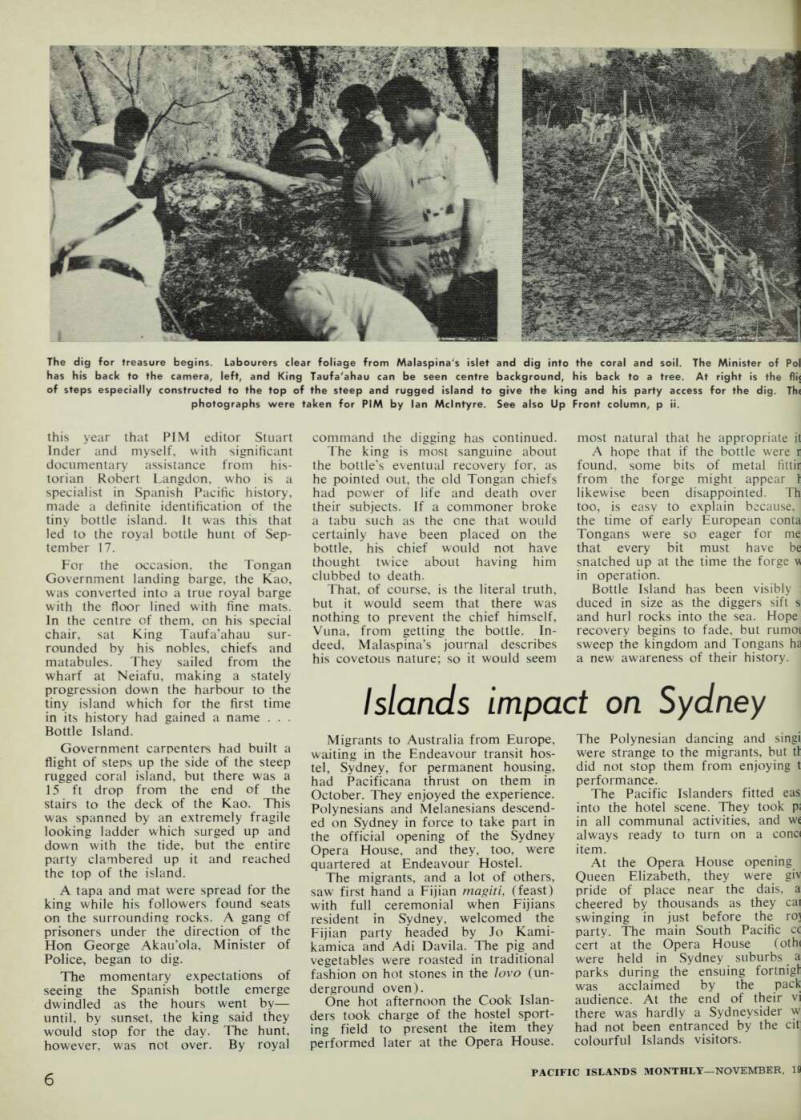
Government carpenters had built a flight of steps up the side of the steep rugged coral island, but there was a 15 ft drop from the end of the stairs to the deck of the Kao. This was spanned by an extremely fragile looking ladder which surged up and down with the tide, but the entire party clambered up it and reached the top of the island.
A tapa and mat were spread for the king while his followers found seats on the surrounding rocks. A gang of prisoners under the direction of the Hon George Akau’ola, Minister of Police, began to dig.
The momentary expectations of seeing the Spanish bottle emerge dwindled as the hours went by— until, by sunset, the king said they would stop for the day. The hunt, however, was not over. By royal
command the digging has continued.
The king is most sanguine about the bottle’s eventual recovery for, as he pointed out, the old Tongan chiefs had power of life and death over their subjects. If a commoner broke a tabu such as the one that would certainly have been placed on the bottle, his chief would not have thought twice about having him clubbed to death.
That, of course, is the literal truth, but it would seem that there was nothing to prevent the chief himself, Vuna, from getting the bottle. In deed, Malaspina’s journal describes his covetous nature; so it would seem
most natural that he appropriate it A hope that if the bottle were r found, some bits of metal fittir from the forge might appear 1: likewise been disappointed. Th too, is easy to explain because, the time of early European conta Tongans were so eager for me that every bit must have be snatched up at the time the forge v in operation.
Bottle Island has been visibly ] duced in size as the diggers sift S' and hurl rocks into the sea. Hope recovery begins to fade, but rumot sweep the kingdom and Tongans ha a new awareness of their history.
The dig for treasure begins. Labourers clear foliage from Malaspina's islet and dig into the coral and soil. The Minister of Pol[?] has his back to the camera, left, and King Taufa'ahau can be seen centre background, his back to a tree. At right is the flic[?] of steps especially constructed to the top of the steep and rugged island to give the king and his party access for the dig. The[?] photographs were taken for PIM by lan Mclntyre. See also Up Front column, p ii.