Buying Back The Farm...
pp. 104-108 · Read in the full issue
By Harry Jackman
Next to inflation, buying back the farm continues to be the big economics issue in Canada, Australia and several other industrialised nations. It is, or soon will be, a very hot political potato in those Pacific countries where foreign interests own and/or control the greater part of industry, commerce and banking. n VT v , ® jb , hat a ess • , " ra , e nal f ’ *l as a B rowi ng nee .^ lr T capita investment
/,f yh ,T 8 /
™te ° f the last decade ,s t 0 be mam '
tamea ‘
The present coalition government knows this. In December, 1972, the Chief Minister, Mr Michael Somare, said that foreign investment and selfemployed New Guinean businessmen are the backbone of the economy, The retention of the ‘mixed’ economy is indicated by the Improvement Programme, the new economic plan announced last March, but there are to be considerable changes in its structure.
To quote the first of the pro gramme’s eight basic aims, there is to be “a rapid increase in the pro portion of the economy under the control of New Guinean individuals and groups, and in the proportion of personal and property income that goes to New Guineans”, New Guineans are currently receiv ing no more than 36.4 per cent of monetary sector income and, unless «hey gain a growing share in owner ship’ this P crcenta gc must decrease as technological progress requires in creasing capital-intensity in just about every industry. Therefore, it is not surprising that the Minister for Finance, Mr Julius Chan, praised the Investment Corporation Fund of Papua New Guinea’s first share issue on September 1.
The investment corporation itself, a statutory body, began in 1972 to acquire equity in locally-based large enterprises on behalf of New Guineans. The corporation now has holdings valued at $10.3 million, The fund, which it has set up and manages, will use the money it re ceives from its shareholders to buy
quity investments already acquired y the corporation. Among these are 6 per cent of equity in Burns Philp NG) Ltd, 35 per cent in Com lonwealth New Guinea Timbers Ltd, 0 per cent in John Lysaght (NG) td and 45 per cent in Watkins roperty and Investment Corp Pty -td, giving a spread over several idustries.
The first issue of one million lares, each of $1 par plus 5 per cent ;e, is only available to New luineans. Not only individuals but iso councils, co-operatives, religious odies and other groups are expected > subscribe in what the corporation’s lairman, Mr E. S. Owens, regards > a medium-term investment. Shares "e offered in minimum parcels of JO, and shareholders may sell their hidings back to the fund or to other iew Guineans. It is hoped to pay a ividend of at least 8 per cent.
In the past, New Guineans have irely responded to offers of equity 1 enterprises floated or controlled Y expatriates, and where they have Dne so, they have often lost their Loney through chicanery or mis lanagement not of their own making, he investment corporation fund, a lit trust with minimal risk, will be good pointer to current investment titudes among the people.
Some observers believe that arm’s ngth investment in ventures owned id managed by New Guineans in eir own district have a greater ipeal than a unit trust, and see a ;ed to give such ventures priority seeking the people’s money.
None will, however, surely fail to cognise the ICFs first share issue a most significant step towards Fective control by New Guineans 'er the economy of their country.
Prom a Honiara correspondent
Bicycles on Tulagi from October 1 must have seats, bells, brakes and lights and their riders must begin obeying traffic regulations. Three policemen were sent to Tulagi to open a post early in August.
In these two small moves are the signs of Tulagi joining once more the mainstream of Solomons life, after being a backwater since the destruction of the pre-war capital during the Japanese invasion.
The Japanese brought Tulagi’s de struction, and now bring it boom times with the building of the Solo mons’ biggest factory, the Solomon Taiyo Limited freezer, cold storage, canning and arabushi (smoke-dried fish) base, the first to be built since the government and Taiyo agreed to the go-ahead less than a year ago.
The police and new bicycle laws follow the increase in heavy traffic population and—as yet minor—evils of industrialisation. The traffic regu lations, by the way, are operative only in Honiara, Auki on Malaita Gizo (Western District) and on tiny Tulagi which is only three miles around with less road than that Sleepy Tulagi’s fine safe harbour which brought to it the government slip-way and the R.C. Symes slipway also made it Taiyo’s almost automatic first choice after Honiara since the government was keen to decentralise the skipjack fishing industry as much as possible. If the fish can be found other shore bases might follow, but this probably depends on the results of trials in fishing methods other than the preSent pole and line and ' thus
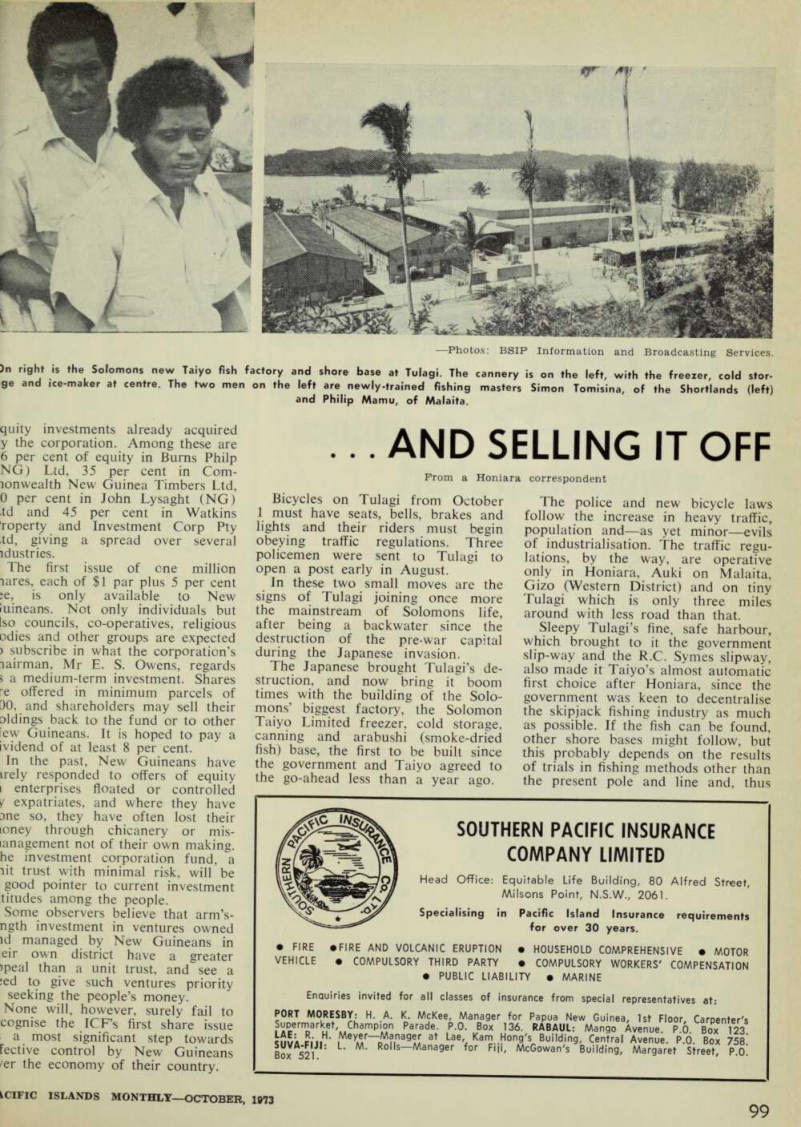
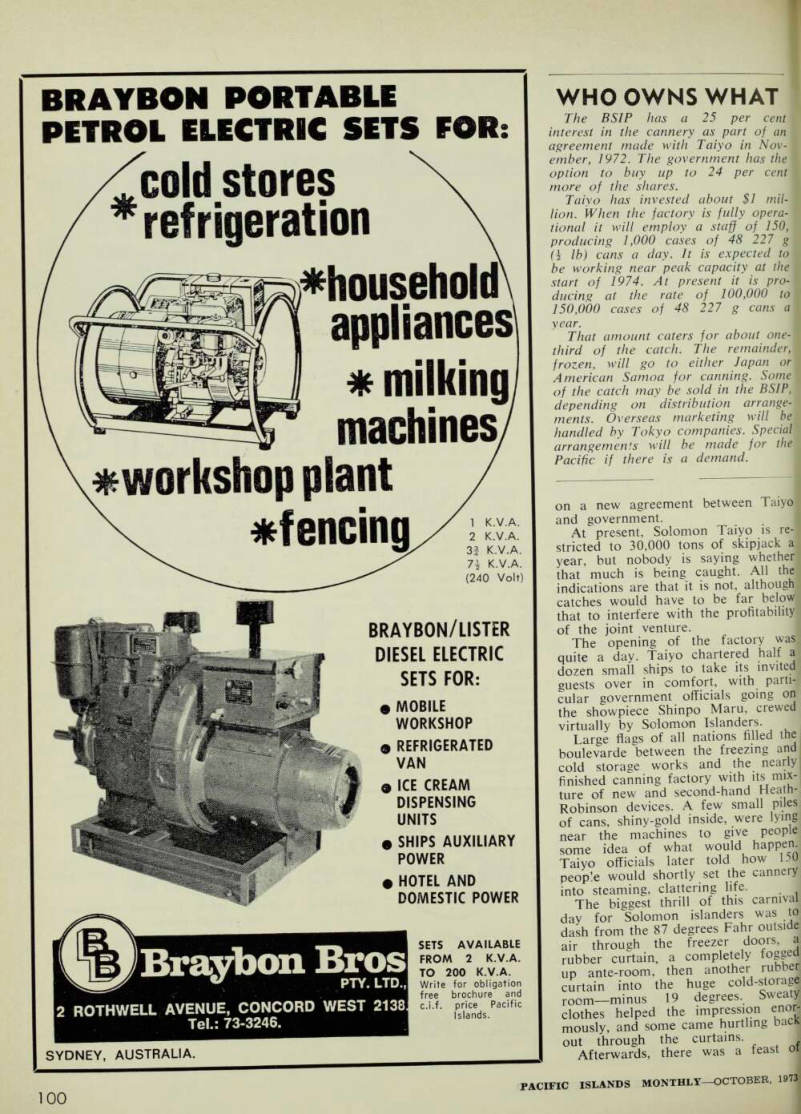
Photos: BSIP Information and Broadcasting Services.
On right is the Solomons new Taiyo fish factory and shore base at Tulagi. The cannery is on the left, with the freezer, cold stor age and ice-maker at centre. The two men on the left are newly-trained fishing masters Simon Tomisina, of the Shortlands (left) and Philip Mamu, of Malaita.
on a new agreement between Taiyo and government.
At present, Solomon Taiyo is re stricted to 30,000 tons of skipjack a year, but nobody is saying whether that much is being caught. All the indications are that it is not, although catches would have to be far below that to interfere with the profitability of the joint venture.
The opening of the factory was quite a day. Taiyo chartered half a dozen small ships to take its invited guests over in comfort, with parti cular government officials going on the showpiece Shinpo Maru, crewed virtually by Solomon Islanders.
Large flags of all nations filled the boulevarde between the freezing and cold storage works and the nearly finished canning factory with its mix ture of new and second-hand Heath- Robinson devices. A few small piles of cans, shiny-gold inside, were lying near the machines to give people some idea of what would happen Taiyo officials later told how 15U people would shortly set the cannery into steaming, clattering life. I The biggest thrill of this carnival day for Solomon islanders was to dash from the 87 degrees Fahr outside air through the freezer doors, a rubber curtain, a completely toggea up ante-room, then another rubber curtain into the huge cold-storage room —minus 19 degrees. Sweaty clothes helped the impression enor mously, and some came hurtling bacK out through the curtains.
Afterwards, there was a feast oi
local and imported foods laid out on tables 30 yards long under heavy yellow plastic sheeting. All the food and drink disappeared very rapidly with the dozens if not hundreds of gate-crashers, but nobody minded too much. Naturally, the beer was good and cold and everyone enjoyed them selves.
Besides, there were the celebra tions at Taroniara on the main island of Gela, for the Diocese of Melane sia’s Sister Christine Woods who was celebrating her 40th year in the Solomons with the honour of a re vived custom dance in which she appeared as the long-gone Queen of Gela (the Florida Islands). Sister Woods was Matron of the Central Hospital for 10 years, then “retired” to the service of the Anglican Mission where one of her self-appointed tasks was the care of pioneer missionary Dr Charles E. Fox until he finally returned to his New Zealand home at the age of 94 in March this year.
Gela had not been so lively in a long time.
Fiji's multi-million
dollar land deal
Some of Fiji’s best cattle country, at Navua and Naitonitoni, about 30 miles west of Suva, has changed hands. W. R. Carpenter (South Pacific) Ltd will receive $4.2 million over three years for the Naitonitoni land, held in the name of Morris Hedstrom Ltd, and for their 54 per cent share of the Fiji Pastoral Co’s land at Navua. The remaining 46 per cent in the Fiji Pastoral Co was held by private shareholders. One of these was Mr J. M. Hedstrom, a Carpenter director whose interest was 25 per cent.
The purchaser was Property, Development and Agricultural Co of Fiji Ltd, which, according to Mr Charles Scott, whose company, Inter national Lands Developments Ltd, was agent for the transaction, is owned mainly by local businessmen.
The transaction involved the 5,818acre Fiji Pastoral Co dairy and beef cattle farm on the western side of the Navua River, and 1,048 acres at Naitonitoni, between Navua town and the Navua Hills. The Naitonitoni property has a long beach front.
Mr Lyle Cupit, managing director of the Carpenter group in Fiji said the $4.2 million would finance further development of the group’s operations in Fiji.
Castaway Island resort on Qalito Island in Fiji’s Mamanuca group, has been bought by a Hong Kong Com pany, Castaway Resort Ltd, for $1 million. The resort was built 14 years
ago by Sydney businessman Mr Richard Smith.
A number of other Fiji properties have sold at high prices recently.
Overseas buyers have paid from $300,000 to $412,000 for three 1,500 to 2,000-acre coconut plantations in Taveuni, and $550,000 for 437 acres of freehold land at Momi Bay on the south-west coast of Viti Levu.
Another property near Momi was sold to three Californian investors for $461,000.
Strike trouble
tor Nauru Centre
Construction on the 51-storey Nauru Centre in Melbourne has fallen behind schedule through a dogmen’s strike which has hit all the city’s major high-rise building pro jects. It now seems certain that the first tenants will not move into the lower sections of the Nauru Centre tower until early next year, rather than in November or December as had been planned originally.
The strike followed rejection of a claim by 50 dogmen—the daredevils who swing at the end of cranehooks manipulating loads—for a 30 per cent increase in pay. This would have brought them into line with crane drivers who make SAI3S for a 40hour week, but often double that with their overtime earnings.
The main problem for Nauru is that the strike may result in their having to adjust the project’s cash flow. For every week the cranes aren’t working (the crane drivers went on strike in support of the dogmen’s claim) it is costing Nauru about $A13,250.
Before the strike the project was running slightly ahead of schedule.
It is doubtful that the time lost through the strike will be made up, although the vague mid-1975 com pletion date talked about by Nauru government officials still seems well within the bounds of possibility.
The other question-mark hanging over the whole project is the escala tion of building costs. When the project began it was estimated that it would cost SABO million, but if inflation runs at 10 per cent over the next two years the total cost is more likely to be SA36 million to SA37 million.
Fiji shops
out of sugar
Sugar is Fiji’s number one industry, but for weeks the country’s shop shelves were sugarless.
Just before the beginning of the annual cane crushing season, local supplies of Fiji-produced sugar often run short, but there is usually enough to get by if consumers do not panic, and shelves are re-stocked as soon as crushing begins.
This year, however, a three-week strike by the Fiji Sugar and General Workers’ Union caused a real shortage. Some local sweets and soft drinks manufacturers had to cut pro duction because their stocks ran out, and a brewery nervously watched its supplies dwindle dangerously low.
Disgruntled consumers com plained: “First rice was unavailable.
Then there was no flour. Now we can’t buy our own sugar.” Long awaited shipments of flour, sharps and rice relieved the shortage of these
basics, but sugar remained in short supply until well after the 2,700 strikers went back to work.
In spite of the inconvenience, and the high cost of buying imported castor or lump sugar, most people sympathised with the strikers.
They opposed the idea of the government stepping in as it had in a strike of airport workers at Nadi, when it recruited volunteer labour to replace those who walked out.
They felt such a move would ag gravate the situation and wreck the mills. Certainly, the mill workers did skilled jobs.
Most believed the union was justi fied in its claim for an increase from 40c to 50c an hour, and felt the award of 3c handed down by the chairman of the Prices and Incomes Board, Dr Norman Ross, the sole arbitrator was miserably small.
The strike cost $330,000 in lost sugar exports, the Minister for Agri culture, Mr Doug Brown estimated.
This money now comes out of Fiji’s pocket, not some overseas-based private company.
Harbour study
in the Cooks
Engineers recently visited Atiu Island in the Cooks to study the possibility of establishing a harbour.
In the team with New Zealand public works engineers Don Haliburton and Donald Matheson were Colonel J.
Harman, chief engineer in the NZ Army, and Squadron Leader R.
Padamson of the RNZAF.
The two defence department en gineers also inspected the airstrip on Atiu to see how much work would be necessary to make it capable of carrying C-130 Hercules aircraft. If the strip can be strengthened adequately it is thought army en gineers, explosives and heavy equip ment could be flown in. • Credit for a gift of $60,000 for a chair of administrative studies at the University of Papua New Guinea was given by PIM (Sept, p 43) to the tobacco firm of W. D. & H. O.
Wills (Aust) Ltd. In fact charity be gan at home. The giver was its re lation, Wills (PNG) Ltd which em ploys more than 400 Papua New Guineans with less than 10 ex patriates. • Wuvulu Holdings Pty Ltd is advertising one acre beachfront blocks on Wuvulu Island, PNG, for $lO,OOO in Sydney newspapers. The company was formed in 1970 to de velop the island as an exclusive re treat.