Pacific Shipping
pp. 83-87 · Read in the full issue

PNG waterfront workers hope for Aust unions' help in wages fight
Port Moresby waterside workers re ;urned to work on September 8, after i five-day strike for higher wages and mproved conditions. But it was an ineasy peace, and experienced water :ront men said there could be further iisruption.
The men were on strike while the \ustralian Council of Trade Unions vas holding its biennial congress in Sydney. That congress carried a re olution aimed at helping the trade inion movement in Papua New juinea to develop, with unions in Australia helping PNG unions in lustrially whenever called on.
Three days later, at a luncheon in Canberra, PNG’s Chief Minister, Mr
Michael Somare, said he did not want to see Australian unions taking action in conjunction with unions in PNG. His government was concerned about interference by Australian unions.
“I think if Australians realise that we have our own problems and leave the problems for us to solve, it would be belter than poking your nose in and trying to intervene in other peo ple’s affairs”, he said.
He added that he hoped to see the president of the ACTU, Mr R. J.
Hawke, to sort out problems of union action between the countries.
Back in Port Moresby, the striking watersiders, who are members of the
Central District Waterside Workers’
Union, called for an Australia-wide ban on all goods for Burns Philp, Steamships Trading and W. R. Car penter, the main employers of water front labour in PNG, if the strike continued for more than a week.
The union secretary, Mr R. Mc- Alister said the union would hope for direct support from the Australian Waterside Workers’ Federation. The union had promised support in the past.
Then the union bickered over the composition of a tribunal to deal with the dispute. It did not want two labour Department officers on the tribunal.
The suggestion to nominate two Lab our Department Officers followed a refusal by the Employers’ Federation to nominate a member for the tri bunal. In such a deadlock the issue is referred to the Administrator for a decision.
The Minister for Labour, Mr Rea, said the government would not stand idle if publicly stated intentions of organising massive strike action were implemented. (Other unions had threatened strike action in support).
Mr Rea accused left wing groups of Australian unions of trying to get a foothold in PNG. PNG wel comed financial and technical as sistance from Australian unions, but those unions were going too far when they tried to carry out negotiations, he said. Ne gotiations concerning PNG workers should be carried out by PNG unions.
The union claimed: • A rise of 14c an hour from the present 40c; • Three weeks annual leave (two at present); • Ten days sick leave; • A 40-hour week (44 at present).
Through Australian union interven tion 12 Papua New Guinea seamen serving in the Pacific Gas, owned by Liquefied Gas Carriers, will receive 5520 each for a period the ship re cently operated on the Australian coast. Three Australian maritime unions placed a black ban on the ship —“forever” if necessary, the union
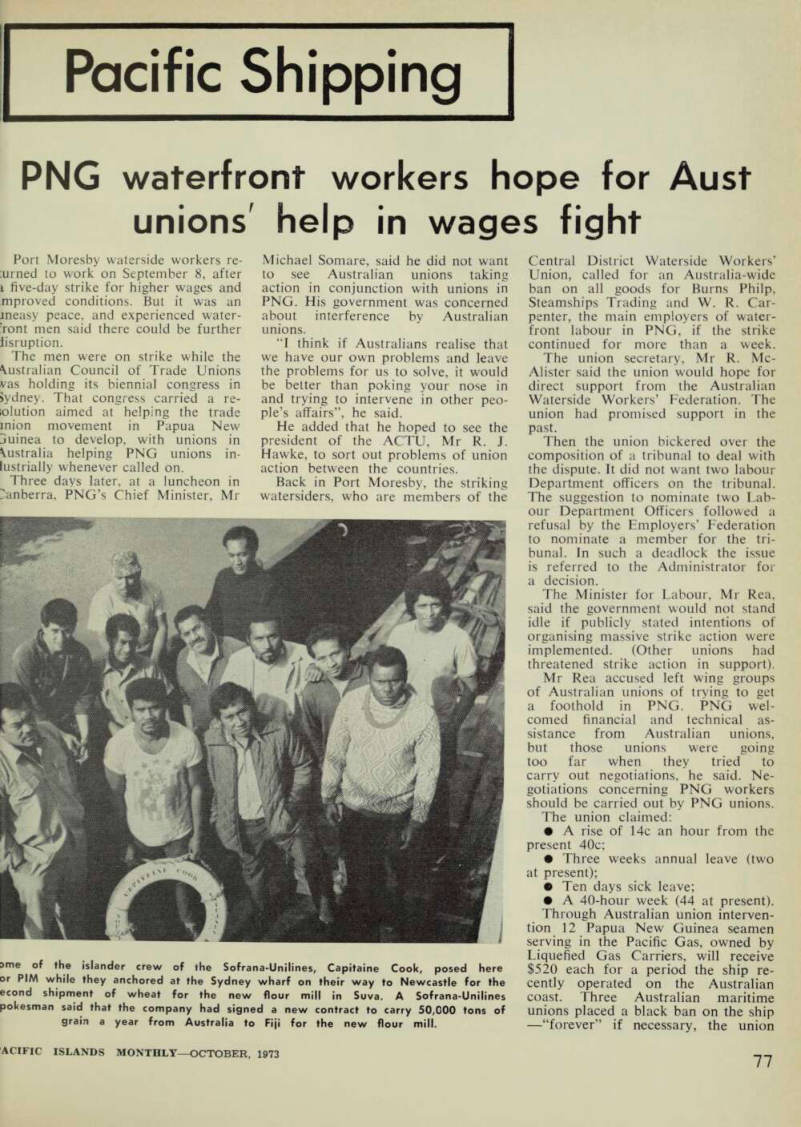
Some of the islander crew of the Sofrana-Unilines, Capitaine Cook, posed here for PIM while they anchored at the Sydney wharf on their way to Newcastle for the second shipment of wheat for the new flour mill in Suva. A Sofrana-Unilines spokesman said that the company had signed a new contract to carry 50,000 tons of grain a year from Australia to Fiji for the new flour mill.
laid —to get Australian rates of pay :or the seamen.
Mr Pat Geraghty, Australian Sea tien’s Union assistant secretary, said he money would be paid into the nen’s bank accounts. Those on leave /ould have their money paid through he PNG Overseas Seamen’s Union.
Other unions concerned in the ban, ✓hich tied the ship up for six days, /ere the Foremen and Deckhands’
Jnion and the Merchant Service juild.
Mr Geraghty said the seamen were etting from $9O to $l2O a month.
Tie Australian rates are up to $8,817 year for seamen and $14,000 for aptains.
He said the union’s policy was to emand Australian rates for ships arrying coastal cargoes. His union as a particular interest in assisting NG seamen. It would help them to et “proper rates of pay” under inter ational conditions.
“The Papua New Guinea Overseas eamen’s Union considers the Mini mm Wages Board decision unsatis ictory, and so do we,” Mr Geraghty lid.
The Minimum Wages Board fixed le following rates for seamen, to ?erate from June 12: Seamen—s 66 • $7O a month in first year; $B2 to )0 a month in second year; $B2 to 120 a month after two years. Bosun -$l5O a month.
Lighter Becomes
Jl Cruise Ship
A cargo ship built in 1967 for the orth Sea trade is being converted to a luxury passenger ship to >erate cruises in Fiji, covering Viti ;vu, Ovalau, Vanua Levu and iveuni. The ship of 2,540 tonnes '>soo tons) will carry 140 passen rs in two-berth air-conditioned bins with private facilities.
The cruises, which will intro ice a new element into the ji tourist industry, will be •crated by Fiji Line Ltd, owner the ship, in which the huge
UK transport group, John Swire, will have a 25 per cent interest. An inter national merchant bank will also take up 25 per cent. Other investors are Mr Peter Chase, an Australian busi nessman who spent three years plan ning the project, 15 per cent, Fiji In vestment and Development Corpora tion Ltd and Mr Jack Smith, former owner of Castaway Island resort, 10 per cent each. Shares will also be offered to the public.
The company will run a local com petition to find a suitable name for the ship.
The ship will leave Suva each Fri day for Levuka (stay overnight), then cruise to Nananu-i-Ra Island, off Rakiraki, Lautoka, Savusavu and Taveuni before returning to Suva. A seven-day cruise will cost $290. A three-day cruise will cost about $125 and a four-day cruise about $165.
Passengers will be able to join or leave the ship at Suva, Lautoka or Savusavu.
Jet Planes Will Take
Over Moana Roa's Job
The Moana Roa, the only New Zealand passenger ship trading out of New Zealand, is expected to be with drawn from the Auckland-Cook Islands run soon after Air-New Zea land inaugurates its jet service to the new Rarotonga airport on December The regular air service will make the Moana Roa passenger service un necessary. The 40-passenger Moana Roa went on to the service in Novem ber, 1960, replacing the Maui Pomare. It is possible she will be con verted into a naval survey ship.
The Moana Roa working account showed a loss of $516,325 for the year ended March 31, compared with a loss of $273,995 in 1971-72. Pas senger occupancy in the ship from New Zealand to the Cook Islands was 69.72 per cent and from the Cook Islands to New Zealand 90.83 per
;cent in 1972-73. In 1971-72, the occu pancy rates were 81.5 per cent to the Cook Islands and 99.25 per cent to New Zealand.
Boom Time In
Pago Harbour
The Department of Port Adminis tration in American Samoa earned revenue of $656,792 in the 12 months to June 30, an increase of 33 per cent aver the previous 12 months. In creases were recorded in 11 major categories of the department’s activi ties, including water transport charges vhich increased by 82 per cent to 579,539. Most of the other substantial ncreases reflected a 6 per cent in crease in the number of vessels enter ng Pago Pago harbour—from 1,091 n 1971-72 to 1,166 in 1972-73. Other ncreases included (1971-72 figures n brackets): Dockage, $66,014 $35,031); pilotage, $44,333 $31,250); tonnage tax, $148,096 $114,645); wharfage, $287,863 $213,076).
[Arlander Steps Up
Ul Services
Karlander (Aust) Line has stepped ip its services into Fiji from Austra ia. The Salamaua is now taking in 7 iji after calling at the New Hebrides nd two ships of the Mexican line, 4ardina, for which Karlander is Australian agent, are now calling at >uva and Lautoka. These are the .astragoni and the Mardina Exporter, /hich carry refrigerated cargo be ween Australia and Mexico. Both hips will also call at Papeete on the 'ay from Australia to Mexico. Kar mder also services Fiji with the levik.
Karlander recently sold the Slembe, 'hich was on the Australia to /ewak, Manus and Dayapura run to ar Eastern interests, and replaced with the Alderjo. • Fourteen Samoan seamen left le Samoan Bay at Suva in August ecause the ship was not calling at ipia. The Samoan Bay, operated by United Steam Ship Ltd, of Vila, was n a “shakedown” return trip to Fiji om Sydney. She did not have lough cargo to warrant a call at pia. The Samoans were replaced by 3 Fijians. • Without so much as “by your ave”, two Japanese trawlers “in ided” GEIC territorial waters :cently without clearance from the ithorities, and the crew of one ship, ie Tonyso, which anchored at enualanga Islet, went ashore on ukulaelae and took some coconuts, hey visited the main village where ieir request for pork and chickens as refused.