Musician, Composer
pp. 69-70 · Read in the full issue
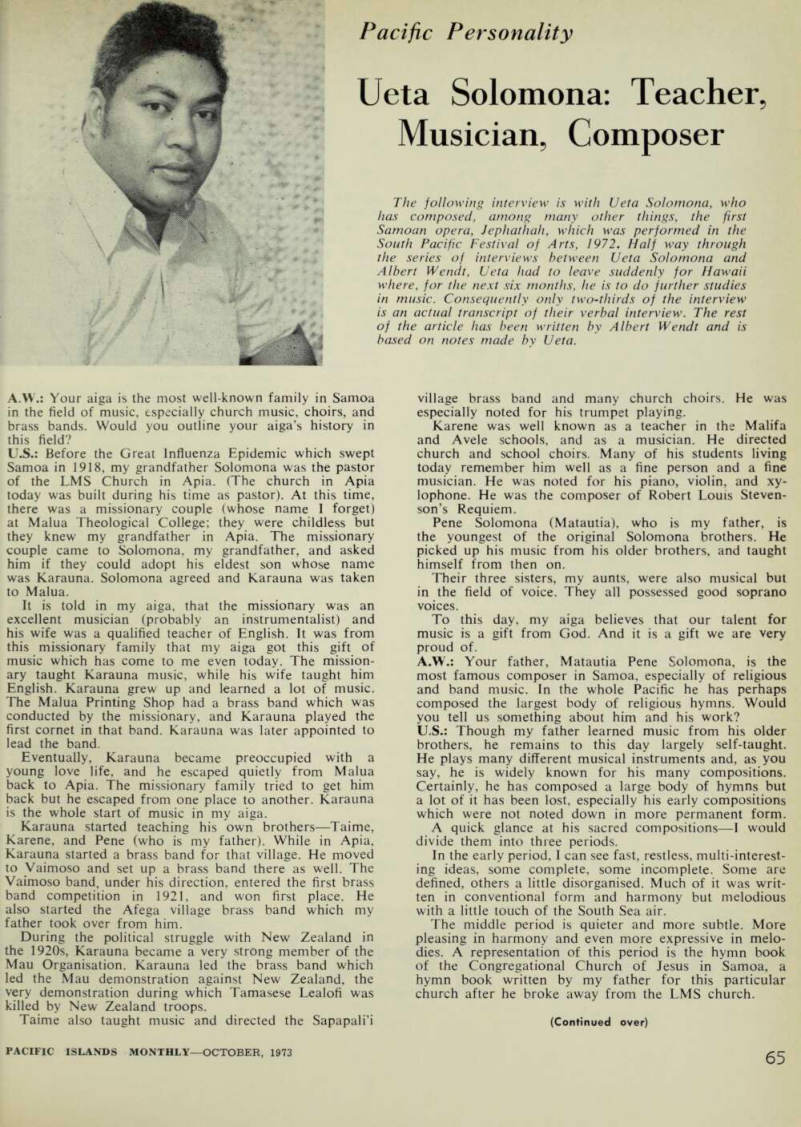
Pacific Personality Ueta Solomona: Teacher,
The following interview is with Ueta Solomona, who has composed, among many other things, the first Samoan opera, Jephathah, which was performed in the South Pacific Festival of Arts, 1972. Half way through the series of interviews between Ueta Solomona and Albert Wendt, Ueta had to leave suddenly for Hawaii where, for the next six months, he is to do further studies in music. Consequently only two-thirds of the interview is an actual transcript of their verbal interview. The rest of the article has been written by Albert Wendt and is based on notes made by Ueta.
A.W.: Your aiga is the most well-known family in Samoa in the field of music, especially church music, choirs, and brass bands. Would you outline your aiga’s history in this field?
U.S.: Before the Great Influenza Epidemic which swept Samoa in 1918, my grandfather Solomona was the pastor of the LMS Church in Apia. (The church in Apia today was built during his time as pastor). At this time, there was a missionary couple (whose name I forget) at Malua Theological College; they were childless but they knew my grandfather in Apia. The missionary couple came to Solomona, my grandfather, and asked him if they could adopt his eldest son whose name was Karauna. Solomona agreed and Karauna was taken to Malua.
It is told in my aiga, that the missionary was an excellent musician (probably an instrumentalist) and his wife was a qualified teacher of English. It was from this missionary family that my aiga got this gift of music which has come to me even today. The mission ary taught Karauna music, while his wife taught him English. Karauna grew up and learned a lot of music.
The Malua Printing Shop had a brass band which was conducted by the missionary, and Karauna played the first cornet in that band. Karauna was later appointed to lead the band.
Eventually, Karauna became preoccupied with a young love life, and he escaped quietly from Malua back to Apia. The missionary family tried to get him back but he escaped from one place to another. Karauna is the whole start of music in my aiga.
Karauna started teaching his own brothers —Taime, Karene, and Pene (who is my father). While in Apia, Karauna started a brass band for that village. He moved to Vaimoso and set up a brass band there as well. The Vaimoso band, under his direction, entered the first brass band competition in 1921, and won first place. He also started the Afega village brass band which my father took over from him.
During the political struggle with New Zealand in the 19205, Karauna became a very strong member of the Mau Organisation. Karauna led the brass band which led the Mau demonstration against New Zealand, the very demonstration during which Tamasese Lealofi was killed by New Zealand troops.
Taime also taught music and directed the Sapapali’i
village brass band and many church choirs. He was especially noted for his trumpet playing.
Karene was well known as a teacher in the Malifa and Avele schools, and as a musician. He directed church and school choirs. Many of his students living today remember him well as a fine person and a fine musician. He was noted for his piano, violin, and xy lophone. He was the composer of Robert Louis Steven son’s Requiem.
Pene Solomona (Matautia), who is my father, is the youngest of the original Solomona brothers. He picked up his music from his older brothers, and taught himself from then on.
Their three sisters, my aunts, were also musical but in the field of voice. They all possessed good soprano voices.
To this day, my aiga believes that our talent for music is a gift from God. And it is a gift we are very proud of.
A.W.: Your father, Matautia Pene Solomona, is the most famous composer in Samoa, especially of religious and band music. In the whole Pacific he has perhaps composed the largest body of religious hymns. Would you tell us something about him and his work?
U.S.: Though my father learned music from his older brothers, he remains to this day largely self-taught.
He plays many different musical instruments and, as you say, he is widely known for his many compositions.
Certainly, he has composed a large body of hymns but a lot of it has been lost, especially his early compositions which were not noted down in more permanent form.
A quick glance at his sacred compositions—l would divide them into three periods.
In the early period, I can see fast, restless, multi-interest ing ideas, some complete, some incomplete. Some are defined, others a little disorganised. Much of it was writ ten in conventional form and harmony but melodious with a little touch of the South Sea air.
The middle period is quieter and more subtle. More pleasing in harmony and even more expressive in melo dies. A representation of this period is the hymn book of the Congregational Church of Jesus in Samoa, a hymn book written by my father for this particular church after he broke away from the LMS church.
(Continued over)
The present period is much more influenced by Roman Catholic chants. Much slower rhythm with little change in harmony. I cannot say much about this period because he is still tapping and developing a new vein of inspiration.
I think the differences of these styles of writing are due to different influences in religious beliefs and cus toms of the different denominations to which he has belonged. He was born and raised in the LMS Church.
The middle period starts with his breaking away from the LMS and joining the Congregational Church of Jesus in Samoa in about 1940. The present period is heavily influenced by Roman Catholicism; he became a Roman Catholic in about 1961.
My father has also written secular songs in a light and happy mood, mostly love songs. He has composed a lot of music for brass bands in different styles— marches, novels, dances and a little jazz.
My father continues to surprise me with his boundless energy and devotion to music. He is a self-taught musician and has never trained overseas. He still com poses, trains brass bands and church choirs. He does all this in his spare time as he works as a fitter and turner in the Public Works Department. I think he has offered a lot of music to our country, not only in the form of music but through the musicians he has trained.
A.W.: When did you learn music? Did you teach your self how to play the many musical instruments that
you play?
U.S.: I began to play the piano when I was about five years old. This I remember because I played the piano before I started primary school at the Marist Brothers School when I was six years old.
Like many other people who were started off by their parents, so my father started me on the piano.
Later, I continued to teach myself the piano until I went to university in the States on my 23rd birthday.
I taught myself the basic techniques of many musical instruments but my knowledge of band and orchestral instruments was certainly improved while studying at uni versity. 1 learned better methods at university.
A.W.: When did you start composing your own music?
U.S.: I started composing before I was 20 years old.
I wrote some hymns in conventional and homophonic style. Even tried some brass band music and songs. At that time, I used to accompany my father when he went out to teach brass bands and church choirs. Sometimes, he composed the hymns and songs, and I taught them. I used to spend every Sunday playing the organ in church. I also used to play in my father’s brass bands.
I think I owe my father nearly all that I know about composing and teaching music and singing.
At university, I really began to write music in a more
sophisticated way. Up to now, I continue to compose vocal, choral, and instrumental music. At university, one of the things I wrote was a Piano and Violin One Movement Sonatina—it won second place in the Music Composition Competition at university. Just one of those happy memories about university.
In 1959, Ueta Solomona was awarded a Fulbright Scholarship to study music at the State University of New York. In 1963, he graduated with a BSc degree in music, the first Samoan to do so. When he returned to Western Samoa, he was appointed Music Specialist for all government schools; a position he holds up to now.
From 1964 to 1970, he also taught music over the radio to all primary and intermediate schools in the country.
In 1964, he founded the first Ecumenical Easter Service which was produced by the combined choirs of two schools and the Teachers’ Training College. Two years later, he organised and produced the first Music Festival involving choirs from all the high schools in Western Samoa. He still directs the music festival every year.
Still two years later, he helped promote and establish the Mafutaga a Aufaipese (Fellowship of Church Choirs) which is made up of 15 choirs from the Congregational Christian Church. Besides workshops, this organisation has given many live sacred music concerts.
At the same time and up to now, Ueta Solomona has lectured about music to many organisations and groups.
He has also directed and still teaches church choirs and village brass bands. He has been one of the main judges in the Samoan Traditional Singing Contests and Band Contests in national celebrations both in Western and American Samoa. At present, he is helping to revise and re-edit the Congregational Christian Churches hymn book.
He has composed, arranged and transcribed hymns and Samoan traditional folk songs for choirs and bands.
He still does this today. Perhaps the most recent high light of his creative activity is the first Samoan opera he composed based on a biblical theme. This opera was performed at the South Pacific Arts Festival in Suva, 1972. Ueta Solomona directed his own opera at the Festival. At the moment he is working on a new opera to be called Vaea and Apaula which is based on a well known Samoan legend. He has completed the first part of this two-part opera.
In 1972, he started to build an orchestra which he hopes to expand into a real standard symphony orchestra.
This year, the beginnings of this orchestra gave its first public performance. The establishment of the orchestra is a major undertaking as Samoa does not yet have the musicians needed for a symphony orchestra. Ueta Solo mona knows that he will have to train musicians himself, and he has already started on this work. If he succeeds he would be giving Western Samoa its first symphony orchestra.
Apart from all this activity, he gives private piano les sons to 60 students, the youngest students are five years old. This group gives regular public recitals.