Pacific Shipping
pp. 89-93 · Read in the full issue
Determined Islanders Prepare To
Fight For Enna G Principle
The October conference in Wel lington about regional shipping in the South Pacific will have the sombre shadow of the Nauruan ship Enna G hanging over it. The Enna G, stranded in Wellington through a New Zealand union-inspired strike of Fijian crew early in June, is likely to be still laid up there then.
In mid-August there had been no further moves to settle the dispute, Mr Willy Star, spokesman for Nauru’s joint shipping venture with Tonga, told PIM by telephone from Melbourne, “We are looking forward to the October meeting,” he said. “Nothing further is likely to happen before then.”
One way or another, the Islanders are going to fight for their rights and ensure for themselves freedom to decide how they will man and operate their own ships without inter ference from foreign trade unions which, under the guise of helping fellow-unionists, are attempting to crowd out the Islands from the ship ping world.
Metropolitan countries at the 13th South Pacific Conference at Guam in September will probably be asked to help the Island countries in their fight.
The New Zealand Government refuses to see the dispute as a simple issue—the right of a country to operate its own ships, crewed by men of its choice, and its right to negotiate working conditions with its seamen through the seamen’s own union.
New Zealand’s Deputy Prime Minister and Labour Minister, Mr Hugh Watt, acting as Prime Minister while Mr Kirk was at the Common wealth Heads of State conference in Ottawa, waffled in parliament and to the press about a “difficult and complex subject”.
Questioned in parliament early in August, he said the Enna G was free to sail about mid-July from Welling ton, where it had been tied up since
June, but there was no indication the Nauru Government was preparing to sail it away. He had written to Nauru’s President Hammer De- Roburt advising him to accept con ditions, apparently agreed to before Nauru decided to leave the ship in Wellington.
Mr Watt also said the combined Wellington waterfront unions had “in dicated” to the Labour Department the ship was free to sail, and as far as he knew freedom to sail was un conditional.
Later Mr Watt told reporters he could not understand why Nauru
abandoned the ship. He could under stand the Nauruans being annoyed and frustrated in the initial stages, but it was hard for him to understand their reasons for not taking the ship away. The basic issue of wages and conditions could be discussed when the ship reached Fiji where parties would “be more in an atmosphere of their own environment.”
Then he added that the wider question of South Pacific shipping services could be thrashed out at the October conference.
A few days later Mr Watt said the Fijian seamen who had been on a
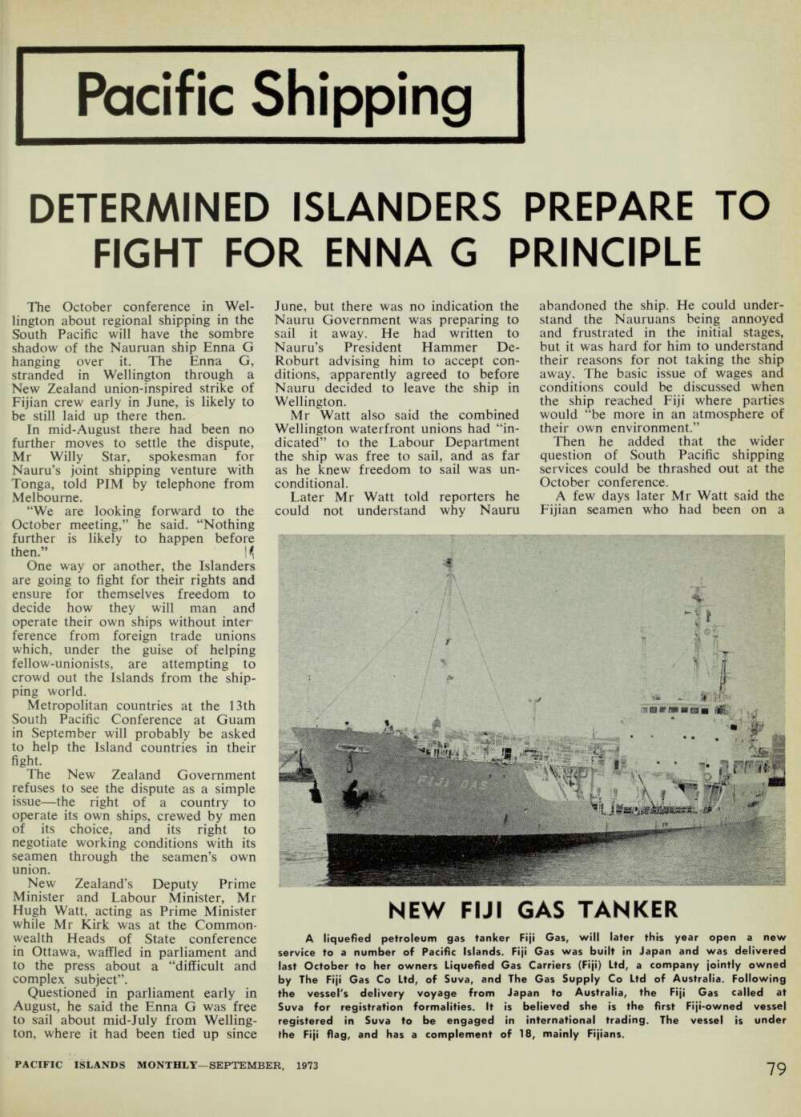
New Fiji Gas Tanker
A liquefied petroleum gas tanker Fiji Gas, will later this year open a new service to a number of Pacific Islands. Fiji Gas was built in Japan and was delivered last October to her owners Liquefied Gas Carriers (Fiji) Ltd, a company jointly owned by The Fiji Gas Co Ltd, of Suva, and The Gas Supply Co Ltd of Australia. Following the vessel's delivery voyage from Japan to Australia, the Fiji Gas called at Suva for registration formalities. It is believed she is the first Fiji-owned vessel registered in Suva to be engaged in international trading. The vessel is under the Fiji flag, and has a complement of 18, mainly Fijians.
series of temporary permits would have to go home. Five of the original 23 involved in the dispute returned earlier.
He did not know what would hap pen, or how the ship would sail with out replacements for the Fijians. He also said he was dismayed President Deßoburt had now withdrawn his agreement to re-engage the Fijian sea men on the Enna G.
The Dominion newspaper in Wel lington saw the matter in a much clearer light than Mr Watt. Late in July, in an editorial, the newspaper said the blacklisted Enna G was a memorial to crass industrial stupidity.
It was also a hazard on which the NZ Government’s bravely expressed hopes of supplying leadership in the South Pacific were likely to founder.
It was all very well for the Minister of Labour to espouse the cause of co-operative regional shipping as a means of advancing the lives of the peoples of the region, and to pro mote a maritime conference in October to plan for it.
“The Enna G mocks the govern ment’s intentions,” the newspaper said. “The sad saga of the vessel, Mr Watt suggested, “brought to the attention of the New Zealand public a ‘difficult and complex issue’.
Frankly, citizens never found the matter so complicated that one ounce of reasonableness on the part of the New Zealand Seamen’s Union could not have fixed it. The affair remains a classic case of industrial brawnman ship. It will do irreparable harm to the government’s ambition to appear as a friend, adviser and champion of the South Pacific—rather than the bully boy”.
Twenty-six Tongan members of the crew went home about the end of July. Four remained in Wellington as part of the skeleton crew of the Enna G. In Tonga they were paid money due to them. They said they were disappointed when the Fijians walked off because they considered they were getting very good payment and treatment.
Captain C. Hill-Willis, of the Pacific Navigation Co, said Tonga’s role in the service which Enna G was to provide was to man the ship. The Pacific Navigation Co also was to act as agents in Tonga and to be responsible for routine maintenance and repairs while the ship was in Tonga.
Tonga would have benefited financially from the venture. How ever, he was not unduly unperturbed because President Deßoburt had promised to employ the Tongan crew on other Nauru ships.
In Australia, shipping company officials, asked to comment on the right of a small Pacific country to
operate its own ships, had this to say about the Enna G dispute; “I don’t think the Australian mari time unions would go along with what the New Zealand unions are doing. The waterside workers here are most helpful towards some of these developing Island places, pro vided the vessels they operate are owned by the particular country and trading in that area. The New Zealand unions seem to think they have the right to operate any vessel out cf New Zealand, no matter who owns it.”
Another said: “Is that small island nation really going about running a
sh pping line on a proper basis or is it just using its money indiscriminately?
Per capita it is one of the richest countries in the world and therefore runs operations in a 19th century attitude. It adopts a very intransigent li ,e and does not worry about cash.
Personally, I think it is an unneces sary and vicious attitude on the part c f the New Zealand union, but when dealing with this sort of people I think there is some justification. It is a case where two completely immovable objects are standing on a point of principle and sound com mercial sense gets thrown out the window. Both sides have to try to
work out their differences. These intransigent attitudes can do harm in the long run.”
From an Islands’ champion: “It is obvious that any form of industrial blackmail of this type is stifling the rights of islanders to do their own thing as far as shipping is concerned,”
Speaking at a meeting of the NZ committee of the Pacific Basin Economic Council, Mr Watt referred to the conference in October and said there would have to be a good deal of give and take by sectional interests of New Zealand, Australia and the Pacific Islands. He said the Islands would need regular shipping services if they wished to increase inter-island and export trade.
Machines Beat Men
Says Harbour Master
Suva’s Harbour Master, Captain Robert Turner, is unlikely to have won any friends among the Fiji Seamen and Dockworkers Union for his recent advocacy of the use of machines to handle cargo. He told Suva businessmen machines were more efficient cargo-handlers than men, giving ships a quicker turnround and helping to cut the cost of imports.
No single factor affected the cost of living in a maritime nation like Fiji as the speed at which ships
turned around at its ports. Men lifting small packages one by one at any stage in the process of trans ferring cargo from ship to consignee was bad practice.
He was really close to home when he said that how well or badly thousands of pieces of cargo were picked up and put down was directly responsible for the efficiency or other wise of a port.
“If, for example, the labour in the port is unable or unwilling to pick up and put down all those pieces as many times as they have to be handled then you get congestion,” he said. “And here we have a situation that is prevalent in Suva.” The logical solution was to increase the size of packages and reduce their number by using containers and pallets.
Containers Reach
The Gilberts
Betio in the GEIC is but a step from the container shipping age. The first container ship to visit the GEIC, the Columbus California, arrived on August 1 and off-loaded 19 containers, using its own crane and lighters. The containers were opened on the wharf, emptied, and then taken back to the ship.
The next and probably last step, to make Betio a full container port,
bearing in mind the size of the place, is to install a wharf crane, which will pluck containers from the ships and land them on the wharf. The Cap Norte was scheduled to arrive at Betio August 30 with a crane. It will take about four weeks to rig up the crane. It should be ready for the Columbus California on its September trip.
Two Columbus container ships are now on the Australia-US west coast run, calling at Betio. These are the Columbus Canada and the Columbus California. A third will be added before the end of the year.
With the three ships operating, Betio will have one calling every 17 days.
Million Dollar Dock
For Ponape
The Ponape District now has “the best dock and wharf facility” in the entire US Trust Territory. The dock, which cost about SUSI million, was officially dedicated recently at a cere mony at Kolonia, the district centre.
Mrs Leo A. Falcam, wife of the Ponape District Administrator, cut the ribbon.
The Trust Territory High Com missioner, Mr Edward E. Johnston, said: “Each time we open a new dock cr harbour facility we cut down on the time that the field trip vessels
need to load and unload. This helps the delivery of surface cargo through out the entire Trust Territory. We will not be completely happy until there is a dock of this nature in every one of our six districts of Micronesia.”
The dock was built by the Ponape Transportation Authority.