(2) And a future which
pp. 45-53 · Read in the full issue
Six Stories On Prosperity—Islands' Elusive Target
(1) New gods for old in Western Samoa
From FELISE VA’A in Apia
During a recent public debate sponsored by the Western Samoa Debating Society, as to whether the vr>te should be given to every Samoan citizen over 21, instead of being con fined to the Matai, one of the most often-repeated arguments from the ‘negatives” was that the introduction of universal suffrage would destroy Samoa’s customs and traditions.
Which poses the question that if universal suffrage can destroy customs and traditions then, by the same token, all imported cultural items should have the same effect. When the white man arrived in force, especially after 1830, he brought with him his own culture which from the beginning had strongly influenced Samoan culture.
The Christian religion was, origin ally, not a part of Samoan customs and traditions. The Samoans had ;heir own local and national gods.
When John Williams, the first Christ an missionary to Samoa arrived in 1830 he was acclaimed by the highest Jignitary, Malietoa Vainuupo, who aroclaimed that the “morning” of Williams’ arrival would be forever commemorated in Samoa’s history— and so it is.
Almost immediately, the Christian •eligion became a hit and spread to all parts of Samoa. Here is an example of a foreign institution which lad successfully invaded the bastion )f Samoan culture. It not only sur /ived, it replaced the ancient religion af Samoa and is now one of the strongest institutions in Samoan society. Yet the Samoans don’t say t is destroying Samoan customs and traditions. They dare not.
There is also the gun, cotton vear, beads, mirrors, combs, canned food such as pea soup (pisupo) and lumerous other items so that Samoans have already incorporated nany items of culture from foreign countries into their own culture. To day, canned corned beef, canned tierring, keg beef and cash play a significant role in the practice of Samoan customs and traditions.
All these things are foreign to Samoan culture, yet Samoans speak Df the threat to their own customs and traditions when they have already accepted that threat. To go to the extreme, for the Samoans to enjoy their customs and traditions to the full and in the purest manner, they
must tear from their culture every thing they have borrowed or adopted from other cultures, yet this is prac tically impossible.
Talk about “threat to Samoan culture and traditions” can be quite senseless as Samoans have already adooted many so-called outside in fluences. It is suspected that such talk is only convenient for politicians who want to substitute a real, live action programme with meaningless talk about values which do not really exist, except in a highly bastardised form.
Visit the capital Apia and what do you see? Modern department stores, Modern cars and wide, paved roads, A few miles outside there are the beautiful European-styled houses of the rich; in the villages many European-style residences. Many village families now have cars, In other words, the 20th century has come to Western Samoa but how many people realise it? How many people realise that Western Samoa is trying to perpetuate 19th century values at the risk of losing the pre sent and possibly the future.
(2) And a future which is already in hock
Like other Island nations, which find themselves in the 20th century, Western Samoa has to worry about money and the debts she owes to the outside world.
At the end of 1972, the state of Western Samoa’s economy had deteriorated so badly that the sound ness of the government’s economic policies could be seriously questioned.
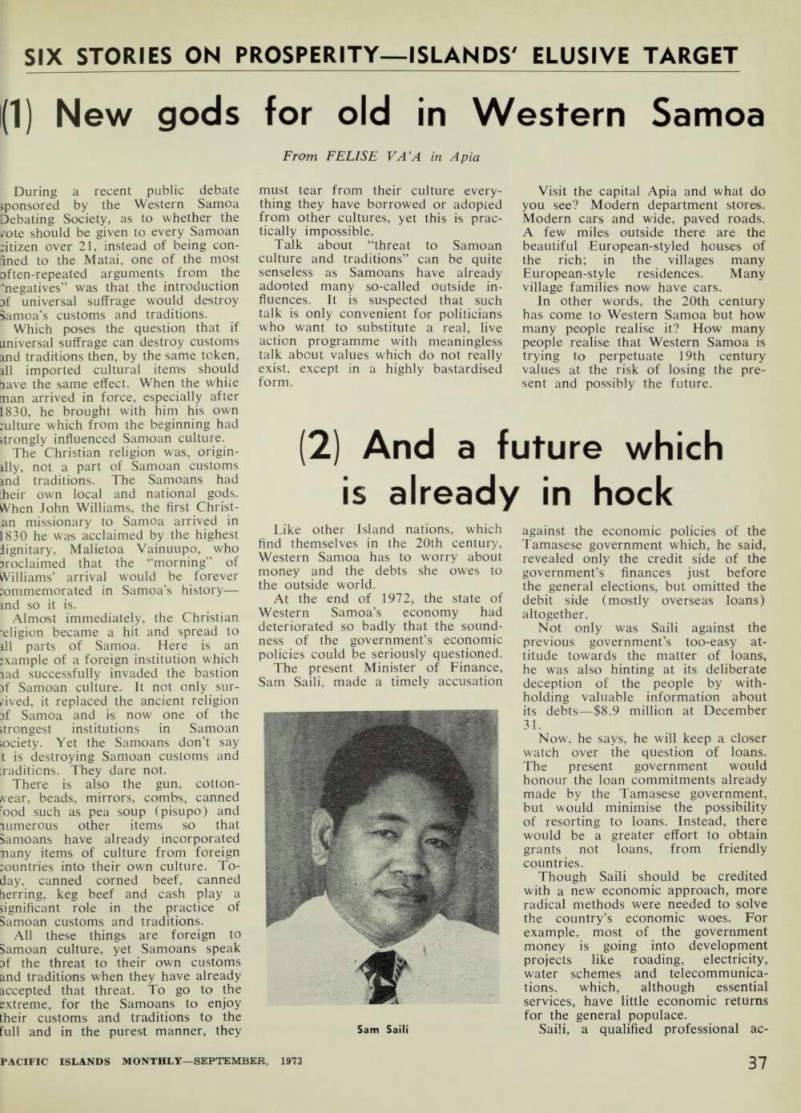
The present Minister of Finance, Sam Saili, made a timely accusation
against the economic policies of the Tamasese government which, he said, revealed only the credit side of the government’s finances just before the general elections, but omitted the debit side (mostly overseas loans) altogether.
Not only was Saili against the previous government’s too-easy at titude towards the matter of loans, he was also hinting at its deliberate deception of the people by with holding valuable information about its debts—sB.9 million at December 31.
Now, he says, he will keep a closer watch over the question of loans.
The present government would honour the loan commitments already made by the Tamasese government, but would minimise the possibility of resorting to loans. Instead, there would be a greater effort to obtain grants not loans, from friendly countries.
Though Saili should be credited with a new economic approach, more radical methods were needed to solve the country’s economic woes. For example, most of the government money is going into development projects like reading, electricity, water schemes and telecommunica tions, which, although essential services, have little economic returns for the general populace.
Saili, a qualified professional ac
Sam Saili
:ountant, has observed this too and i unique among his contemporaries ti that he has pushed for rapid ndustrialisation to provide employ ment for the masses of unemployed, md to help offset the frightening decreases in agricultural exports.
However, he is prepared to protect he industries already established.
Generally speaking, Saili is on the light track of what is needed to ♦ring some commonsense into the ;overnment’s economic plans. The luestion is, how far will he be pre tared to go in his industrialisation icheme and to what extent will he be imited by other factors such as ;abinet and parliament?
The previous manager of the Bank if Western Samoa, Warwick Lan ;aster, has already pointed to the vorsening state of the economy, elling local Rotarians recently that Western Samoa had a record trade leficit of $9.6 million in 1972 as igainst $5.1 million in 1971. When he value of two aircraft and one ;hip was added to the customs figures here was a total deficit of 512,181,600.
The record trade deficit was caused jy a 24.79 per cent drop in export ■eceipts and a 35.67 per cent increase n imports. But this was not all for luring 1972 there was an overall valance of payments deficit of $1.5 million, the first balance of payments leficit since 1967.
These figures do not augur well for a developing nation like Western Samoa. In fact, forecasts for the future are dim.
In 1952, agricultural exports amounted to $3,477,444 for 65,590 :ases of bananas worth $111,636, 17,037 tons of copra worth $2,173,284 and 2,448 tons of cocoa worth 51.192,524. In 1958 total exports :ame to a record $5,746,312 com prising 884,555 cases of bananas worth $2,014,378, 10,777 tons of :opra worth $1,237,318 and 4,209 :ons of cocoa worth $2,494,616. But n 1972 export figures had dropped Iramatically to $2,475,643 comprising M,334 cases of bananas, 18,632 tons Df copra worth $1,377,850 and 1,912 [ons of cocoa worth $896,376.
In 1958 the population totalled SO,OOO compared with 150,000 now, >o that there was a much higher per :apita income in 1958 than now.
The picture, according to govern ment experts, has grown worse, Banana, copra and cocoa production are well below estimated figures for export. Western Samoa faces two alternatives. One, either rapid industrialisation or two, a return to a blissful existence of native ignorance. These are the choices that Western Samoa must decide on now.
(3) Recession or levelling off?
Balance sheet for PNG
With independence coming to Papua New Guinea more than a decade after it came to Western Samoa, the country is already taking a close look at its economic position, determined to make a good start.
What does it see?
While official statistics point to a downturn in the economy of Papua New Guinea, it may be a sign of levelling off rather than a recession.
PNG has enjoyed rapid growth in the last 10 years. Now, says the Minister for Internal Finance, Mr Julius Chan, the territory will have to gear the economy to a more realistic level.
Private investment spending de clined about one-third in 1971-72 and is not expected to pick up again in the short term, says the Quarterly Statistical Bulletin, issued by the
IReserve Bank of Australia in Port Moresby.
Other pointers are fewer vehicle registrations, a fall in private fixed deposits in banks and a 14 per cent drop in savings banks deposits. How lever, capital expenditure on new plant and equipment, which increased (throughout 1971-72, has continued to irise. So has the value of new (building approvals.
Budgeted government revenue, in ispite of higher taxes and other revenue measures, is expected to rise (by only 11 per cent to $223 million, largely through a smaller than usual increase in direct taxation receipts.
This followed the slow-down in the economy, the end of special Com monwealth assistance for the Bougain ville copper project at Arawa, the famine in the Highlands, and some increased wage awards.
In the primary industries there is room for guarded optimism. The cocoa crop will be lower, but as world production for the year Sep tember, 1972-October, 1973, is ex pected to be down, while world demand is expected to rise, higher prices should compensate for the lower output.
The suspension of world coffee quotas should have a very favourable effect on Papua New Guinea as prices are rising on the export market.
Copra production in 1972 was down, while world demand is ex pected to rise, higher prices should compensate for the lower output.
The suspension of world quotas should have a very favourable effect on Papua New Guinea as prices are rising on the export market.
Copra production in 1972 was down by 5 per cent compared with 1971. Exports in the 11 months to November 30, 1972 —about 5 per cent less than for the first 11 months of 1971—were valued at $6.8 million, a little more than half the value of the 1971 copra export earnings. The copra market may be recovering generally, but it looks like a long, slow process in present conditions.
The rubber market is a little un certain, with a possibility of a further improvement in prices if the supply and demand trends of 1972 are sus tained.
Tea exports for the first five months of 1972-73 (940 tons) were 60 per cent higher than for the cor responding period of 1971-72, sugges ing a further large increase in pro duction for the current year. The average auction price paid in London for PNG tea in mid-June was 41.79 pence per kilo, or 34.31 c per lb—7 per cent below the mid-June 1972 price.
(4) Fiji project will stop food rot
Fiji got off to a good start when in dependence came in October, 1970, but there’s still a demand for outside help like that given by Australian Catholic Relief, for instance, which has funded an invention by a Roman Catholic priest. It has footed a $6,850 bill for a project which preserves and processes tapioca, breadfruit, bananas and taro.
The project is at Naililili, 15 miles from Suva on the Rewa lower delta.
Explaining the need for the food processing factory, Father Paul Coquereau said humidity resulting from annual floods and hurricanes caused almost total destruction of locally-grown foods in Rewa. Tapioca, for instance, turned black a couple of days after being dug—alternatively it rotted on the ground. The same held good for dalo, while breadfruit did not survive the rains for more than a day or so.
He discovered that all could be preserved for a couple of months if kept in airtight plastic bags but more
important still he found that the pro ducts could be dehydrated and milled into flour, opening up the concrete possibility of a Rewa delta flour in dustry which could revolutionise the district’s economy.
A highly resourceful man, Father Coquereau is a third generation mem ber of a F;*nch family of inventors.
He has already developed pilot machinery capable of drying, peeling and grating various root crops.
In his application for the grant, he said he had plans for encouraging families in the area to build drying ovens and to buy hand mills so that families could store food for their own use.
But, because people will have, for the first time, the incentive to produce more food to be processed and mar keted, he is planning a central pro cessing plant.
A large hot air drying oven, a peel ing machine and a grating machine— designed by Father Coquereau and built on the spot—are already in operation. The building of a large storage shed to keep the dehydrated food away from rats and floods has already been paid for.
What is needed now is a large building to shelter the already existing equipment and other equipment to come. He plans a building, 50 feet by 40 feet and 24 feet high with a con-
crete floor five feet above ground level to ensure protection against flood damage. Space below the floor will contain airtight rooms to hold the green roots awaiting processing.
Father Coquereau said this central mill will be able to utilise all the products of the area.
It looks something like a moon buggy— but it's the brainchild of Father Paul Coquereau. It's a most ingenious machine for skinning tapioca, before the chopping and grinding process he devised at Naililili Mission in Fiji.
(5) My Lady Nicotine is the Solomons' ex-screen star
A ban on the advertising of dgarettes in Solomon Islands cinemas oegan on July 1, which amounted to i total ban on cigarette advertising in the limited local media.
For some time cigarette manufacurers have concentrated all their advertising guns on the cinemas, ising the glossy wide-screen inducements in glorious technicolor seen n the more “advanced” countries of ;he Pacific. There’s an occasional roster on a bus in Honiara, but dial’s about it.
The government radio doesn’t KS pendent" 0 Kakamor" 8 ' monthly journal so far has not attracted anv cisarette advertising
“gh it y adven?ses the übiquiton!
Queensland beer, XXXX.
The Governing Council’s Internal Affairs Committee decided to ban the cinema advertising, rather in the same way other governments around the world have restricted or banned television advertising, and for the same reasons—so as not to encourage young people to smoke. Local cinemas are distraught, but helplessly acquiescing.
It’s only a few years ago that the government encouraged W. D. and H. O. Wills of Australia with pioneer
status and tax concessions to begin manufacturing the potent twist tobacco in Honiara as an import replacement, through a lo( r ail y‘ registered company, Solomon Islands Tobacco Company, The same incentives are not being offered to Wills to begin local manufacture of cigarettes which was discussed last year between the company and government. The weed has not got a great hold on the Solomons’ 175,000 population, even in the towns, at least partly because of t e sti ow wage s ruc^ charge* Vr cigarettes. Tw.st roHed *A used to ’ call racehorses ( y V erv owns, ready rubbed), V popular substitutes among those who are hooked.
Therefore, a big enough mar et for local manufacture would seem o rely on finding export markets in t Pacific for a Honiara-based mdus ry.
As well, the rate of excise is sti very open question, and one t e government does not seem to be in a hurry to answer, Xhe last Solomons government had a somewhat puritanical approach to such of mankind’s vices. It remains to be seen what the new government will do.
(6) NZ steps up aid to the Islands
From a Wellington correspondent
New Zealand is helping an extensive orestry development scheme on Viti -evu, Fiji. This project will be nanced under New Zealand’s •ilateral aid programme in the •acific, and New Zealand will also Tovide skilled personnel to establish ;. The New Zealand grant will mount to $300,000 and in addition p this, the New Zealand Forest lervice will help with surveying, nd vehicle and plant maintenance.
New Zealand-made pre-cut houses or staff are already going up. The ursery is well established with Caribbean pine seedlings grown from eeds imported from Guatemala. The )rasa-Lololo area is already partly lanted and new roads are being ushed into the two further blocks etween Lautoka and Ba and between Jadi and the Sigatoka River.
New Zealand’s experience in large cale afforestation made the Kiwis logical choice to carry out the lability study on the prospect of a hip export industry for Fiji, and fter the New Zealand Forest Service lade a favourable recommendation ic Fiji Government decided to go head with a scheme to plant 50,000 cres by the end of 1978. It also ecided to go along with the decision f its own Forestry Department to reduce saw logs. In Fiji’s climate, apid growth makes saw logs a ery attractive economic proposition daich can logically lead to later reduction of veneers and chips.
With the departure of the UK as major economic force in Fiji, it )oks as if New Zealand may be ble to fill the economic aid and schnical assistance gap to some ex ;nt. New Zealanders feel they have good practical understanding of the eeds of Island territories and they re certainly jacking up their Pacific iid Programme. The next three years 411 see them spending $NZ27,000,000 i Pacific aid compared to Australia’s A 15,000,000 for the same period.
The amount of aid offered and s timing depend a lot on the ter itories’ capacity to digest it and Iso on the skills available to put aid rejects into practice.
At the moment New Zealand aid i helping to rebuild Apia Hospital i Western Samoa, where agricultural
development is also being given a boost by Kiwi agricultural equipment, fencing and breeding stock. A feasibility study by Enex, the New Zealand consortium of engineering, architec tural and manufacturing skills, is looking into the construction of a new abattoir in Suva. And the same group is working on new ferry terminals between Upolu and Savaii in Western Samoa.
With all these projects the Island governments involved have primary responsibility; all decisions as to how, when and where the available funds are spent are made in consultation between the New Zealand Govern-
ment and the recipient country. This is a no-strings-attached aid pro gramme, and a nice example of Pacific co-operation, • Lord Howe Island may soon be supplying fish to the frozen market, A new fishing ship, the Lord Howe Island Trader, 65 tons, will catch fish off the island, refrigerate the catch and take it to Sydney and Melbourne markets. The Lord Howe Island Trader will probably seek cargo for the return journey. It will be able to cover the distance between the island and Australia in 48 hours. The owner of the ship is Mr Gower Wilson.