Footnotes
pp. 32-33 · Read in the full issue
“ JOSEPHINE of Papua is like Joan of Arc ** of France. She shall have all our support from 99 per cent of the Papuans”. So wrote a contributor to the Letters to the Editor page of Papua New Guinea’s Post-Courier news paper.
Then, bursting into verse, he continued, “Josephine, Josephine, Let your spirit guide us through, Come lead your Papuans to freedom, Josephine we are calling you.”
“1 even have the music for it”, he adds. I think it is unlikely that we shall hear this one over the ABC, and I am quite certain we shall not hear it over the Administration radio net work.
At the other end of the scale, there is the recommendation that Miss Josephine Abaijah, MHA, should go back to her village, get mar ried and have 12 children. Yet another
correspondent proposes that she should be deported to Mururoa Atoll, though whether as a punishment or to calibrate her megaton rating is not quite clear.
And so it goes on, in issue after issue of our national news paper, running the full gamut of praise and abuse.
Miss Abaijah and her Papua Besena (Papua for the Papuans) Movement have cer
tainly started something which has got both our own and the Australian governments wor ried; and was probably one of a complex of factors which touched off a riot in Port Moresby in July, following a Papua v New Guinea rugby football match.
The really ironic thing about all this is that it was a decision by an Australian government 70 years ago which started it all off. When Australia took over the former British colony of New Guinea early this century it decided to call the place Papua, instead of making the more obvious choice of changing the name
With Percy Chatterton
in Port Moresby
Josephine of Arc in a hurry
from British New Guinea to Australian New Guinea. “Papua for the Papuans” is a first rate slogan. I doubt if even the dynamic Miss Abai jah could make much of Australian New Guinea for the Australian New Guineans.
Recently External Territories Minister Mor rison referred sneeringly to “so-called Papuans”. So called by whom? So called by Mr Morrison’s Australia.
Of course, there’s more to it than that. The name Australia has an emotional content for dinkum Aussies, and even for a long expatri ated pommie like myself there is magic in the
name England. We cannot be surprised, nor have we any right to be contemptuous, if the name Papua has in 70 years acquired an emotional content for those whose homeland it is.
A perceptive Papuan jour nalist, Pauline Bona, has sug gested that Papuans think of themselves as Papuans in a way in which the people of larger and more diverse New Guinea
don’t think of themselves as New Guineans.
The smaller size and more compact character of Papua has something to do with it, but perhaps even more formative was the long reign and personal impact of its pre-war Lieu tenant-Governor, Sir Hubert Murray.
The clearest indication that this sense of identity is real is to be found in the fact that New Guineans recognise, and often resent it.
“I was born in Papua, but I regard myself as a New Guinean,” declared one young Papuan in Port Moresby a couple of years ago. Per haps he does, but if he were to say so in some
parts of New Guinea he would be told, “No, you’re not, you’re a bloody Papuan.”
Papua Besena means “The Papuan Tribe”.
Ethnologically this is complete nonsense, but socially and temperamentally it makes sense.
It is quite wrong to suppose that there is anything new in what Miss Abaijah is saying.
Papuans have been saying things like these to me in private for years. What Miss Abaijah has done is to say them, and to say them with very considerable courage, out loud.
Nor is it true, as its detractors claim, that only unsophisticated villagers are supporting the Papua Movement. A few weeks ago I met a middle-aged Papuan whom I have known since he was a kid.
Educated overseas, he has held down a very responsible job in a variety of postings, in New Guinea as well as in Papua. I was quite taken aback by the vehemence with which he told me of his support for Miss Abaijah.
When I could get a word in I said gently, “I’m afraid that if Papuans go it alone, they’ll be poor.”
He turned on me almost angrily. “All right,” he said, “we’ll be poor. I’m not afraid of being poor. But we’ll be poor on our own; we won’t be the poor relations of rich New Guineans.”
Sentiments like these are the fruits of many years of neglect of Papua by a colonial govern ment intoxicated by the greater economic pos sibilities of New Guinea.
To be fair to Chief Minister Michael Somare, he has frankly recognised this neglect and has declared his government’s intention of putting things straight. But will he be able to imple ment his promises in time?
Not all Papuans support Miss Abaijah.
There are those who agree with her in prin ciple, but think that it’s too late. As one Papuan said in Rabaul recently, “If this move ment had started 10 or even five years ago I would have joined it; but it’s too late now”.
Then there are those who are grateful to her for highlighting the neglect of Papuan development, but don’t think that political separation is the right answer.
Finally, there are those who have given their allegiance to the bung wantaim or unitary state movement promoted by the Australian Gov ernment to facilitate its own getaway. Some, perhaps, arc influenced by the fact that they have a vested interest in the maintenance of the status quo, but many believe, sincerely
and fervently, that this is the best thing for their country.
The fact is that we don’t know what the strength of the Papua Movement is. Is it the 99 per cent of the admirer with whose words I began this article? Is it the “not very many” of Mr Somare’s assessment? Are its supporters a small extremist minority, a substantial minority or a majority of Papuans?
We don’t know. And we ought to know be fore we allow ourselves to be hustled into an independence styled for us by Australian theoreticians, declared to be non-negotiable by Prime Minister Whitlam, blessed by the United Nations, and finally by a quaint misuse of language described as self-determination. 1 wonder whether the enthusiast who com pared Josephine Abaijah with Joan of Arc knows what happened to Joan of Arc. It is true, of course, that 500 years after she was burnt at the stake the Church, which con demned her, changed its mind about her and declared her a saint. But I get the impression that Miss Abaijah is not prepared to wait 500 years. In fact, she has declared her objective to be the political separation of Papua and New Guinea within one year.
A couple of months ago I would have said that she hadn’t a hope in the world. Now I’m not so sure.
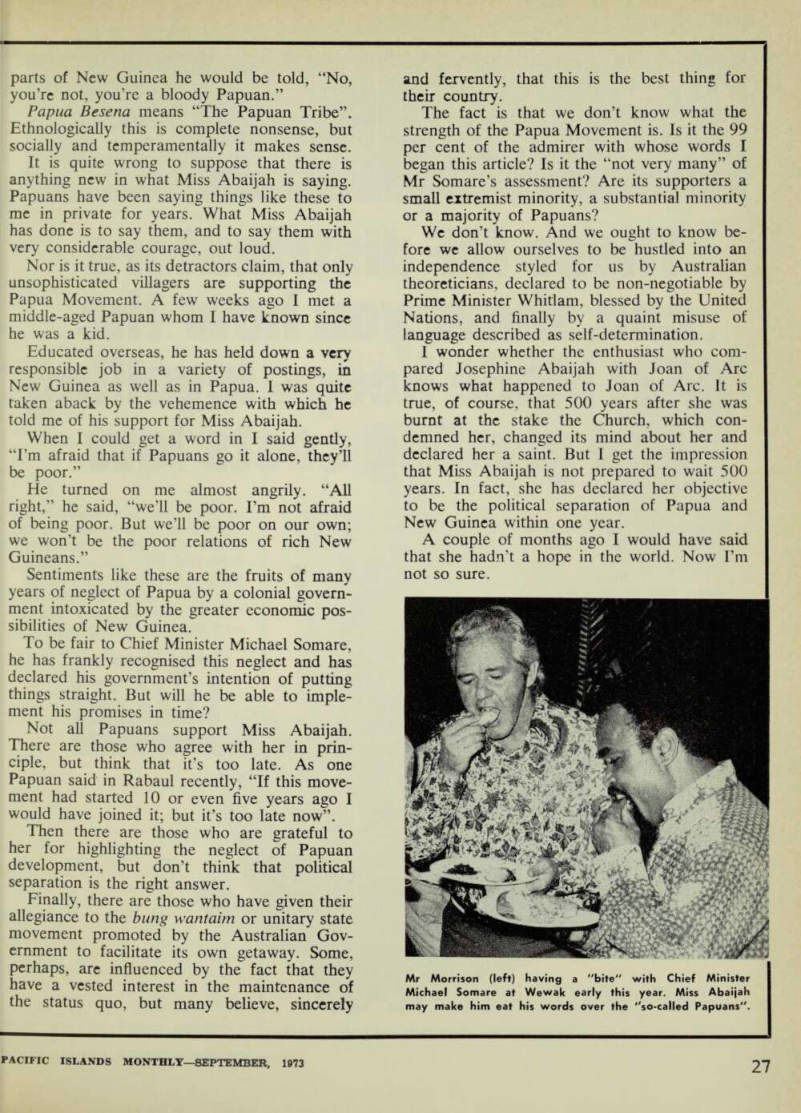
Mr Morrison (left) having a "bite" with Chief Minister Michael Somare at Wewak early this year. Miss Abaiiah may make him eat his words over the "so-called Papuans".