his spell and
pp. 27-31 · Read in the full issue

The sorcerer weaves his spell and a man dies in Fiji
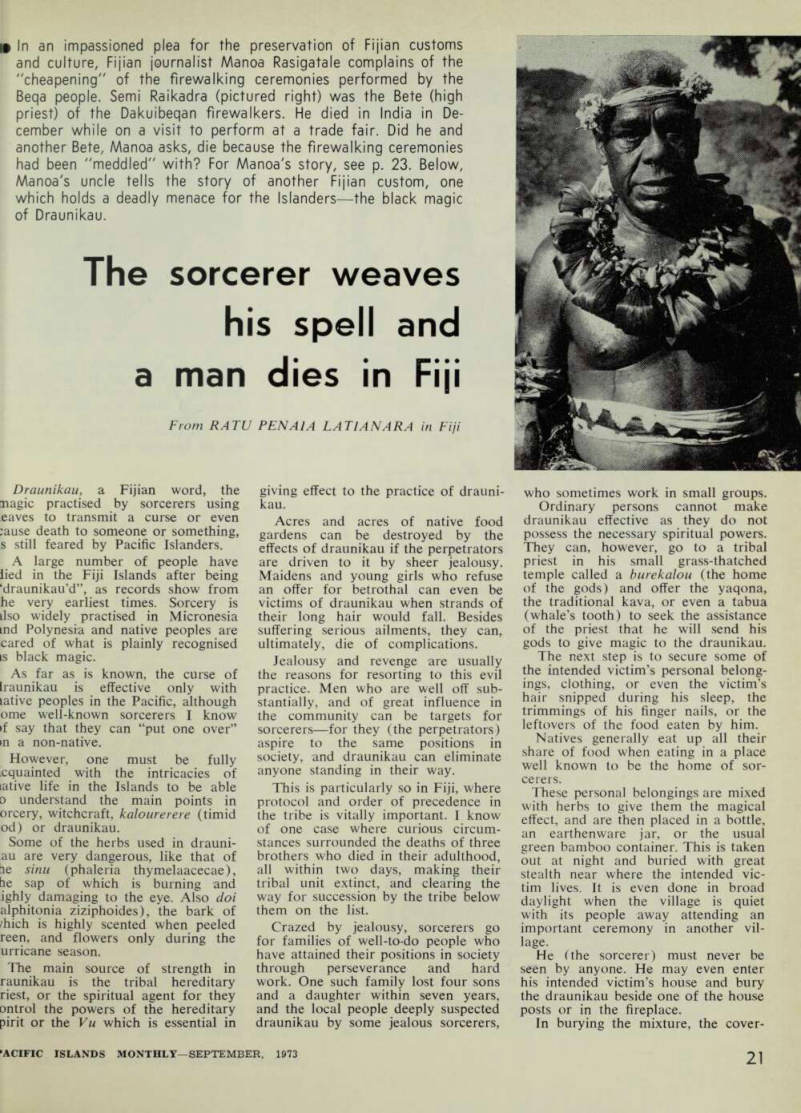
it In an impassioned plea for the preservation of Fijian customs and culture, Fijian journalist Manoa Rasigatale complains of the “cheapening" of the firewalking ceremonies performed by the Beqa people. Semi Raikadra (pictured right) was the Bete (high priest) of the Dakuibeqan firewalkers. He died in India in De cember while on a visit to perform at a trade fair. Did he and another Bete, Manoa asks, die because the firewalking ceremonies had been “meddled" with? For Manoa's story, see p. 23. Below, Manoa's uncle tells the story of another Fijian custom, one which holds a deadly menace for the Islanders—the black magic of Draunikau.
From Ratu Penaia Latianara In Fiji
Draunikau, a Fijian word, the magic practised by sorcerers using eaves to transmit a curse or even :ause death to someone or something, s still feared by Pacific Islanders.
A large number of people have lied in the Fiji Islands after being ‘draunikau’d”, as records show from he very earliest times. Sorcery is ilso widely practised in Micronesia ind Polynesia and native peoples are cared of what is plainly recognised is black magic.
As far as is known, the curse of Iraunikau is effective only with lative peoples in the Pacific, although ome well-known sorcerers I know >f say that they can “put one over” ►n a non-native.
However, one must be fully cquainted with the intricacies of lative life in the Islands to be able o understand the main points in orcery, witchcraft, kalourerere (timid od) or draunikau.
Some of the herbs used in drauni au are very dangerous, like that of ie sinu (phaleria thymelaacecae), tie sap of which is burning and ighly damaging to the eye. Also doi alphitonia ziziphoides), the bark of diich is highly scented when peeled reen, and flowers only during the urricane season.
The main source of strength in raunikau is the tribal hereditary riest, or the spiritual agent for they ontrol the powers of the hereditary pirit or the Vu which is essential in
giving effect to the practice of drauni kau.
Acres and acres of native food gardens can be destroyed by the effects of draunikau if the perpetrators are driven to it by sheer jealousy.
Maidens and young girls who refuse an offer for betrothal can even be victims of draunikau when strands of their long hair would fall. Besides suffering serious ailments, they can, ultimately, die of complications.
Jealousy and revenge are usually the reasons for resorting to this evil practice. Men who are well off sub stantially, and of great influence in the community can be targets for sorcerers—for they (the perpetrators) aspire to the same positions in society, and draunikau can eliminate anyone standing in their way.
This is particularly so in Fiji, where protocol and order of precedence in the tribe is vitally important. I know of one case where curious circum stances surrounded the deaths of three brothers who died in their adulthood, all within two days, making their tribal unit extinct, and clearing the way for succession by the tribe below them on the list.
Crazed by jealousy, sorcerers go for families of well-to-do people who have attained their positions in society through perseverance and hard work. One such family lost four sons and a daughter within seven years, and the local people deeply suspected draunikau by some jealous sorcerers,
who sometimes work in small groups.
Ordinary persons cannot make draunikau effective as they do not possess the necessary spiritual powers.
They can, however, go to a tribal priest in his small grass-thatched temple called a burekalou (the home of the gods) and offer the yaqona, the traditional kava, or even a tabua (whale’s tooth) to seek the assistance of the priest that he will send his gods to give magic to the draunikau.
The next step is to secure some of the intended victim’s personal belong ings, clothing, or even the victim’s hair snipped during his sleep, the trimmings of his finger nails, or the leftovers of the food eaten by him.
Natives generally eat up all their share of food when eating in a place well known to be the home of sor cerers.
These personal belongings are mixed with herbs to give them the magical effect, and are then placed in a bottle, an earthenware jar, or the usual green bamboo container. This is taken out at night and buried with great stealth near where the intended vic tim lives. It is even done in broad daylight when the village is quiet with its people away attending an important ceremony in another vil lage.
He (the sorcerer) must never be seen by anyone. He may even enter his intended victim’s house and bury the draunikau beside one of the house posts or in the fireplace.
In burying the mixture, the cover-
ing earth must be loose to let the gas out so that it can be inhaled by the intended victim. Sooner or later the victim feels the ill effects, be comes ill, and eventually dies.
The tribal priest or the spiritual agent who controls powerful tribal spirits or Vu prescribe for the man who has sought their help, certain essential rites. One of these is cer tainly the most risky or dangerous, especially in a crowded Fijian village.
He must dance naked beneath a rising moon in the quiet of the night—in order to please the spirits.
He must never be seen or observed by anyone, lest there is a general up roar in the village. Sorcerers are known to have been manhandled and stoned when doing the dance. Some sorcerers even wade far out to sea to dance there in secret on a moon light night. Their only adornment may perhaps be a red hibiscus flower!
Men well known to be sorcerers go to lonely plantations, and sing songs and chants during the dance, as a diversion, so as not to arouse suspicion.
A draunikau sorcerer was caught dancing to the moon at a spot not far from my village recently, and he was singing the well known hymn, Abide with me! Although risky in the extreme if seen or observed, the sor cercer’s attempt at draunikau can be foiled by using the traditional anti
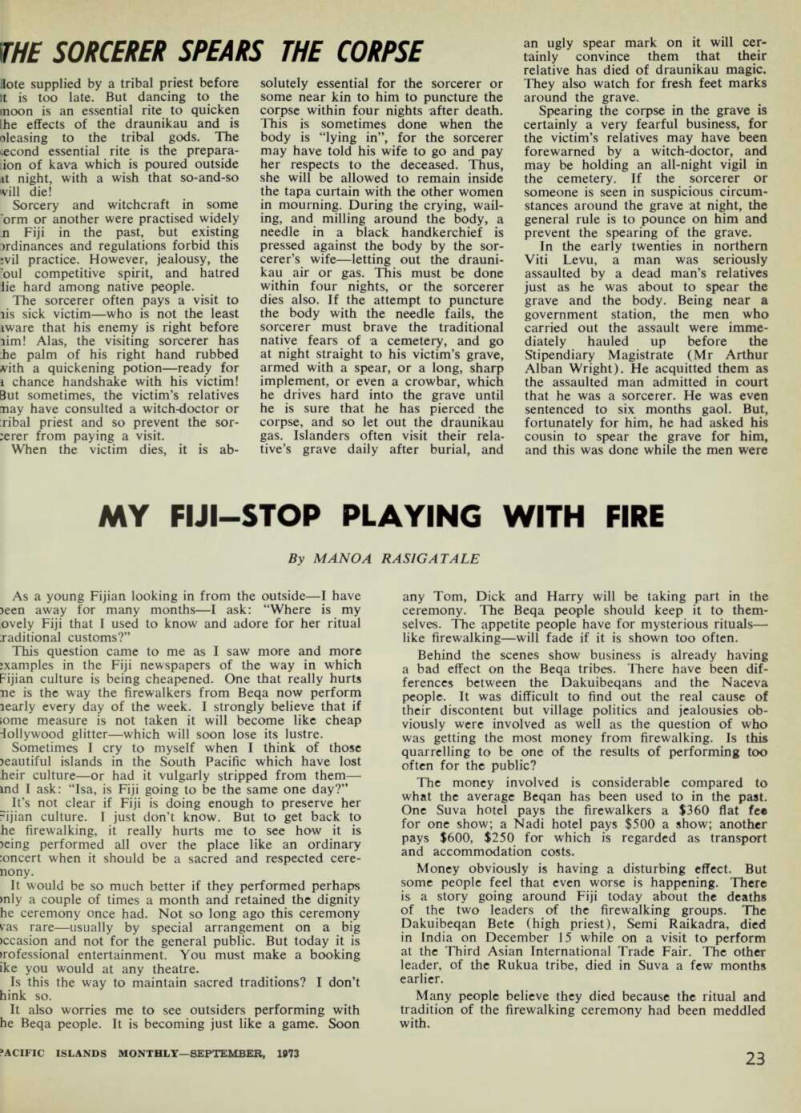
Ratu Penaia Lalabalavu Latianara, 58, is the younger brother of the high Chief of Serua in Fiji. A member of the Great Council of Chiefs since 1956, he is a civil service pensioner. He is one of five translators at present modernising the Old Testament in the Fijian language.
[?]The Sorcerer Spears The Corpse
Hote supplied by a tribal priest before It is too late. But dancing to the moon is an essential rite to quicken Ihe effects of the draunikau and is leasing to the tribal gods. The second essential rite is the prepara ion of kava which is poured outside nt night, with a wish that so-and-so will die!
Sorcery and witchcraft in some r orm or another were practised widely u Fiji in the past, but existing ordinances and regulations forbid this jvil practice. However, jealousy, the :oul competitive spirit, and hatred lie hard among native people.
The sorcerer often pays a visit to lis sick victim—who is not the least iware that his enemy is right before lim! Alas, the visiting sorcerer has ;he palm of his right hand rubbed with a quickening potion—ready for i chance handshake with his victim!
But sometimes, the victim’s relatives may have consulted a witch-doctor or xibal priest and so prevent the sor cerer from paying a visit.
When the victim dies, it is ab
solutely essential for the sorcerer or some near kin to him to puncture the corpse within four nights after death.
This is sometimes done when the body is “lying in”, for the sorcerer may have told his wife to go and pay her respects to the deceased. Thus, she will be allowed to remain inside the tapa curtain with the other women in mourning. During the crying, wail ing, and milling around the body, a needle in a black handkerchief is pressed against the body by the sor cerer’s wife—letting out the drauni kau air or gas. This must be done within four nights, or the sorcerer dies also. If the attempt to puncture the body with the needle fails, the sorcerer must brave the traditional native fears of a cemetery, and go at night straight to his victim’s grave, armed with a spear, or a long, sharp implement, or even a crowbar, which he drives hard into the grave until he is sure that he has pierced the corpse, and so let out the draunikau gas. Islanders often visit their rela tive’s grave daily after burial, and
an ugly spear mark on it will cer tainly convince them that their relative has died of draunikau magic.
They also watch for fresh feet marks around the grave.
Spearing the corpse in the grave is certainly a very fearful business, for the victim’s relatives may have been forewarned by a witch-doctor, and may be holding an all-night vigil in the cemetery. If the sorcerer or someone is seen in suspicious circum stances around the grave at night, the general rule is to pounce on him and prevent the spearing of the grave.
In the early twenties in northern Viti Levu, a man was seriously assaulted by a dead man’s relatives just as he was about to spear the grave and the body. Being near a government station, the men who carried out the assault were imme diately hauled up before the Stipendiary Magistrate (Mr Arthur Alban Wright). He acquitted them as the assaulted man admitted in court that he was a sorcerer. He was even sentenced to six months gaol. But, fortunately for him, he had asked his cousin to spear the grave for him, and this was done while the men were
celebrating their acquittal for assault with a big kava drinking bout.
I, myself, have seen five graves punctured or holed by the sorcerers.
In some instances, the sorcerer him self volunteers to be one of the grave-diggers, thus ensuring that the grave is of the right depth for his evil deed.
Of course, there are antidotes to all these evils, for the victim’s rela tions may have consulted the tribal priest who warns them that someone has cast the evil spell of draunikau on their deceased relative. Or, if the victim is still alive though very sick, an antidote is applied, which soon nullifies the evil and its harmful effects.
If this occurs the draunikau sor cerer immediately chooses another victim to replace the former—for the magic works both ways and can affect the sorcerer’s own relations if this is not done. The brightly coloured leaves of plants and shrubs planted around a Fijian house are not just home decor, but they are useful in warding off evil spirits. The Fijian via mila (Alocasia indica) is one of them.
One method of nullifying the effects of puncturing a victim’s body by a sorcerer is to put two green
mummy apples or papaw, one under each armpit of the deceased. If this is done the sorcerer sees his demise as a sure thing—when the mummy apples rot inside the grave.
Draunikau and other forms of witchcraft are practised in nearly all the island groups in the Pacific, in New Guinea, in the Gilbert and Ellice Islands, in the New Hebrides, and last, but not least, in the Solomons, where a plant called ria is used by sor cerers for making love charms to make a person love another. The plant was introduced to Fiji by labourers from the Solomon Islands at the turn of the last century. The ria is dreaded by Fijian women for its magical influence in instilling love, especially between unmatched couples.
Belief in the effectiveness of draunikau makes it highly potent. I can safely say that the evil has not been stamped out completely in Fiji, even though Christianity has been here for nearly 140 years. The laws and regulations that forbid draunikau and other forms of sorcery are still in force in Fiji, and there is no evi dence that these evil practices are on the wane, so as to warrant their repeal. It is my earnest prayer that they remain in the ordinances of Fiji for a long time to come.